GUEST POST from Art Inteligencia
I. Introduction: Reframing the AI Narrative
Beyond Substitution to Augmentation
For too long, the prevailing narrative surrounding artificial intelligence in the enterprise has been dominated by fear—specifically, the anxiety of displacement. Organizations often default to viewing AI through a narrow, cost-reduction lens focused on task automation and labor substitution. However, true value creation in the modern era requires a fundamental pivot: moving from substitution to augmentation. AI should not be viewed merely as a tool to automate away human effort, but as a dynamic learning partner and catalyst for scaling human capability, creativity, and strategic ingenuity.
The Core Premise: The AI Apprenticeship Economy
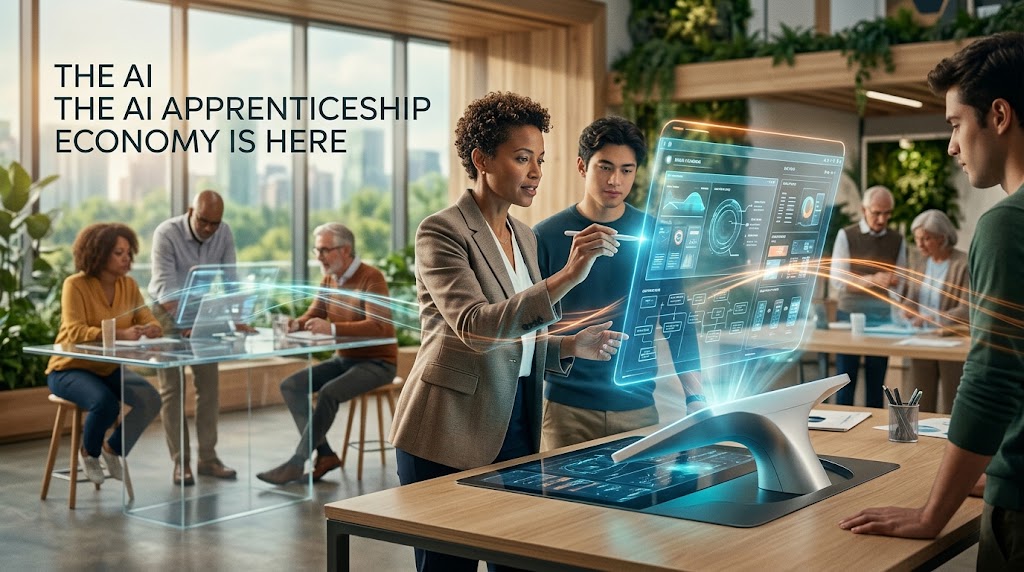
We are entering a transformative operational era—the AI Apprenticeship Economy. In this model, the workplace becomes an ecosystem of reciprocal learning and co-creation. Humans and AI systems form a dual-learning engine: AI scales human speed, analytical reach, and exploratory range, while humans provide critical context, qualitative judgment, strategic vision, and emotional intelligence. This symbiotic partnership redefines capability building from a static, periodic exercise into a continuous, embedded habit.
The Strategic Urgency
Organizations stand at a pivotal crossroad. Those that focus solely on cost-efficiency and task replacement will quickly encounter a ceiling of commoditization, diminishing workforce morale, and strategic stagnation. Conversely, leaders who design human-centered experiences and change architectures that elevate human potential will build resilient, highly adaptable enterprises. The imperative is clear: we must intentionally design the future of work around human capability enhancement, ensuring that technological progress directly expands human possibility.
II. The Architecture of the AI Apprenticeship Economy
Dual Mentorship Model
The foundation of the AI Apprenticeship Economy relies on a bidirectional exchange of knowledge where both human worker and artificial intelligence system act as mentor and apprentice to one another in real time.
- Human to AI (Context & Judgment): Humans provide the essential contextual grounding, ethical oversight, strategic intent, and qualitative nuance that algorithms lack. They guide the AI through edge cases, decode cultural and emotional subtleties, and steer output toward alignment with human-centered goals.
- AI to Human (Speed & Synthesis): AI acts as a high-velocity apprentice-mentor, offering real-time feedback, identifying hidden patterns across vast datasets, synthesizing complex concepts on demand, and generating multi-scenario modeling to expand human decision-making horizons.
Continuous Capability Loops
Traditional corporate learning relies on episodic, classroom-style training or isolated e-learning modules that exist outside the daily flow of work. The AI Apprenticeship Economy replaces this fragmented approach with continuous, context-aware capability loops. Learning occurs dynamically at the point of action, embedding skill acquisition, micro-coaching, and adaptive feedback directly into the tools and processes employees use every day.
Redefining “Apprenticeship” for the Modern Era
Legacy apprenticeship models were structured around fixed timelines, rigid hierarchies, and slow knowledge transfer over years. In an AI-augmented ecosystem, apprenticeship becomes fluid, non-linear, and perpetual. Skill acquisition is no longer limited by the availability of a senior colleague; workers can continuously cross-train across multidisciplinary domains, rapidly prototyping ideas and accelerating their personal and professional growth trajectory.
III. Experience Design (EX) as the Engine of Adoption
Designing Collaborative Touchpoints
Technology adoption succeeds or fails based on the quality of the user experience. In the AI Apprenticeship Economy, Experience Design (EX) shifts focus from static user interfaces to fluid, collaborative touchpoints. Interfaces must be engineered to facilitate natural hand-offs between human intent and machine execution, ensuring that AI interactions feel like an intuitive extension of human thought rather than an intrusive technical layer.
Psychological Safety and Trust
Unlocking the full potential of human-AI collaboration requires an environment grounded in psychological safety and trust. Workers cannot thrive alongside intelligent systems if they feel monitored, threatened, or overwhelmed by algorithmic velocity. Thoughtful experience design addresses these anxieties by establishing operational transparency, granting users clear control over AI decision boundaries, and framing machine outputs as supportive suggestions rather than absolute directives.
Frictionless Feedback Mechanics
A true apprenticeship relies on continuous, lightweight feedback. System designers must embed frictionless feedback loops directly within daily workflows, enabling workers to correct, guide, and refine AI outputs in real time without breaking their cognitive flow state. By minimizing the effort required to train and tune AI partners, organizations create an environment where active guidance becomes a natural, rewarding part of the daily employee experience.
IV. Human-Centered Innovation: Leading the Organizational Change
Designing the Change Architecture
Integrating artificial intelligence into the enterprise is not a technical upgrade; it is a fundamental human transformation. Successfully navigating this transition requires a deliberate, structured change architecture—such as the methodologies found in the Change Planning Toolkit™—that aligns strategic intent, leadership mindsets, and cultural readiness. Leaders must move beyond change management as a reactive communication exercise and instead architect systematic change journeys that actively engage stakeholders as co-creators of their new ways of working.
Reframing Roles and Metrics
Legacy organizational metrics prioritize volume, transactional speed, and individual output—measurements designed for an era of manual routine work. In an AI-augmented organization, performance indicators must be radically reframed around uniquely human attributes: creative problem-solving, strategic synthesis, collaborative velocity, and capability growth. Job descriptions and role profiles must evolve from static lists of task responsibilities into dynamic charters defined by outcomes, curiosity, and continuous learning capacity.
Managing Transition Anxiety
The fear of obsolescence and the discomfort of shifting professional identity can stall even the most advanced AI initiatives. Addressing this requires an empathy-driven approach to organizational change. Leaders must establish psychological safety by providing clear, transparent career development pathways that illustrate how employees can elevate their value alongside AI tools. By pairing proactive skill-building programs with empathetic leadership, organizations transform worker anxiety into shared ownership and constructive momentum.
V. Strategic Implications for Futures & Leadership
The Capability Advantage
In an increasingly volatile market landscape, the ultimate competitive advantage belongs not to companies with the largest AI models, but to organizations that build superior human capability ecosystems. Leaders who cultivate an AI Apprenticeship Economy unlock unprecedented organizational agility, faster innovation cycles, and higher employee retention. By expanding human potential rather than merely cutting headcount, these enterprises create a resilient workforce capable of continuously identifying and capturing new market opportunities.
Ecosystem and Talent Strategy
The rise of AI-augmented work forces a total rethinking of talent acquisition, retention, and development strategies. Forward-looking leadership must shift focus from recruiting narrow technical specialists to hiring and developing adaptable, holistic thinkers. Future-ready talent strategies prioritize experience design literacy, systems thinking, critical evaluation, and emotional intelligence—attributes that allow workers to effectively prompt, guide, and orchestrate complex AI systems toward strategic outcomes.
Responsible Innovation Framework
As intelligent systems take on greater autonomy within enterprise workflows, establishing a robust framework for responsible innovation becomes a strategic imperative. Leadership must proactively address critical questions around human agency, data dignity, algorithmic bias, and ethical decision boundaries. True leadership in the AI era requires ensuring that artificial intelligence remains anchored to human values, with strategic vision, moral accountability, and core governance remaining firmly in human hands.
VI. Conclusion: The Call to Action
The Human-Centered Imperative
Technology enables new possibilities, but human intent, empathy, and ingenuity are what transform those possibilities into real economic and social value. The transition into an AI Apprenticeship Economy is not an inevitable outcome of technological evolution; it is a deliberate design choice that organizational leaders must make today. How we architect our workflows, tools, and change journeys will determine whether artificial intelligence diminishes human contribution or dramatically unlocks human potential.
Building the Augmented Ecosystem
The future of work does not belong to fully automated enterprises operating without human insight, nor does it belong to legacy organizations resisting technological progress. The future belongs to augmented human ecosystems—organizations that master the art of reciprocal learning between human expertise and machine intelligence. By prioritizing human-centered innovation, intentional experience design, and structured change management, leaders can build resilient, highly capable enterprises ready to thrive in a constantly evolving world.
Frequently Asked Questions
- What is the AI Apprenticeship Economy?
- The AI Apprenticeship Economy is a workforce framework where humans and artificial intelligence systems engage in continuous, reciprocal learning. AI augments human capability, analytical speed, and pattern recognition, while humans provide critical context, ethics, emotional intelligence, and strategic direction.
- How does this model differ from traditional corporate automation?
- Traditional automation focuses primarily on task substitution and cost reduction by replacing human labor. In contrast, the AI Apprenticeship Economy focuses on human capability expansion, using AI as a collaborative learning partner to elevate human creativity, problem-solving, and decision-making capacity.
- How can organizations successfully transition to an AI Apprenticeship model?
- Organizations must adopt human-centered change frameworks (such as the Change Planning Toolkit™), redesign employee experience (EX) touchpoints for seamless collaboration, reframe performance metrics around capability growth, and foster psychological safety to address worker transition anxiety.
Image credit: Pixabay
 Sign up here to get Human-Centered Change & Innovation Weekly delivered to your inbox every week.