What Remains Exclusively Human When Knowledge is Free and Infinite
GUEST POST from Chateau G Pato
I. The Death of the Knowledge Monopoly
For centuries, competitive advantage was built on the asymmetry of information. The individual or organization that held the most data, mastered the most complex formulas, or memorized the broadest archive of industry knowledge held the keys to the kingdom. We built our educational systems, performance metrics, and corporate hierarchies around the accumulation and retention of expertise. Expertise was scarce, expensive, and precious.
That paradigm is officially dead.
The Abundance Paradox
As advanced artificial intelligence and dynamic intelligence models render technical synthesis, deep analysis, and code generation effectively free and instantaneous, the economic value of pure knowledge approaches zero. Information has transformed from a proprietary asset into a ubiquitous utility—as available and ambient as the electricity powering our devices. When every organization has instant access to the sum total of human technical output, knowing the answer is no longer a competitive moat.
This creates a profound organizational paradox: as technical capabilities become infinite, the friction of transformation increases. Technology accelerates execution, but execution without human orientation simply leads us off a cliff faster.
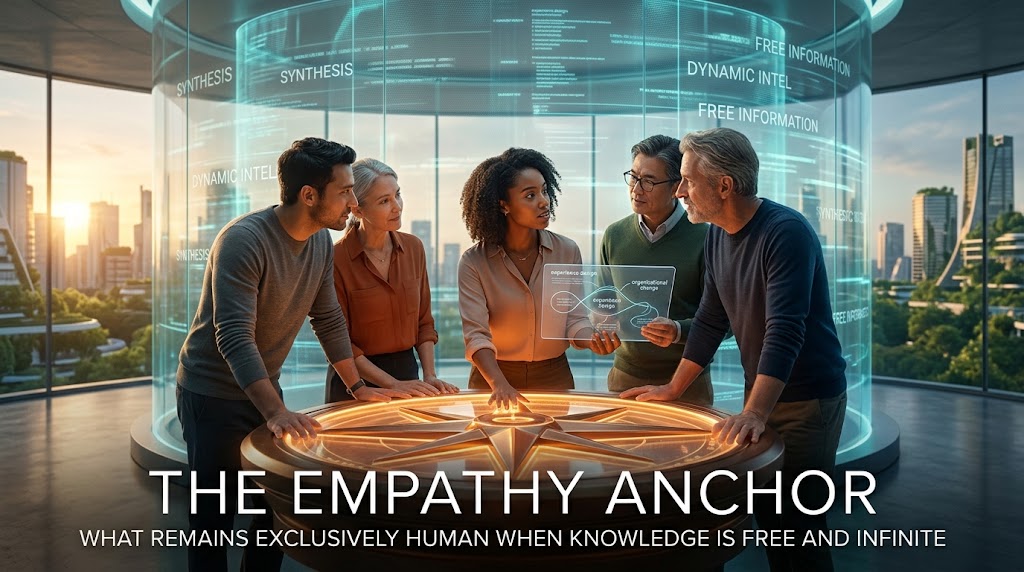
Introducing the Empathy Anchor
To navigate this landscape, leaders must ground their transformation efforts in what I call the Empathy Anchor. The Empathy Anchor represents the irreplaceable human capabilities that give technological execution direction, relevance, and intent. It is our capacity to:
- Frame the deep, latent problems that algorithms cannot perceive.
- Ground complex technical capabilities in authentic human context and lived experience.
- Design experiences that cultivate trust, psychological safety, and genuine emotional resonance.
- Navigate the cultural friction and emotional resistance inherent in any meaningful organizational change.
The Shift in Strategic Value
When raw answers are infinite and instantly accessible, strategic value shifts entirely from answer generation to problem framing. Algorithms can optimize a route, but only human empathy can determine if the destination is worth reaching. As change leaders, innovators, and experience designers, our imperative is no longer to be the smartest person in the room—it is to be the most human. The future belongs not to those who harness knowledge, but to those who anchor it to human purpose.
II. The Three Pillars of the Exclusively Human Domain
If knowledge and execution are automated commodities, where does sustainable human value reside? The answer lies at the intersection of context, emotion, and organizational dynamics. To build resilient organizations in an automated era, we must double down on the three core capabilities that artificial systems cannot replicate.
Pillar 1: Contextual Wisdom Over Data Synthetics
Machines process inputs, detect correlations, and synthesize massive datasets with breathtaking speed. However, correlation is not context. Algorithms operate on historic parameters—they analyze what has been measured, not what is felt or unstated.
Human leaders possess contextual wisdom: the ability to read subtle cultural cues, interpret political nuance, and integrate shared lived experience into strategic decision-making. Contextual wisdom allows us to understand why a mathematically optimal solution might fail completely within a specific corporate culture or community context. It bridges the gap between what is technically feasible and what is humanly viable.
Pillar 2: Experience Design as Emotional Value Creation
Functional utility is no longer enough. When every product or service can achieve feature parity almost overnight using intelligent platforms, experience becomes the ultimate differentiator. True experience design extends far beyond slick interfaces or optimized user flows—it targets human emotion.
Humans do not form loyalty to algorithms; they form bonds with experiences that make them feel heard, valued, and secure. Designing for emotional resonance requires:
- Building psychological safety into every employee and customer touchpoint.
- Transforming routine transactional interactions into moments of genuine delight and connection.
- Designing with radical inclusion to honor the diverse needs of real people.
Pillar 3: Change Facilitation & Human Momentum
The greatest strategy in the world is useless if your workforce refuses or fears to adopt it. Technology moves exponentially, but human beings adapt linearly. This tension creates organizational friction, anxiety, and change fatigue.
Change management is fundamentally an act of empathy. Algorithms cannot inspire a demotivated team, mediate interpersonal conflict, or guide an organization through the grief of letting go of old ways of working. Human change facilitators bring the emotional intelligence needed to align diverse mindsets, build cross-functional momentum, and co-create futures that people actually want to inhabit.
III. Reimagining Innovation in an Infinite Knowledge Era
When knowledge was scarce, innovation was often treated as an R&D pipeline—a structured process of discovering insights, generating ideas, and engineering solutions. In an era where generative systems can synthesize technical solutions instantly, the traditional innovation pipeline breaks down. Innovation is no longer about finding answers; it is about defining the right problems to solve.
From Solutioning to Radical Problem Framing
The greatest threat to modern organizations is not failing to find a solution, but solving the wrong problem with high precision. Intelligent systems excel at optimizing for defined metrics, but they cannot feel the underlying friction, anxiety, or unmet aspirations of a human being.
Human-centered innovation begins with deep curiosity and empathy. It requires leaders to step away from the dashboard, observe real human behavior, and ask radical questions:
- What unstated job-to-be-done is the customer trying to accomplish?
- Where are emotional bottlenecks creating unspoken resistance?
- Are we optimizing an outdated process, or should we redefine the experience entirely?
Co-Creation and the Human Network
Top-down, isolated innovation models are obsolete. True alignment requires bringing cross-functional teams, stakeholders, and customers along on the journey. Innovation is a team sport, and co-creation serves as the ultimate engine for driving ownership and reducing transformation friction.
By leveraging visual toolkits, collaborative canvases, and structured change frameworks, leaders create a shared language. This shared language breaks down departmental silos, transforms passive onlookers into active co-architects, and builds the collective momentum necessary to move from concept to real-world impact.
Ethics, Meaning, and Strategic Intent
An algorithm can calculate the path of least resistance, but it cannot weigh moral implications or establish purpose. As the speed of execution nears real-time, the distance between a strategic choice and its impact shrinks dramatically. This makes ethical stewardship a core innovation discipline.
Innovating with an Empathy Anchor means establishing a clear moral compass. It ensures that technological deployments enhance human capability rather than commodifying it, foster genuine trust, and build sustainable value for employees, customers, and society as a whole.
IV. Conclusion: Leading with Human Purpose
The rise of infinite knowledge and autonomous capability marks not the obsolescence of human leadership, but its ultimate test. As algorithms absorb the heavy lifting of analysis, synthesis, and execution, the spotlight returns entirely to our character, our culture, and our capacity for genuine empathy.
The Imperative for Future-Ready Leaders
Leading in this new landscape requires a fundamental shift in posture. The leaders who thrive in an automated world will not be those who attempt to out-calculate the machines, but those who excel at connecting human beings. This requires cultivating three core leadership capabilities:
- Radical Empathy: Listening deeply to unstated customer and employee anxieties, making psychological safety a non-negotiable operational standard.
- Active Facilitation: Replacing command-and-control directive leadership with co-creative frameworks that empower cross-functional teams to build the future together.
- Continuous Organizational Learning: Framing change not as a stressful single event, but as a ongoing capability built on curiosity, experimentation, and growth.
Anchor to the Human
Technology accelerates execution, expands scale, and removes operational friction. But speed without direction is merely disorientation, and efficiency without purpose is meaningless. Technology provides the velocity, but human empathy must always dictate the vector.
When answers are free and knowledge is infinite, your competitive advantage is not what you know—it is how deeply you care, how clearly you frame human problems, and how effectively you guide people through change. Anchor your strategy to human empathy, and the rest will follow.
Frequently Asked Questions
What is the ‘Empathy Anchor’ in business transformation?
The Empathy Anchor represents the irreplaceable human capabilities—such as problem framing, contextual wisdom, experience design, and change facilitation—that ground technological capabilities in meaningful human context, purpose, and emotional resonance.
Why does pure knowledge lose competitive value as AI advances?
As artificial intelligence makes technical analysis, synthesis, and information processing free and instantaneous, knowledge transforms from a scarce asset into an ambient utility. Competitive advantage shifts from having the answers to asking the right human-centered questions.
How do leaders successfully drive innovation when technology is infinite?
Leaders succeed by shifting focus from solutioning to radical problem framing, utilizing visual co-creation toolkits to align cross-functional teams, and maintaining a strong moral and ethical compass that puts human needs and psychological safety at the center of transformation.
EDITOR’S NOTE: Braden Kelley’s Problem Finding Canvas can be a super useful starting point for doing design thinking or human-centered design.
“The Problem Finding Canvas should help you investigate a handful of areas to explore, choose the one most important to you, extract all of the potential challenges and opportunities and choose one to prioritize.”
Image credit: misterinnovation.com
 Sign up here to get Human-Centered Change & Innovation Weekly delivered to your inbox every week.