The “Invisible Drain”
LAST UPDATED: March 11, 2026 at 4:54 PM
by Braden Kelley and Art Inteligencia
I. Introduction: The Hidden Cost of Poor Customer Experience (CX)
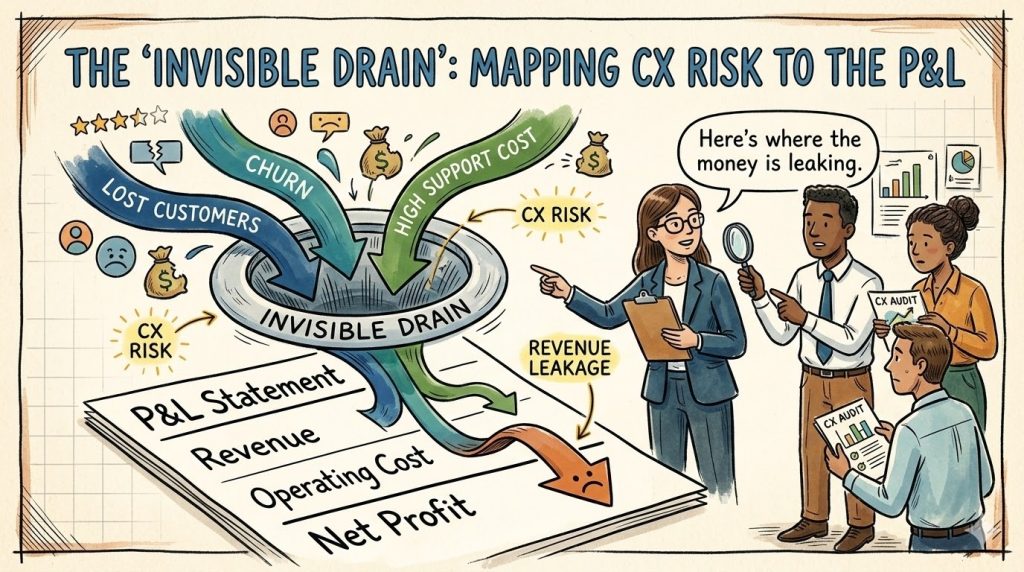
Every organization believes it values its customers. Yet, time and again, businesses lose revenue in ways that are invisible, insidious, and avoidable. This loss is what I call the “Invisible Drain”—the financial leakage caused by friction, frustration, and unmet expectations across the customer journey.
Unlike operational costs that are tracked in spreadsheets or marketing budgets that are accounted for in campaigns, the Invisible Drain does not appear as a line item. It hides in subtle behaviors: customers quietly switching to competitors, abandoning shopping carts, leaving negative reviews, or declining renewal opportunities. Over time, these small losses accumulate into a significant hit to the P&L.
The purpose of this article is to uncover that drain, to show you how to identify where CX failures are costing real money, and to provide practical ways to map those risks directly to the P&L. When organizations understand the financial stakes of every customer touchpoint, they can act decisively—transforming hidden loss into tangible opportunity.
By making the Invisible Drain visible, leaders can move beyond abstract metrics like Net Promoter Score or CSAT and focus on the real outcomes that matter: revenue retention, margin protection, and sustainable growth fueled by exceptional customer experience.
II. Understanding CX Risk
Customer Experience (CX) risk is the potential for negative customer interactions to erode revenue, increase costs, or damage brand reputation. While organizations track operational and financial risks rigorously, CX risk often goes unmeasured, making it invisible until it manifests as lost customers or diminished profits.
CX risk can appear in many forms, including:
- Churn: Customers leave due to poor experiences or unmet expectations.
- Service Failures: Delayed support, inconsistent processes, or unresolved complaints that increase operational costs.
- Lost Opportunities: Friction in the customer journey reduces upsell, cross-sell, or referral potential.
- Brand Damage: Negative word-of-mouth or social media exposure that indirectly affects revenue and growth.
These risks are often underestimated because the financial impact is not immediately visible on the P&L. CX issues may seem minor in isolation—a delayed delivery, a confusing website flow, or a mismanaged support request—but cumulatively, they drain revenue, reduce margins, and erode long-term customer loyalty.
Understanding CX risk requires looking at the customer journey holistically, identifying points where expectations are not met, and quantifying the potential impact on both revenue and costs. Organizations that take this approach can move from reactive problem-solving to proactive risk management, ultimately protecting both the customer experience and the bottom line.
III. Why CX Risk is “Invisible”
Customer experience risk often remains hidden because traditional business metrics fail to capture its true impact. While organizations monitor sales, costs, and operational efficiency, the subtle erosion of revenue caused by poor experiences rarely shows up in standard financial reports. This invisibility makes CX risk particularly dangerous—it quietly undermines growth before anyone notices.
Several factors contribute to the invisible nature of CX risk:
- Siloed Departments: Different teams handle sales, support, marketing, and product development independently. CX failures often fall between the cracks, making accountability diffuse.
- Overreliance on Limited Metrics: Scores like NPS or CSAT provide surface-level insights but don’t fully reveal financial consequences of negative experiences.
- Short-Term Focus: Quarterly targets and immediate KPIs can overshadow long-term CX considerations, allowing slow leaks to persist unnoticed.
- Customer Behavior Gaps: Customers rarely voice dissatisfaction for every negative interaction. Silent churn, abandoned carts, and reduced engagement are often invisible until they translate into revenue loss.
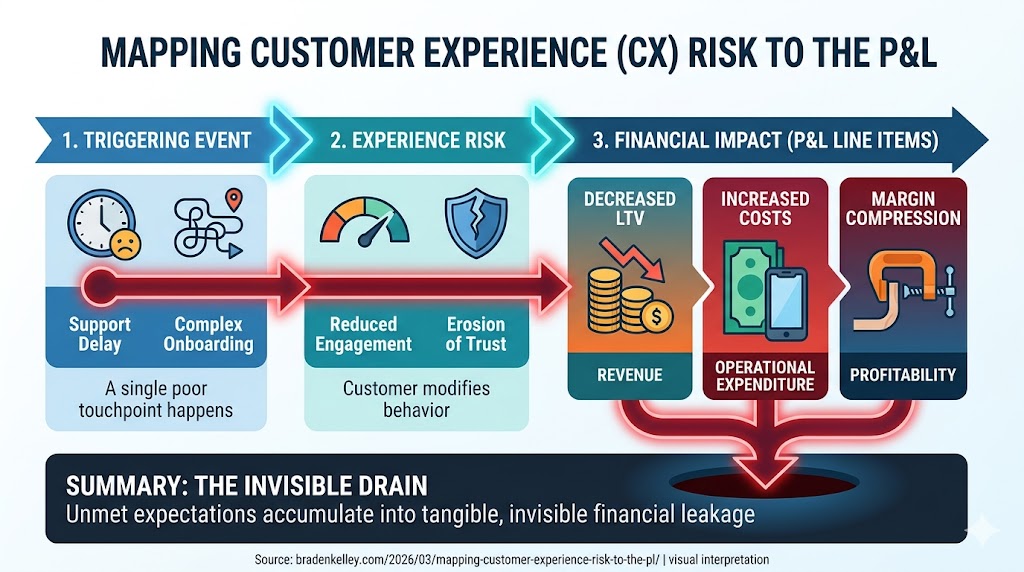
Consider a scenario where onboarding friction causes a small percentage of new customers to abandon a subscription within the first three months. Individually, these losses seem minor, but over time they accumulate into a significant financial impact. Without mapping CX touchpoints to P&L, this drain remains unseen—hence the term Invisible Drain.
Making CX risk visible requires connecting experience failures to tangible outcomes, identifying patterns, and translating them into financial terms. Only then can organizations treat CX risk with the same rigor as operational or market risks.
IV. Linking CX to Financial Outcomes
To address the Invisible Drain, organizations must translate customer experience risk into tangible financial terms. CX failures are not just operational issues—they directly impact revenue, costs, and margins. By mapping CX touchpoints to P&L outcomes, companies can quantify the true cost of friction and make data-driven decisions to protect growth.
A practical approach begins by examining each customer interaction along the journey and asking: How could this touchpoint affect revenue, costs, or future opportunities if it fails? Some examples include:
- Revenue Impact: Delays or confusion during onboarding can reduce customer lifetime value or increase churn.
- Cost Impact: Frequent support escalations due to unclear processes increase operational expenses.
- Margin Impact: Lost upsell opportunities or discounts given to appease frustrated customers reduce profitability.
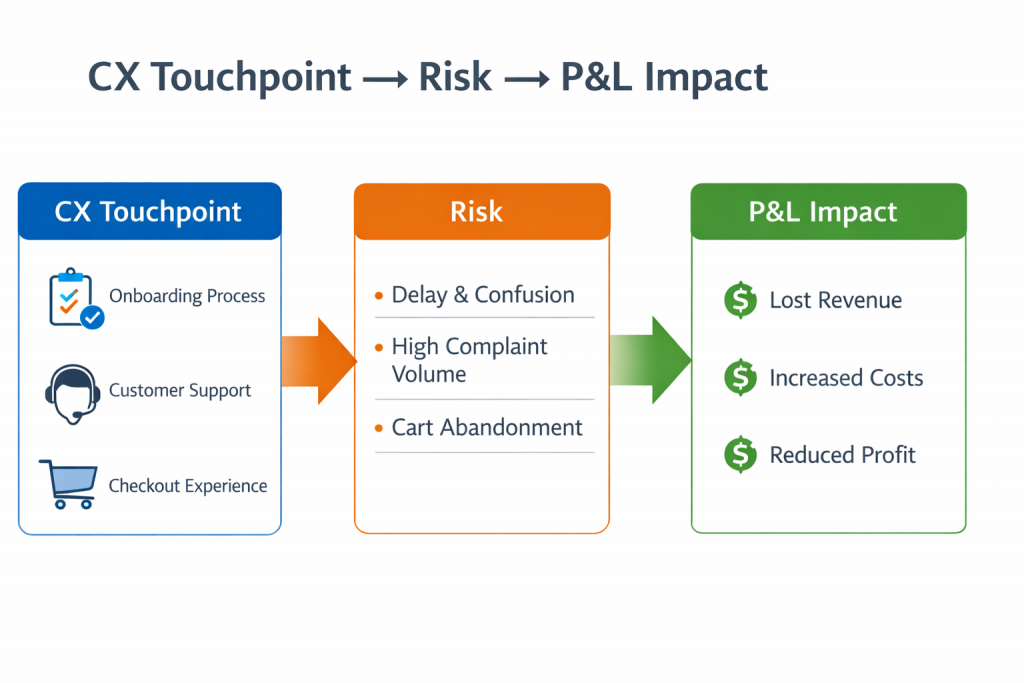
Visualizing the connection helps. Consider a simple framework: CX Touchpoint → Risk → P&L Impact. Each touchpoint carries potential risk; that risk translates into measurable financial outcomes, which then inform prioritization and mitigation strategies.
Quantifying CX risk may involve combining multiple data sources, such as customer surveys, transactional data, operational metrics, and predictive analytics. For example, analyzing churn rates by onboarding experience can reveal the dollar value of friction points. Similarly, tracking complaint resolution times against retention can indicate hidden cost leaks.
By making these connections explicit, executives can see not only where CX risks lie but also how they threaten the bottom line. This clarity enables organizations to invest strategically in improvements, turning customer experience from a perceived cost center into a driver of sustainable revenue and profitability.
V. Identifying High-Risk Areas
Once organizations understand the financial impact of CX risk, the next step is identifying which touchpoints are most vulnerable. Not all interactions carry the same weight—some failures can cost millions, while others have only minor effects. Prioritizing high-risk areas ensures resources are focused where they can deliver the greatest financial and experiential impact.
There are several practical approaches to uncover high-risk CX points:
- Customer Journey Mapping: Visualize every step in the customer journey to identify friction points, handoff issues, and moments of frustration.
- Root Cause Analysis of Complaints: Analyze customer complaints and feedback to determine recurring issues and underlying systemic problems.
- Voice-of-Customer Insights: Leverage surveys, reviews, and social listening to understand where customers experience dissatisfaction or confusion.
- Predictive Analytics: Use data to identify patterns that indicate future churn or dissatisfaction, enabling proactive intervention before financial impact occurs.
Human-centered design plays a critical role in this process. By observing and empathizing with customers, organizations can uncover risks that quantitative metrics alone might miss, such as emotional frustration, subtle confusion, or unmet expectations that quietly erode loyalty.
The combination of data-driven analysis and human-centered insights provides a comprehensive view of high-risk areas. Once these touchpoints are identified, organizations can take targeted action to mitigate risk, improve the customer experience, and protect the P&L from the Invisible Drain.
VI. Measuring and Prioritizing CX Risk
Identifying high-risk areas is only the first step. To act effectively, organizations must measure the potential financial impact of each risk and prioritize interventions where they will deliver the greatest return. Quantifying CX risk ensures decisions are grounded in evidence rather than intuition.
Several approaches can help measure CX risk in financial terms:
- Revenue at Risk: Estimate the potential revenue lost due to churn, abandoned purchases, or missed upsell opportunities caused by CX failures.
- Customer Lifetime Value Erosion: Calculate how friction points reduce the long-term value of customers by shortening retention or decreasing engagement.
- Cost of Poor Service: Analyze the operational expense incurred from repeated complaints, returns, or service escalations at specific touchpoints.
Once risks are measured, organizations can prioritize them using a simple framework: Impact vs. Likelihood. Touchpoints that have a high financial impact and a high likelihood of failure should be addressed first, while low-impact or unlikely risks may be monitored rather than immediately mitigated.
Combining quantitative data with qualitative insights—such as customer feedback, employee observations, and usability testing—ensures prioritization decisions are accurate and holistic. This approach prevents resources from being wasted on minor issues while focusing efforts on areas that truly protect revenue, margins, and customer loyalty.
Measuring and prioritizing CX risk transforms abstract experience concerns into actionable financial decisions. Organizations gain clarity on where to intervene, creating a roadmap for mitigating risk and safeguarding the P&L from the Invisible Drain.
VII. Connecting CX Risk to the P&L
Measuring and prioritizing CX risk is critical, but the ultimate goal is to translate those insights into financial outcomes that executives and decision-makers can act upon. Connecting CX risk directly to the P&L makes the Invisible Drain visible and creates accountability across the organization.
This connection can be achieved by linking each high-risk touchpoint to specific revenue, cost, and margin impacts:
- Revenue: Estimate lost sales or reduced renewals caused by friction or poor experiences at key touchpoints.
- Costs: Quantify additional expenses incurred from repeated service interactions, returns, or complaint management.
- Margins: Assess the impact of discounts, retention incentives, or lost upsell opportunities driven by CX failures.
Visual frameworks help make these connections clear. A simple but powerful approach is: CX Touchpoint → Risk → P&L Impact. Each touchpoint carries potential risks, which can be quantified and linked to financial outcomes. This framework allows leaders to see not only where the risks exist, but also the tangible dollar value associated with each.
Dashboards and reporting tools can further reinforce this connection. By integrating CX metrics with financial KPIs, organizations can track the real-time impact of experience issues on revenue and costs, creating transparency and urgency. Executives can then allocate resources strategically to mitigate risk and optimize returns.
Cross-functional collaboration is essential. Marketing, operations, product, and customer service teams must work together to understand the financial stakes, address high-risk touchpoints, and implement sustainable improvements. When CX risk is mapped to the P&L, experience management becomes a shared responsibility with clear business outcomes.
VIII. Mitigation Strategies and Innovation Opportunities
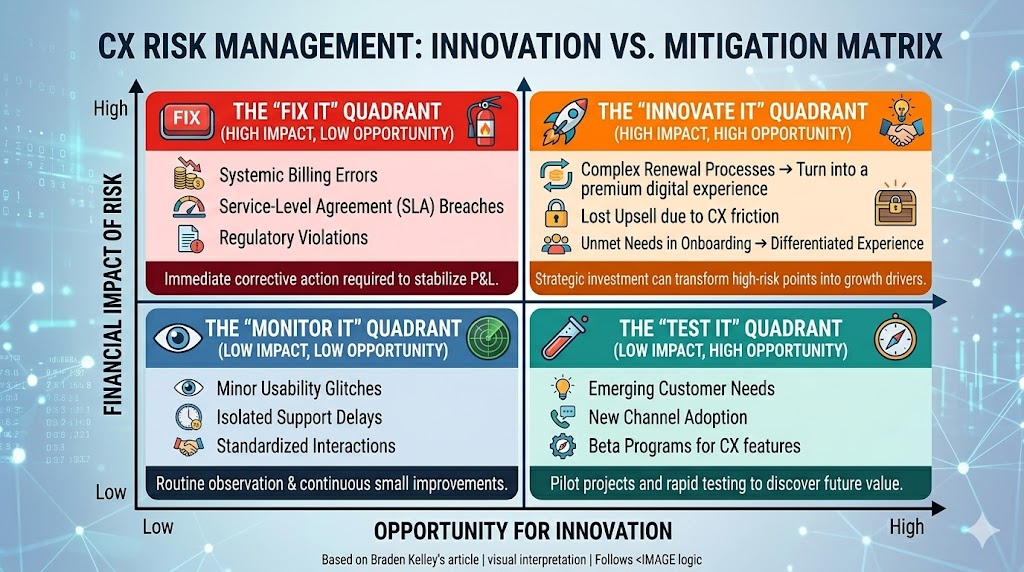
Once CX risks are identified, measured, and linked to the P&L, the next step is to act. Mitigation strategies reduce the financial impact of poor experiences, while innovation opportunities turn risk management into a driver of growth.
Practical strategies to mitigate CX risk include:
- Process Redesign: Simplify and streamline customer journeys to remove friction points and prevent recurring failures.
- Empowering Employees: Equip frontline staff with tools, authority, and training to resolve issues proactively before they escalate.
- Digital Tools and Automation: Use technology to improve experience efficiently, such as chatbots for quick support or predictive notifications to prevent errors.
- Proactive Communication: Anticipate customer needs, set clear expectations, and keep customers informed to reduce uncertainty and dissatisfaction.
Beyond risk mitigation, high-risk areas often reveal opportunities for innovation. Friction points highlight unmet customer needs, enabling organizations to design new products, services, or experiences that differentiate the brand while generating revenue. For example:
- Redesigning onboarding processes can create a premium, differentiated experience that boosts retention.
- Improving support interactions may inspire new self-service tools that reduce costs and increase customer satisfaction.
- Streamlining e-commerce flows can reduce abandoned carts and increase average order value.
By approaching CX risk with a mindset of both mitigation and opportunity, organizations transform potential drains into strategic assets. Risk management becomes a pathway to innovation, improved loyalty, and measurable impact on the bottom line.
IX. Governance and Continuous Monitoring
Identifying, measuring, and mitigating CX risk is not a one-time effort. Sustained impact requires robust governance structures and continuous monitoring to ensure that improvements are maintained and new risks are detected early.
Effective CX governance includes:
- Cross-Functional Oversight: Create a CX risk committee or council with representation from marketing, operations, product, and customer service to oversee initiatives and ensure alignment with financial objectives.
- Defined Roles and Accountability: Assign ownership for each high-risk touchpoint so that responsibilities for monitoring, intervention, and improvement are clear.
- Integration with Financial Planning: Include CX risk metrics in budgeting and P&L reviews to make experience management a part of routine business decision-making.
Continuous monitoring involves tracking CX performance and its financial implications over time. Tools and approaches include:
- Dashboards linking CX touchpoint metrics to revenue, costs, and margins.
- Regular analysis of customer feedback, complaints, and behavior patterns to detect emerging issues.
- Predictive analytics to anticipate potential risk before it affects the bottom line.
- Periodic audits of processes, technology, and employee training to ensure consistent experience delivery.
By embedding governance and continuous monitoring into organizational processes, companies create a dynamic system that not only protects against the Invisible Drain but also adapts to evolving customer needs. This disciplined approach ensures that CX improvements are sustainable and that the financial benefits are measurable and enduring.
X. Conclusion: From Invisible Drain to Strategic Asset
The Invisible Drain—hidden financial losses caused by poor customer experience—is real, measurable, and preventable. By understanding CX risk, linking it to the P&L, and prioritizing interventions, organizations can turn what was once a silent drain into a strategic asset.
Mapping CX touchpoints to revenue, costs, and margins brings clarity to the financial stakes of every interaction. It transforms abstract metrics like satisfaction scores into actionable insights that executives can understand and act upon. With the right governance, measurement, and continuous monitoring, organizations can protect their bottom line while delighting customers.
Beyond risk mitigation, this approach uncovers opportunities for innovation. High-risk areas highlight unmet needs and friction points that, when addressed, can differentiate the brand, improve loyalty, and generate sustainable growth. CX risk management thus becomes not just a defensive exercise but a proactive strategy for competitive advantage.
In the end, the organizations that succeed are those that treat customer experience as a financial imperative. By making the Invisible Drain visible, measuring it, and acting decisively, businesses can protect revenue, enhance margins, and transform CX from a potential liability into a powerful driver of value.
Visual Aids and Frameworks
Visualizing the connection between CX risk and financial outcomes helps make the Invisible Drain tangible. These frameworks provide clarity for executives, managers, and frontline teams, turning abstract concepts into actionable insights.
CX Touchpoint → Risk → P&L Impact Framework
A simple way to see the financial impact of CX failures is by mapping each touchpoint through risk to its P&L effect. This framework helps teams prioritize interventions based on measurable financial consequences.
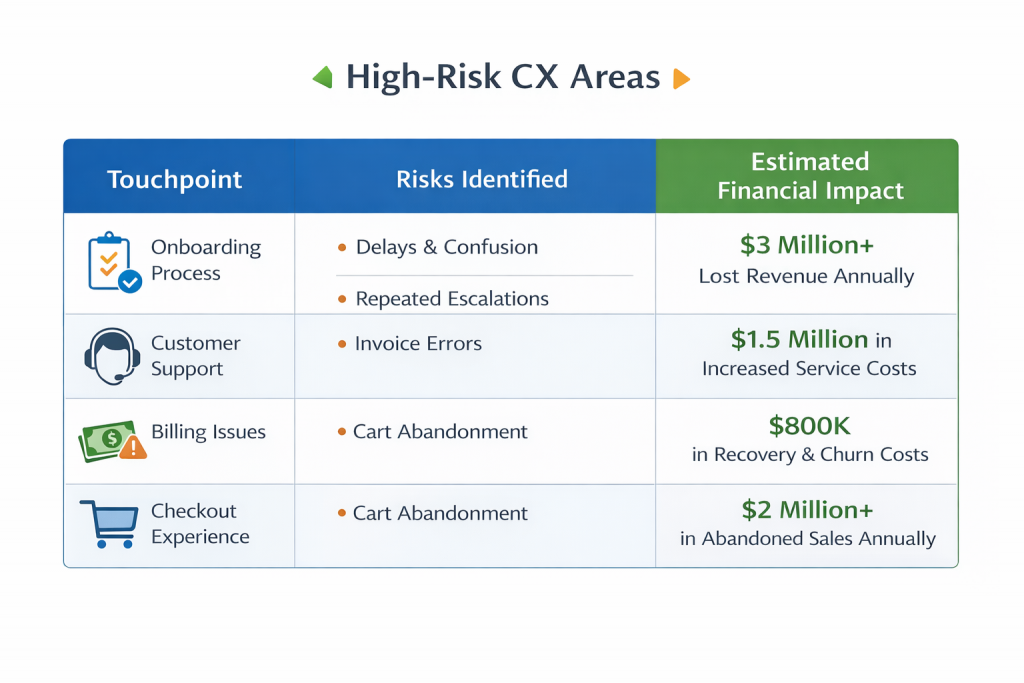
High-Risk CX Areas Table
Identifying the most vulnerable points in the customer journey allows organizations to focus resources effectively. The table below is an example of mapping high-risk areas to estimated financial impact.
“Illustrative estimates based on industry research: Temkin Group (2020), Forrester Research (2018-2021), Gartner (2021).”
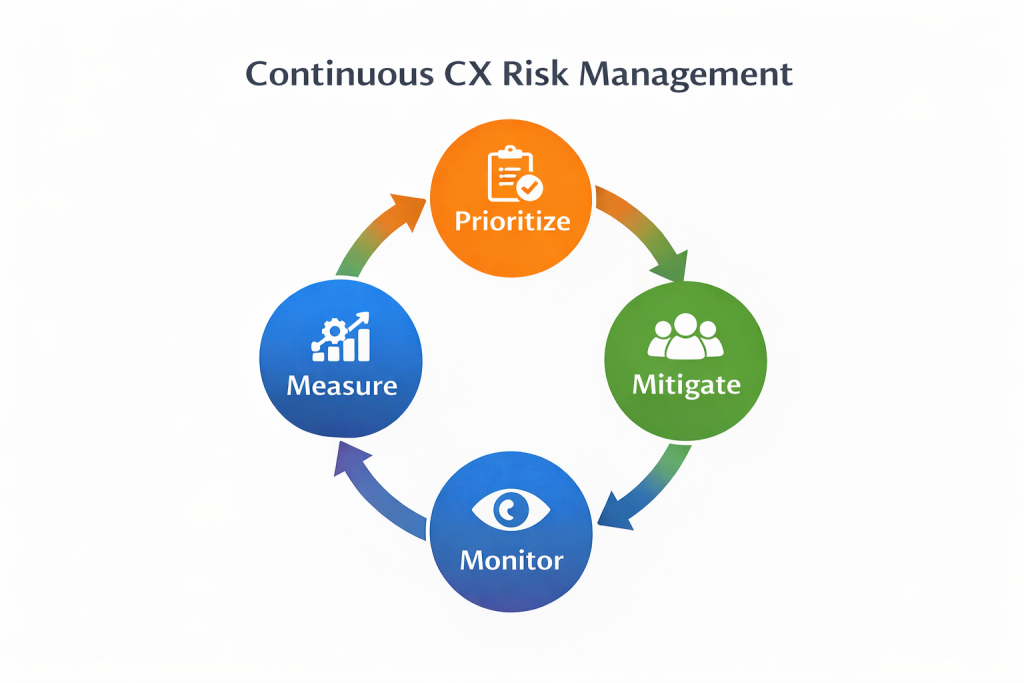
Prioritize → Mitigate → Measure → Monitor Loop
Continuous CX risk management is essential. This cycle ensures risks are addressed, interventions are measured for effectiveness, and monitoring prevents future drains.
By integrating these visuals into reports, presentations, and dashboards, organizations can communicate CX risk clearly, justify investments in improvement, and make the Invisible Drain visible to all stakeholders.
Reserve your Customer Experience Risk & Revenue Leakage Diagnostic with Braden Kelley today
Frequently Asked Questions
1. What is the ‘Invisible Drain’ in customer experience?
The ‘Invisible Drain’ refers to the hidden financial losses caused by poor customer experiences that are not immediately visible in traditional business metrics. These losses may appear as silent churn, abandoned sales, or increased operational costs, slowly impacting the P&L.
2. How can organizations link CX risk to the P&L?
Organizations can map each customer touchpoint to potential risks and quantify the associated revenue loss, cost increases, or margin impact. Frameworks like ‘CX Touchpoint → Risk → P&L Impact’ help visualize and measure the financial consequences of poor experiences.
3. What are effective strategies to mitigate high-risk CX areas?
Effective strategies include redesigning processes to reduce friction, empowering employees to resolve issues proactively, leveraging digital tools for efficiency, and continuously monitoring CX metrics. High-risk areas also reveal opportunities for innovation that can enhance revenue and loyalty.
Reserve your Customer Experience Risk & Revenue Leakage Diagnostic with Braden Kelley today
Image credits: ChatGPT, Google Gemini
Content Authenticity Statement: The topic area, key elements to focus on, etc. were decisions made by Braden Kelley, with a little help from ChatGPT to clean up the article and add citations.
 Sign up here to get Human-Centered Change & Innovation Weekly delivered to your inbox every week.