Shifting from High-Level Theory to Actionable Visual Toolkits
GUEST POST from Art Inteligencia
The Innovation Paradox
For years, organizations have treated innovation as an elite sport. Beautifully bound strategy briefs and abstract, high-level theories are debated in wood-paneled boardrooms, only to stall out before they ever reach the front lines. This is the Ivory Tower Problem: a persistent disconnect between the executive desire for transformation and the organization’s collective capacity to execute it. When innovation remains locked in the realm of academic jargon, it becomes exclusive, intimidating, and ultimately ineffective.
True democratization means dismantling this barrier. Innovation isn’t the sole responsibility of a specialized R&D department or an insular leadership team; it belongs to the people who interact with your customers and handle your operations every single day. However, telling people to “be innovative” without giving them the means to do so only breeds frustration. To bridge the gap between intent and execution, we must look past the complex prose of business theory and focus on human psychology and organizational empathy.
To build a resilient, future-ready culture, organizations must shift their focus from abstract frameworks to tangible, collaborative, and actionable visual toolkits. By replacing dense manuals with intuitive, human-centered visual tools like the Change Planning Toolkit and the Human-Centered Innovation Toolkit, we can unlock the collective intelligence of the entire enterprise and turn passive strategy into active, shared experimentation.
Why Visual Toolkits Work (The Cognitive & Social Science)
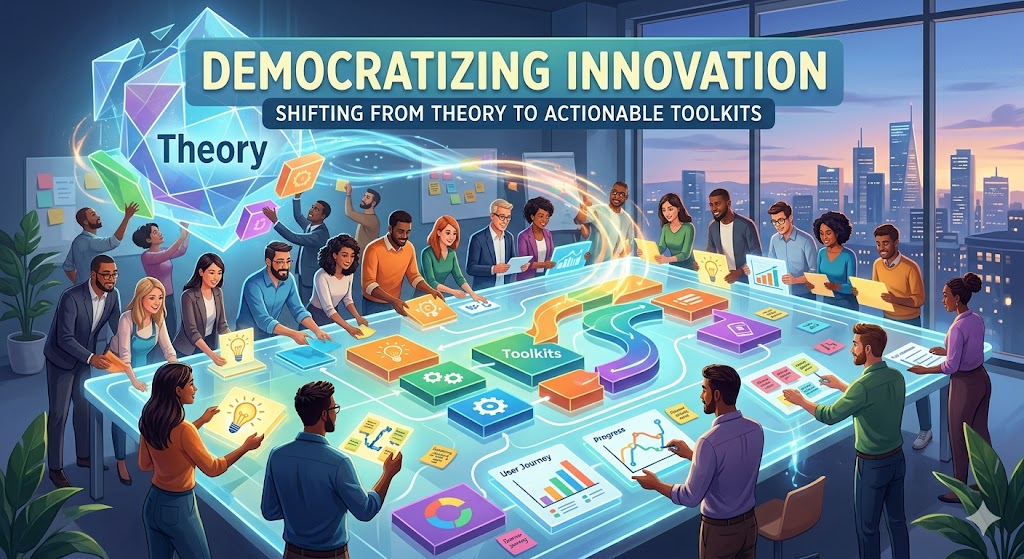
To move past the barrier of corporate jargon, we have to look at how humans actually process information and collaborate. Traditional business communication relies heavily on text-dense documents and lengthy slide presentations, which naturally favor the loudest or most senior voices in a room. Visual frameworks — such as canvases, matrix diagrams, and structured templates — fundamentally change this dynamic. By moving ideas out of people’s heads and onto a shared physical or digital canvas, we level the playing field, removing corporate hierarchy and ensuring that a brilliant insight from a frontline employee carries the exact same visual weight as one from a vice president.
From a cognitive standpoint, these visual tools work because they dramatically reduce cognitive load. When teams try to tackle complex, systemic business problems through open-ended discussion, the sheer volume of variables can quickly lead to mental fatigue and analysis paralysis. Visual toolkits act as external cognitive architecture. By breaking a massive strategic challenge down into deliberate, structured, and bite-sized visual components, they allow the human brain to focus intensely on one specific dimension of a problem at a time without losing sight of the broader ecosystem.
Beyond individual psychology, visual toolkits serve a critical social function within an organization: they foster a deep, shared understanding. Different functional departments naturally develop their own distinct languages and biases; engineering speaks in constraints and capabilities, marketing speaks in personas and positioning, and finance speaks in spreadsheets and risk. A well-designed visual framework acts as a universal translator. It bridges these traditional functional silos, creating a single “common language” that allows cross-functional teams to align their perspectives, surface hidden assumptions, and collaborate seamlessly on the exact same page.
Anatomy of an Actionable Visual Toolkit
An effective visual toolkit like the Change Planning Toolkit or the Human-Centered Innovation Toolkit is never just a collection of pretty boxes on a page; it is a purposefully engineered vehicle for collaboration. At its core, a successful toolkit applies human-centered design principles to the employee experience itself. Just as we design products to be intuitive for customers, we must design innovation tools to be seamless, accessible, and empathetic to the realities of the employees using them. When a tool is built around the natural workflow and psychological needs of a team, it transforms from a bureaucratic chore into an empowering asset.
While every organizational challenge is unique, an actionable visual toolkit consistently relies on three critical architectural elements:
- The Canvas: A structured, highly visible space that maps out the entire landscape of a challenge. It brings together customer insights, operational constraints, and strategic goals into a single view, forcing hidden assumptions into the open where they can be evaluated objectively.
- The Progressive Flow: A deliberate, step-by-step pathway that guides a team seamlessly from problem identification through to rapid experimentation. It removes the guesswork of “what do we do next?” by visually mapping out the journey of an idea.
- Constraints as Catalysts: Built-in guardrails and explicit boundaries that prevent teams from getting overwhelmed. By narrowing the scope of focus, these visual constraints channel creative energy effectively and prevent the common trap of analysis paralysis.
In practice, these components come to life through specific, highly targeted visual frameworks. For instance, ecosystem maps help teams visualize complex stakeholder relationships and hidden value chains at a glance. Customer journey canvases shift the focus away from internal processes and ground the team entirely in the user’s lived experience. Meanwhile, change readiness matrices help organizations plot out the psychological and operational hurdles of adoption long before a rollout begins, translating high-level organizational theory into immediate, localized action steps.
Overcoming the Friction of Adoption
Introducing new tools into an organization always triggers a natural human response: resistance. In any established corporate culture, employees have survived wave after wave of management fads, leaving them fiercely protective of their time. If a visual toolkit is introduced carelessly, it will immediately be labeled as “just another corporate process” or a bureaucratic exercise designed to create more paperwork. To overcome this cynicism, leaders must demonstrate immediate utility, proving that these visual frameworks are designed to eliminate friction and streamline work rather than add to an already overflowing plate.
The true secret weapon of a visual framework is its unique ability to cultivate psychological safety within a team. In traditional, text-driven or verbal meetings, critiquing an idea often feels like a direct, personal attack on the person who voiced it, causing people to shut down or play it safe. Visual tools fundamentally shift this dynamic by externalizing thoughts. When an idea is written on a sticky note and placed onto a shared canvas, it detaches from the individual. The team is no longer critiquing their colleague; they are critiquing a piece of data on the wall, allowing for candid, robust evaluation without the interpersonal fear.
Ultimately, scaling these toolkits across an enterprise requires a fundamental shift in the role of leadership. Managers must move away from the traditional persona of the “sole arbiter and approver of ideas” and instead step into the role of a facilitator. Leadership’s job is no longer to sit in judgment at the end of a pipeline, but to actively champion the environment, provide the necessary visual resources, and guide their teams through the toolkit. When leaders model this collaborative behavior, they signal that the organization values collective intelligence over top-down control.
Conclusion: Driving Sustainable, Human-Centered Change
Democratizing innovation is not a soft, feel-good corporate initiative; it is a rigorous operational strategy with a measurable, bottom-line return on investment. When you equip your entire workforce with actionable visual toolkits, you unlock a massive wave of employee engagement, because people finally feel heard and empowered to impact their daily realities. Operationally, this shift dramatically accelerates your organizational velocity, collapsing pivot times from months to days. Instead of waiting for top-down mandates, localized teams can rapidly identify friction points, map solutions, and run low-risk experiments, building an inherently resilient culture capable of navigating continuous change from the bottom up.
Ultimately, a company’s capacity for transformation is limited by the accessibility of its tools. You can have the most brilliant corporate strategy on earth, but if your frontline employees cannot easily visualize their role within it or see the exact next step they need to take on Monday morning, that strategy is dead on arrival. If we want to survive and thrive in an increasingly volatile business landscape, we have to stop hoarding the tools of creation in the upper echelons of leadership.
The challenge for modern leaders is straightforward: it is time to perform an honest audit of your current innovation and change management strategies. Look closely at how you communicate transformation to your teams. If your organization is still relying on dense, text-heavy decks, rigid manuals, and abstract corporate jargon, you are actively slowing your own progress. It is time to put down the textbooks, step away from the podium, and put actionable visual toolkits directly into the hands of the people who power your enterprise.
Frequently Asked Questions
What is the difference between an innovation framework and an actionable visual toolkit?
An innovation framework provides the high-level strategy and theory explaining why an organization needs to change or evolve. An actionable visual toolkit like the Change Planning Toolkit or the Human-Centered Innovation Toolkit translates that abstract theory into concrete step-by-step practices, using visual canvases and structured guardrails to show teams exactly how to collaborate and execute daily.
How do visual toolkits build psychological safety during the change process?
In traditional meetings, critiquing an idea often feels like an attack on the person who said it. Visual toolkits externalize thoughts onto a shared space or sticky note. This detaches the idea from the individual, allowing the team to objectively evaluate the data on the wall without fear of interpersonal friction or corporate hierarchy.
Can front-line employees use these toolkits without extensive training?
Yes, that is the primary goal of democratization. Well-designed visual toolkits are engineered with intuitive, human-centered progressive flows that minimize cognitive load. By stripping away complex corporate jargon and replacing it with bite-sized, visual steps, anyone can lead or participate in a session immediately.
Image credit: Gemini
 Sign up here to get Human-Centered Change & Innovation Weekly delivered to your inbox every week.