Automating the Radar
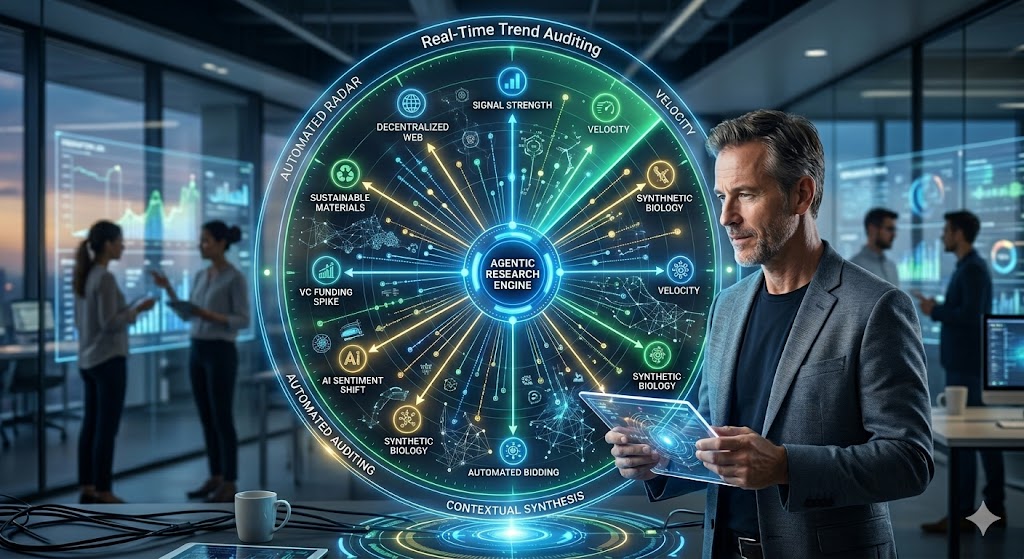
GUEST POST from Art Inteligencia
The Crisis of the Static Radar
Every innovation leader loves the metaphor of “the radar.” We talk about scanning the horizon, identifying weak signals, and tracking disruptive forces before they hit our core business. Yet, if we are completely honest with ourselves, the way most organizations populate and maintain their innovation radars is fundamentally broken.
Historically, environmental scanning and trend auditing have been episodic, exhausting, and prone to massive human blind spots. The standard corporate approach looks something like this: once a year, or perhaps quarterly, a strategy team or an external agency conducts a frantic sprint of desktop research, runs a few workshops, and visualizes the findings on a beautiful, multi-colored circular graphic. But by the time that static presentation is finalized and distributed, the ground has already shifted. In an exponential world, the velocity gap between market reality and corporate perception is widening at an alarming rate.
A true radar does not take a snapshot every six months and call it a day; it scans continuously, in real time, sweeping the landscape to detect velocity, trajectory, and proximity. When corporate foresight remains stuck in an episodic cadence, it ceases to be a strategic sensing tool and becomes a historical artifact.
We are entering a new paradigm driven by agentic research tools—autonomous AI entities capable of formulating their own hypotheses, navigating the web, cross-referencing sources, and updating strategic models without constant human prompting. By shifting from passive, manual tracking to an agentic auditing engine, organizations can transform the trend radar into a living, real-time sensing organ. This enables innovation leaders to move away from reactive firefighting and move toward continuous, proactive experience design and strategic agility.
Anatomy of an Agentic Research Engine
To build a radar that scans in real time, we must first understand how agentic research tools differ fundamentally from the legacy automation tools we have relied on for years. For decades, “automated scanning” meant setting up keyword alerts, RSS feeds, or social listening dashboards. While useful, these tools are inherently passive and rigid; they only look for exactly what you tell them to look for, resulting in a mountain of unstructured noise that still requires hours of human labor to filter, categorize, and synthesize.
An agentic research engine represents a paradigm shift from passive aggregation to autonomous exploration. Instead of executing a static search string, an agentic system is given an objective—such as “Identify emerging structural shifts in sustainable supply chain logistics within the Pacific Northwest”—and is empowered to determine its own path to achieve it.
What Makes it Agentic?
True agentic research tools exhibit three core characteristics that distinguish them from traditional software:
- Autonomous Query Formulation: Based on an initial objective, the agent does not just search a single keyword. It breaks the topic down into sub-hypotheses, generates its own multi-layered search queries, and iteratively refines those queries based on the initial results it uncovers. If it hits a dead end, it pivots; if it finds a high-value signal, it digs deeper.
- Dynamic Credibility Validation: Unlike a standard search engine that ranks results primarily by SEO optimization or traffic, an agent can be trained to evaluate source authority. It cross-references patent databases, academic journals, venture capital funding rounds, and niche industry forums, weighing the validity of a signal by triangulating data points across disparate sectors.
- Contextual Synthesis: The agent doesn’t just hand you a list of links. It reads, interprets, and synthesizes the content, translating raw data into cohesive, narrative executive briefs that highlight the relevance of the trend to your specific organization.
The Architecture of Continuous Scanning
When deployed effectively, an agentic research engine creates a multi-layered filter that constantly refines data from the macro-environment down to micro-signals. At the top of the funnel, autonomous “scouts” constantly graze the digital landscape, looking for anomalies, linguistic shifts, or sudden spikes in cross-industry activity.
Once an anomaly is detected, the scout passes the data to a “synthesis layer”—a secondary agent optimized to map the new signal against your organization’s existing strategy, internal frameworks, and specific industry constraints. The result is a system that filters out the ambient noise of the internet, ensuring that when a trend finally arrives on the human innovation leader’s desk, it is already contextualized, validated, and ready for strategic evaluation.
The 4-Step Real-Time Auditing Framework
Transforming your organization’s foresight capability from a passive, episodic ritual into a dynamic corporate advantage requires a structured operational loop. We cannot simply turn AI agents loose on the internet and hope for the best; we must design a systematic pipeline that ingests raw data, contextualizes it, flags critical shifts, and elegantly hands off the insights to human decision-makers. This human-centered approach ensures technology handles the data drudgery while people focus on strategic empathy and experience design.
The following four-step framework outlines how an agentic research tool integrates into the daily flow of a modern innovation office.
1. Continuous Ingestion (The Autonomous Scout)
The loop begins with continuous ingestion. Instead of relying on human analysts to manually browse tech blogs or wait for industry whitepapers, autonomous “scout” agents are deployed across a vast, predefined digital perimeter. These agents operate 24/7, grazing through high-value, unstructured data sources including:
- Global patent filings and intellectual property registries.
- Academic pre-prints and peer-reviewed scientific journals.
- Early-stage venture capital funding announcements and regulatory filings.
- Niche developer communities, open-source repositories, and fringe cultural chatter.
By scanning the periphery continuously, the engine catches the earliest whispers of change long before they break into mainstream business media.
2. Dynamic Contextualization (The Synthesis Layer)
A signal without context is just noise. In the second stage, the engine takes raw, disparate data points and immediately runs them through an organization’s specific strategic lens. The agent categorizes each signal utilizing classic macro-environmental frameworks like STEEP (Social, Technological, Economic, Environmental, Political), but it doesn’t stop there.
The synthesis layer maps the incoming trend against your organization’s internal taxonomy, current product portfolios, and active innovation pipelines. It answers the algorithmic question: “If this signal accelerates, which of our current business units or customer experiences will be impacted first?” The output is a highly tailored, continually updated knowledge graph rather than a generic bucket of trends.
3. Automated Anomaly Detection (The Tripwire)
Innovation leaders don’t have time to review every minor market ripple. The engine uses automated tripwires to identify mathematical or semantic anomalies that indicate a trend is shifting gears. The agent triggers an alert only when a weak signal crosses a critical velocity threshold, such as:
- Convergence: When two previously unrelated trends (e.g., a specific breakthrough in synthetic biology colliding with an update in supply chain cold-storage tracking) suddenly appear in the same context.
- Velocity Spikes: A sudden, exponential increase in patent filings or venture funding within a previously dormant niche.
- Sentiment Inversion: A rapid shift in public or professional sentiment regarding a specific technology or social movement.
These tripwires prevent cognitive overload, ensuring human leaders are only disrupted when a signal demands genuine strategic attention.
4. The Human-in-the-Loop Intersect (The Curator)
The ultimate goal of automating the mechanics of the radar is not to remove humans from the loop, but to elevate them. When an agentic tripwire is triggered, it generates a comprehensive narrative brief and passes the baton to the human innovation team.
Liberated from the exhausting work of manual data-gathering, human leaders step into the role of strategic curators and experience designers. They evaluate the agent’s findings, layer on corporate intuition, assess political feasibility, and determine how to actively shape the organization’s response. This final step turns automated intelligence into authentic, human-centered action.
Overcoming the Pitfalls of AI-Driven Foresight
While the speed and scale of agentic research tools are undeniable, blind reliance on automated systems introduces significant strategic risks. If we hand the keys of corporate foresight entirely to algorithms, we risk optimizing for efficiency while completely losing our strategic bearings. To build a resilient, real-time radar, innovation leaders must understand and actively mitigate three critical structural pitfalls.
The Echo Chamber Effect
Algorithms are fundamentally built to find patterns based on historical data and user preferences. Left unchecked, an agentic research engine can easily fall victim to confirmation bias on an organizational scale. If the system observes that executives consistently click on, praise, or fund projects related to a specific technology—such as generative AI or spatial computing—it will naturally optimize its search parameters to find more signals validating that preference.
This creates a dangerous corporate echo chamber, blinding the organization to contrarian views, alternative technologies, or subtle socio-economic shifts that challenge current investments. To counter this, innovation offices must intentionally program “adversarial constraints” into their agents, explicitly instructing them to hunt for disconfirming evidence, failure modes, and fringe perspectives that run counter to established corporate strategy.
Sifting Signal from Synthetic Noise
We are currently witnessing an unprecedented explosion of synthetic content across the digital landscape. Content farms, automated SEO sites, and corporate PR engines are utilizing AI to flood the web with optimized, low-substance text. If an agentic scout simply counts the frequency of certain buzzwords or tracks superficial media velocity, it runs the risk of auditing its own reflection—tracking AI-generated noise rather than authentic market signals.
An effective agentic engine must be architected with sophisticated data-provenance filters. Instead of scanning superficial web layers, agents must prioritize primary source environments where synthetic manipulation is harder to sustain: raw patent applications, peer-reviewed technical documentation, developer commits on open-source repositories, and verified regulatory filings. The engine must be trained to look past marketing vocabulary to find the underlying structural mechanisms of change.
The Empathy Deficit
This is perhaps the most critical boundary line for any technology-enabled innovation strategy. An AI agent is exceptionally skilled at tracking what is happening, where it is accelerating, and who is funding it. It can map the mechanics of a trend with flawless precision. However, an algorithm possesses an inherent empathy deficit: it cannot truly comprehend the deep, emotional, and psychological why behind changing human behavior.
Trends are not just data points; they are the outward expression of shifting human anxieties, aspirations, values, and unmet needs. An agent can flag that a new decentralized social platform is gaining traction among teenagers, but it cannot feel the profound sense of digital fatigue or the craving for authentic intimacy that drove those users there in the first place. This is where automated data auditing must end, and human-centered experience design must begin. We use the machine to map the terrain, but we rely on human empathy to interpret the soul of the market.
Driving Action: From Real-Time Insights to Agile Strategy
Possessing an automated, highly accurate trend radar offers zero competitive advantage if your organizational governance remains rigid and slow. Beautiful data dying inside a digital dashboard is no better than a static PDF gathering dust on a shelf. To unlock the true value of an agentic research engine, organizations must evolve their internal structures, moving from annual planning cycles to a state of continuous, dynamic resource allocation and proactive experience design.
The Living Dashboard
The first structural shift occurs in how foresight data is visualized and democratized across the enterprise. Traditional innovation radars are treated as guarded secrets, updated once a year by a specialized team and revealed to executives in high-stakes meetings. An agentic radar replaces this ritual with a living dashboard—a shared, interactive internal utility.
Because autonomous agents update the system continuously, any product manager, experience designer, or business unit leader can log in at any moment to see a real-time heat map of emerging disruptions. Trends are no longer static dots on a fixed chart; they are dynamic vectors, visually indicating their acceleration, cross-industry convergence, and calculated proximity to the core business. This shift transforms foresight from a localized corporate function into an omnipresent organizational capability.
Dynamic Portfolio Realignment
When your radar detects market shifts in real time, maintaining a rigid annual budgetary cycle becomes a severe operational liability. If a crucial technological convergence or a dramatic shift in consumer sentiment is flagged in month two of the fiscal year, waiting until the next annual planning cycle to pivot ensures failure.
Forward-thinking organizations use the outputs of real-time trend auditing to inform an agile portfolio management model. Instead of locking 100% of capital into fixed annual initiatives, innovation leaders maintain a liquid, dynamic allocation fund. When an agentic tripwire validates that a peripheral weak signal has suddenly moved into the core accelerator zone, governance structures must allow leadership to immediately shift resources, spin up lean exploration teams, and realign R&D priorities within days, rather than quarters.
Proactive Experience Design
Ultimately, the most profound impact of real-time trend auditing is felt in how we craft experiences for customers and employees. In a hyper-connected market, customer expectations are liquid; a breakthrough experience in an entirely different industry instantly resets what a customer expects from your brand. If you wait for traditional market research to tell you that customer preferences have changed, you are already too late.
By leveraging an agentic research tool to continuously analyze peripheral shifts—such as emerging behavioral patterns in fringe digital communities or micro-innovations in adjacent sectors—experience designers can practice predictive innovation. They can accurately anticipate emerging friction points, design intuitive user journeys, and deploy experience-led solutions that solve customer anxieties before the customer even has the vocabulary to articulate them. This elevates the organization from a position of rapid market reaction to one of market orchestration.
Conclusion: The Future of the Futurist
The dawn of agentic research tools does not spell the end of the corporate futurist, the innovation strategist, or the experience designer. Rather, it marks their liberation. For decades, highly skilled foresight professionals have had their cognitive bandwidth consumed by the grueling, manual labor of data harvesting—scouring blogs, sorting spreadsheets, and wrestling with rigid keyword alerts just to keep their heads above the digital deluge.
By automating the mechanics of the radar, we shift the human role from data collector to strategic alchemist. The machine takes over the continuous, cold, and calculated task of scanning the periphery, allowing human leaders to return to what they do best: thinking deeply, connecting disparate ideas, and applying radical empathy to complex human problems. Technology maps the velocity of the trend, but humans determine its ethical implications and cultural resonance.
As we move deeper into this accelerated era, competitive advantage will no longer belong to the organizations that possess the most information. In an AI-saturated world, information is commoditized. Instead, the premium will be placed on organizations that build the most intelligent, human-centered systems to interpret, contextualize, and act on that information in real time. The goal is to build an enterprise that senses continuously, adapts dynamically, and innovates perpetually.
The static radar is dead. The living radar is waiting to be built. The only question left for innovation leaders is whether they will continue to paint historical portraits of the market, or choose to orchestrate its future in real time.
Frequently Asked Questions
How do agentic research tools differ from standard keyword or RSS alerts?
Traditional alerts are passive and rigid; they only scan for exact keyword strings and require humans to filter the resulting noise. Agentic research tools are autonomous. They are given a high-level strategic objective, formulate their own evolving search queries, cross-reference data across diverse sources to validate credibility, and synthesize findings into contextualized briefs without needing constant human prompts.
Does automating the trend radar risk replacing human innovation leaders?
No, it liberates them. Automating the radar removes the manual drudgery of data-harvesting and landscape tracking. This shifts the human role from data collection to strategic curation, ethical evaluation, and human-centered experience design—areas requiring deep empathy and intuition that AI cannot replicate.
How can an organization prevent AI bias from creating a corporate echo chamber?
Left unchecked, agents will optimize for trends that executives already favor. To mitigate this, innovation teams must program explicit adversarial constraints into the system. This forces the AI agents to actively hunt for disconfirming evidence, contrarian viewpoints, and structural failures that challenge established corporate strategies.
Image credit: Gemini
 Sign up here to get Human-Centered Change & Innovation Weekly delivered to your inbox every week.