LAST UPDATED: April 27, 2026 at 11:44 AM
GUEST POST from Art Inteligencia
I. Introduction: The Universal Language of Problem Solving
For decades, the corporate world has operated under the persistent myth of the “Creative Class.” This siloed perspective suggests that innovation and design are specialized functions reserved for those with specific artistic credentials or a mastery of aesthetic software. By confining “design” to a specific department, organizations inadvertently build walls around their most potent tool for adaptation.
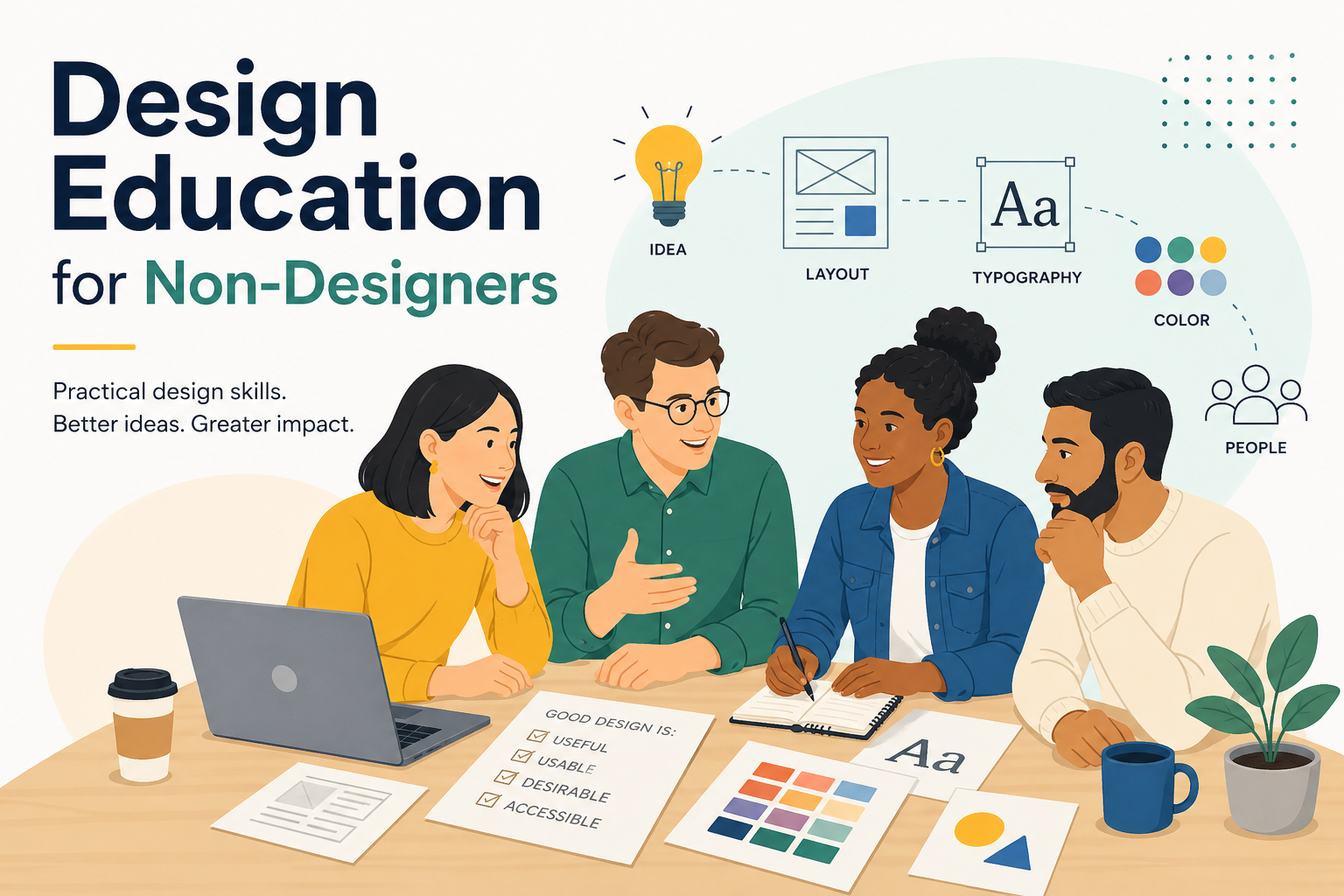
True design is not about the polish of the final product; it is a fundamental human mindset geared toward intentionality. To educate non-designers is not to turn every employee into a graphic artist, but to democratize a way of thinking. It is about equipping the entire workforce with the tools of empathy, structured curiosity, and the willingness to iterate.
The strategic imperative in today’s landscape is the shift from technical uptime to human outcomes. When design literacy becomes a universal skill, we move from simply building systems to crafting meaningful experiences. The goal is to maximize the Δ (delta) between a user’s current friction and a future of seamless interaction.
As we move toward an increasingly automated future, the human capacity to reframe problems and design for emotional resonance becomes our most valuable competitive advantage. Investing in design education across the organization ensures that innovation is no longer an occasional event, but a continuous, shared responsibility.
II. The Core Pillars of Design Literacy
Design literacy for the non-designer is built upon three foundational pillars. These are not technical skills, but rather cognitive shifts that transform how an individual perceives their role and the value they provide to the end-user.
1. Empathy as a Business Metric
We must move beyond superficial “customer focus” and embrace deep, human-centered understanding. By utilizing Experience Level Measures (XLMs), we can quantify the emotional and functional state of the user. In this framework, empathy is not a “soft skill” — it is the data point that drives strategic direction.
2. The Power of Visualization
Visualization is the quickest path to alignment. For a non-designer, this means using low-fidelity sketching and mapping to externalize complex ideas. When a team can see a problem through a shared visual model, the friction of misunderstanding evaporates.
3. Iterative Resilience
The final pillar is the reframing of failure. Design literacy teaches us to value the “learning cycle” over the “polished presentation.” By focusing on rapid prototyping, we reduce the risk of large-scale failure and build an organizational culture that values the Σ (sum) of incremental improvements.
By mastering these pillars, non-designers stop being passive recipients of design decisions and start becoming active architects of the human experience.
III. Bridging the Gap: Tactical Skills for the Non-Designer
To transition from theory to practice, non-designers must adopt specific tactical maneuvers that allow them to intervene in the problem-solving process effectively. This isn’t about mastering tools; it’s about mastering the “how” of inquiry.
Problem Reframing
The most critical skill a non-designer can acquire is the ability to challenge the initial ask. Often, teams rush to solve a symptom rather than the cause. Instead of asking, “How do we increase click-through rates?” a design-literate professional asks, “What friction is preventing the human at the other end from reaching their goal?”
Collaborative Synthesis
In a data-rich environment, the challenge is finding the “signal in the noise.” Collaborative synthesis involves facilitating diverse perspectives — from engineering to marketing — to build a unified view of the customer journey. It is the art of moving from raw data to actionable insight through shared sense-making.
The Ethics of Design
Design is never neutral. Every business decision alters a human experience. Non-designers must learn to evaluate the long-term impact of their choices. This includes considering accessibility, inclusivity, and the potential for unintended consequences in the digital ecosystem.
IV. Designing the Transformation
Moving from one-off workshops to a culture of continuous enablement.
Building a design-literate organization is not a “one-and-done” training exercise. It requires an intentional architecture for learning — one that treats design as a living capability rather than a static certification.
Micro-Learning and Immersion
Traditional two-day workshops often fail because the skills aren’t applied immediately. The transformation happens through project-based immersion, where non-designers are coached while working on real-world business challenges. This ensures that the methodology sticks and produces immediate tangible value.
The Role of the Design Mentor
In this model, professional designers transition from being “the people who do the work” to “the people who enable the work.” By acting as mentors, they provide the guardrails that allow non-designers to experiment safely, maintaining quality while scaling design thinking across the enterprise.
Building a Shared Toolkit
Democratization requires a common language. By establishing a shared repository of frameworks — such as standardized Visual Project Charters or Customer Experience Audit templates — the organization ensures that everyone is using the same map to navigate complex problems.
V. Measuring the Impact of Design Education
The primary challenge in democratizing design is proving its value to stakeholders who are accustomed to traditional KPIs. To justify the investment in design education, we must look beyond aesthetic output and measure the fundamental shift in organizational performance.
The Shift in Velocity
Design literacy significantly reduces “re-work.” When non-designers understand how to prototype and validate ideas early, the organization avoids the costly mistake of building the wrong thing. We measure success by the acceleration of the path to market and the reduction in mid-stream pivot costs.
Employee Agency and Engagement
There is a direct correlation between design agency — the ability to improve one’s own work processes — and employee retention. When employees are equipped to redesign their own workflows, engagement scores rise. We track this through internal sentiment analysis and turnover rates within design-enabled teams.
From SLAs to XLMs
Traditional Service Level Agreements (SLAs) focus on technical “uptime.” By introducing Experience Level Measures (XLMs), we measure the human outcome. success is defined by a decrease in user frustration and an increase in the meaningful completion of tasks, creating a high-resolution map of organizational impact.
VI. Conclusion: The Future of the Human-Centered Enterprise
We are standing at the threshold of a great democratization. As AI and automation continue to handle the “doing,” the human role must shift toward the “designing.” In the enterprise of the future, Design Thinking will no longer be a specialized workshop topic; it will simply be “thinking.”
The organizations that thrive will be those that stop treating creativity as a scarce resource to be managed and start treating it as a latent capability to be unleashed. By investing in design education for every employee, you aren’t just teaching a new skill set — you are upgrading the collective operating system of your business.
A Call to Action
Stop “outsourcing” your organization’s creative future to a handful of specialists. Start investing in the empathy, visualization, and iterative capacity of your entire workforce. The transition to a human-centered enterprise begins the moment you give your non-designers the permission — and the tools — to design a better way forward.
In an era of relentless digital transformation, the most valuable “software” we can upgrade is our own capacity for intentionality. When everyone speaks the language of design, we stop building features and start crafting experiences that truly matter.
Frequently Asked Questions
1. Why should non-designers learn design principles?
Design is the universal language of problem-solving. When non-designers master these principles, it breaks down silos, accelerates innovation, and ensures that business decisions are grounded in human empathy rather than just technical requirements.
2. Does this mean everyone needs to learn graphic design tools?
No. Design education for non-designers focuses on mindset over mastery of tools. It’s about learning to reframe problems, visualize complex ideas with simple sketches, and use Experience Level Measures (XLMs) to track success.
3. How does design literacy impact organizational ROI?
It increases organizational agility by reducing “re-work” and ensuring products meet actual user needs the first time. By empowering employees to design their own workflows, it also significantly boosts engagement and retention.
Image credit: Google Gemini
 Sign up here to get Human-Centered Change & Innovation Weekly delivered to your inbox every week.