Evidence-Based Answers
LAST UPDATED: April 11, 2026 at 10:03 AM
GUEST POST from Chateau G Pato
The Great Methodology Clash
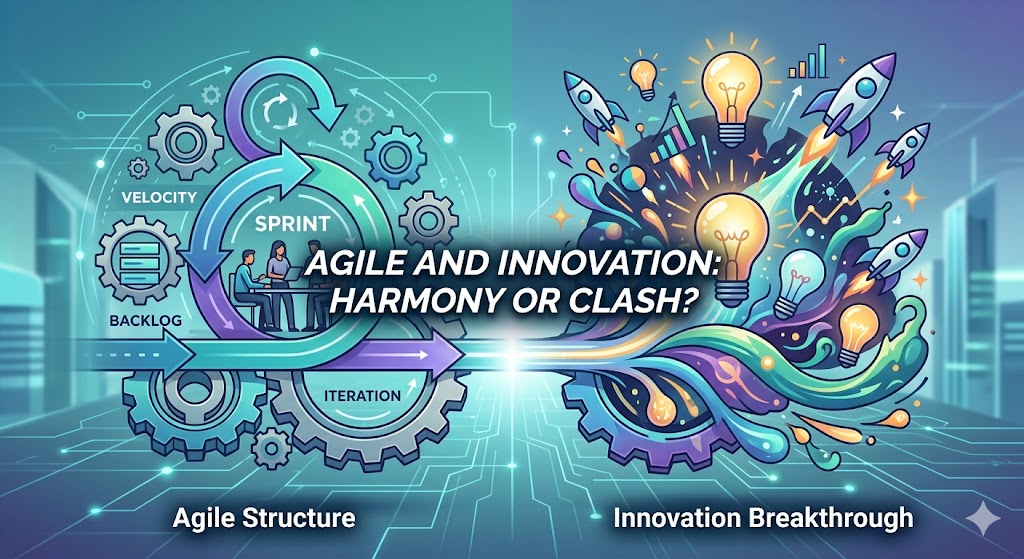
In the modern business landscape, Agile is often sold as the ultimate antidote to stagnation. However, a growing tension exists between the disciplined structure of Agile frameworks and the messy, non-linear reality of pure innovation.
Organizations frequently find themselves caught in a paradox: they adopt Agile to increase speed and responsiveness, yet they often discover that while their output increases, their “Big Ideas” seem to shrink into a series of minor, safe iterations. This phenomenon raises a critical question for leadership: Is the methodology driving us toward breakthroughs, or is it merely optimizing the status quo?
To find the answer, we must look past the anecdotes and marketing hype. This article explores the evidence-based reality of how Agile frameworks — including Scrum, Kanban, and SAFe — impact different types of innovation, from incremental improvements to radical, market-shifting discoveries.
How Agile Fuels the Innovation Engine
Contrary to the belief that structure stifles creativity, when implemented with a human-centered mindset, Agile provides the essential scaffolding for innovation to thrive. By shifting the focus from rigid long-term planning to adaptive learning, Agile frameworks can actually accelerate the journey from a raw idea to a market-ready solution.
De-Risking through Iteration
The “Fail Fast” mentality is often misunderstood as a celebration of failure; in reality, it is about reducing the cost of learning. By breaking down complex innovation projects into smaller, manageable increments, teams can test high-risk assumptions early. This prevents the “Big Bang” failure — where millions are spent on a product that no one actually wants.
The Feedback Loop: Aligning with Human Needs
Continuous integration and frequent review cycles ensure that innovation remains tethered to reality. Instead of innovating in a vacuum, Agile forces a constant dialogue with the end-user. This evidence-based approach ensures that the “Experience Design” isn’t just a hypothesis, but a validated solution that solves real human problems.
Psychological Safety and Autonomy
Innovation requires a culture where people feel safe to take risks. Agile’s emphasis on self-organizing, cross-functional teams empowers individuals to take ownership of their work. This autonomy is a primary driver of intrinsic motivation, which is the “secret sauce” behind most creative breakthroughs.
Eliminating “Innovation Theater”
Traditional waterfall environments often reward “Innovation Theater” — the production of elaborate slide decks and theoretical business cases. Agile demands working prototypes. By prioritizing tangible output over documentation, organizations can more accurately measure progress and pivot resources toward the ideas that demonstrate real potential.
When Agile Becomes a Straightjacket
While the benefits of Agile are well-documented, the methodology can inadvertently become a “innovation killer” if applied dogmatically. When the process becomes the priority over the purpose, the very structures meant to enable speed can end up anchoring a team to the shoreline of incrementalism.
The “Tyranny of the Sprint”
Innovation often requires deep, uninterrupted thinking and “unstructured” time to explore dead ends. The relentless cadence of two-week sprints can create a culture of urgency that prioritizes low-hanging fruit. Teams may gravitate toward tasks they are certain they can finish within the sprint window, effectively self-censoring breakthrough ideas that require longer, more complex exploration.
The Incrementalism Trap
Evidence suggests that Agile is a master at “polishing the stone” but can struggle to “find the diamond.” Because the framework is built on iterative feedback, it excels at evolutionary innovation (making an existing product 10% better). However, it often fails at revolutionary innovation, where the end goal isn’t yet clear enough to be broken down into neat user stories.
Loss of the “North Star”
In a poorly managed Agile environment, the Product Backlog can morph into a never-ending grocery list of features and bug fixes. When teams become obsessed with clearing tickets, they lose sight of the strategic vision. Without a strong “North Star” to guide the experience design, the product risks becoming a disjointed collection of features rather than a cohesive, meaningful solution.
Over-Emphasis on Velocity
What gets measured gets managed. If leadership defines success solely by “Velocity” (the number of story points completed), teams will naturally optimize for output over impact. This creates a “feature factory” where there is no room for the “productive waste” of experimentation, questioning assumptions, or starting over — all of which are vital to the innovation process.
The Evidence-Based Verdict: Context is King
The debate over whether Agile supports or kills innovation is rarely a binary “yes” or “no.” Instead, the evidence points toward a situational reality. Data from high-performing organizations suggests that Agile’s effectiveness is directly tied to the type of innovation being pursued and the horizon in which the team is operating.
The Innovation Horizon Model
To understand the impact of Agile, we must view it through the lens of the Three Horizons of Innovation:
- Horizon 1 (Incremental): In this space of “polishing the stone,” Agile is an undisputed powerhouse. The evidence shows that iterative cycles significantly improve speed-to-market and quality for existing products.
- Horizon 2 (Adjacent): Here, Agile requires a hybrid approach. Success depends on integrating Design Thinking to explore new markets before the engineering sprint begins.
- Horizon 3 (Radical/Disruptive): This is where pure Agile often stumbles. Evidence indicates that radical breakthroughs require “Discovery Tracks” that are decoupled from the standard delivery cadence to allow for high-variance experimentation.
Why “Pure Agile” Isn’t Enough
Industry analysis of failed digital transformations shows a recurring pattern: organizations that adopt Agile without Human-Centered Design often end up building the “wrong thing” faster. The verdict is clear: Agile is a delivery framework, not a discovery framework. To support innovation, it must be paired with methodologies that focus on causal insights and human behavior.
The Cultural Variable
Finally, the evidence suggests that the “Agile-Innovation” link is moderated by culture. In organizations where “Agile” is used as a tool for micromanagement or purely for cost-cutting, innovation invariably dies. Conversely, in cultures that prioritize organizational agility and psychological safety, Agile provides the necessary structure to turn creative sparks into sustainable revenue.
Best Practices: Harmonizing the Two Worlds
Bridging the gap between the rigid requirements of a sprint and the fluid nature of innovation requires a shift from “Dogmatic Agile” to “Pragmatic Agility.” To ensure your methodology supports rather than stifles breakthroughs, consider these evidence-based strategies for harmonization.
Dual-Track Agile: Separate Discovery from Delivery
One of the most effective ways to protect innovation is to implement Dual-Track Agile. In this model, the “Discovery” track focuses on identifying human needs, rapid prototyping, and validating causal links, while the “Delivery” track focuses on building and deploying production-ready code. This ensures that the innovation pipeline is always full of validated ideas before they ever hit a developer’s backlog.
Allocating “Innovation Sprints” and Slack Time
Innovation cannot be scheduled into 15-minute stand-ups. Leading organizations often dedicate specific sprints — sometimes called “Innovation Sprints” or “Hack Weeks” — where the backlog is frozen, and teams are given the autonomy to explore speculative “What If” scenarios. This “slack” in the system is not waste; it is the necessary breathing room for creative synthesis.
Shift KPIs: From Output to Outcomes
If you measure a team by how many story points they finish (Output), they will avoid difficult, innovative tasks. To support innovation, leadership must shift to Outcome-based metrics. Instead of asking “How much did we build?”, ask “What customer behavior did we change?” or “What new revenue leakage did we plug?” Measuring Experience Level Measures (XLMs) ensures the team stays focused on value creation.
The Product Owner as a Visionary, Not a Clerk
For Agile to support innovation, the Product Owner must move beyond simply managing tickets. They must act as a “Chief Innovation Officer” for their product, balancing the immediate needs of the users with the long-term strategic “North Star.” Their role is to protect the team from feature bloat and ensure that every sprint is a step toward a more meaningful human experience.
Conclusion: It’s Not the Tool, It’s the Craftsman
The evidence is clear: Agile does not kill innovation. However, a rigid, dogmatic application of Agile ceremonies — without the balancing force of experience design and strategic foresight — can certainly suffocate it. When we prioritize “following the process” over “responding to human needs,” we lose the very essence of why we innovate in the first place.
To truly support innovation, organizations must move beyond the “Feature Factory” mindset. We must stop treating Agile as a set of handcuffs and start treating it as a flexible framework that empowers teams to explore, experiment, and execute with purpose. The goal isn’t just to move faster; it’s to move faster toward meaningful value.
As you look at your own organizational agility, ask yourself: Is your current velocity moving you toward a breakthrough, or just toward a deadline? Innovation requires the courage to step out of the sprint cycle when the path forward is unclear and the discipline to use Agile to scale that vision once the “North Star” is found.
Final Thought for Leaders
“Don’t let your methodology become your strategy. The most successful organizations are those that use Agile to deliver value, but use Human-Centered Innovation to define what that value should be.”
Frequently Asked Questions
Does Agile only work for incremental improvements?
While Agile is highly effective for incremental (Horizon 1) innovation, it can support radical breakthroughs if paired with a dedicated “Discovery Track.” Without this, the pressure of short sprints tends to favor smaller, safer updates over disruptive changes.
How can leadership prevent Agile from becoming a “Feature Factory”?
Leadership must shift focus from output metrics like “Velocity” or “Story Points” to outcome-based measures (XLMs). By rewarding the value created for the user rather than the volume of code shipped, teams are empowered to prioritize innovation.
What is the biggest risk of using Agile for innovation?
The primary risk is the “Tyranny of the Sprint,” where the relentless two-week cadence discourages the deep, unstructured exploration and “productive failure” necessary for true human-centered breakthroughs.
Image credits: Gemini
 Sign up here to join 17,000+ leaders getting Human-Centered Change & Innovation Weekly delivered to their inbox every week.