LAST UPDATED: March 15, 2026 at 06:39 PM
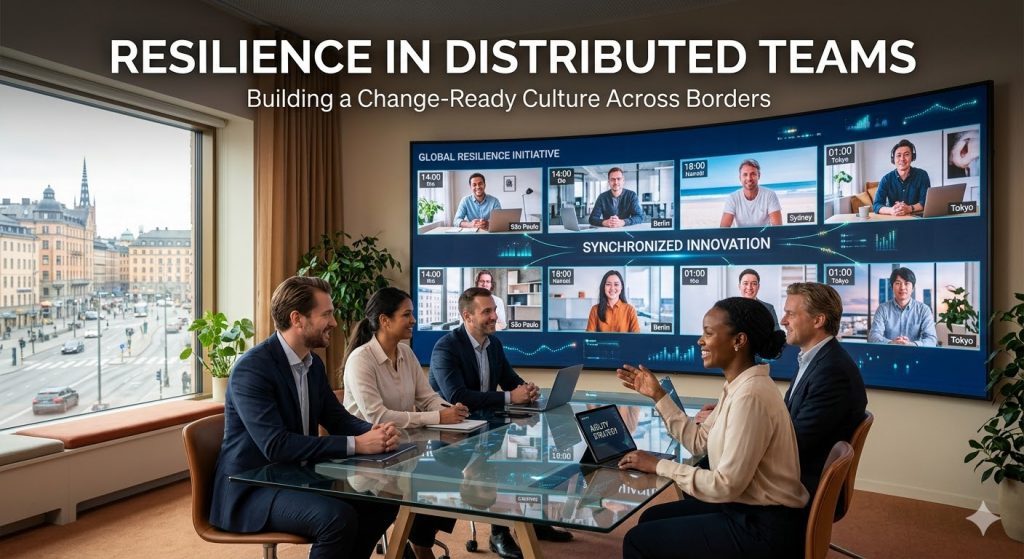
GUEST POST from Art Inteligencia
I. The New Architecture of Resilience: Beyond “Bouncing Back”
In the traditional corporate lexicon, resilience was often treated as a reactive defense mechanism — a sturdy umbrella to be deployed only when the storm of market volatility or internal restructuring began to pour. We viewed it as the ability to “bounce back” to a previous state of equilibrium. However, in a world defined by human-centered innovation and increasingly distributed teams, that definition is no longer sufficient. To thrive today, we must shift our perspective from recovery to evolution.
Moving from Defensive to Proactive Resilience
True resilience in a modern, borderless organization isn’t about returning to the status quo; it’s about springing forward into a new reality. It is a proactive strategy built into the very fabric of how we work. In a distributed environment, where the physical cues of the office are absent, resilience must be architected intentionally. It is the collective capacity of a team to absorb tension, learn from disruption, and reorganize itself to be even more effective than it was before the challenge arose.
The Distributed Reality: Culture Beyond “Place”
We have moved past the era where “place” was the primary container for organizational culture. When your team spans time zones, languages, and home-office setups, you cannot rely on the “accidental collisions” of the hallway to build strength. The architecture of a distributed team must be fluid yet firm. We are no longer managing a physical site; we are managing a network of human potential. This shift requires us to rethink how we anchor our people — not to a building, but to a shared purpose and a robust digital ecosystem.
The Three Pillars of the Change-Ready Culture
Building this new architecture requires a focus on three fundamental pillars that ensure a team remains “change-ready” regardless of their physical coordinates:
- Psychological Safety: The bedrock that allows individuals to take risks and speak up without fear of retribution, even through a screen.
- Operational Agility: The structural flexibility to shift workflows and communication styles as the environment demands.
- Empathetic Leadership: A leadership style that prioritizes the human experience, recognizing that the person on the other side of the Zoom call is a whole human, not just a resource.
By integrating these pillars, distributed teams transform from a collection of isolated individuals into a dynamic, resilient organism capable of navigating the complexities of the modern innovation landscape.
II. Pillar 1: Strengthening the Human Connection (Psychological Safety)
In a physical office, psychological safety is often reinforced through the micro-signals of human interaction — a nod in the hallway, a shared laugh before a meeting, or the ability to sense the “vibe” of a room. In a distributed environment, these signals are filtered through screens and asynchronous text, creating a “context deficit.” To build a resilient team, we must intentionally over-index on creating a safe harbor for ideas, questions, and even dissent.
Combating Digital Isolation through Intentional Rituals
Isolation is the silent killer of innovation. When individuals feel like “nodes” in a network rather than members of a team, they stop taking risks. Building resilience requires us to move beyond the transactional nature of video calls. We must design intentional rituals that facilitate human connection:
- The “Check-In” Protocol: Starting meetings not with an agenda item, but with a human-centric pulse check. This isn’t just “How are you?” but “What is your energy level today, and how can we support you?”
- Working Out Loud: Encouraging teams to share “half-baked” ideas or works-in-progress in public channels. This demystifies the creative process and signals that perfection is not a prerequisite for participation.
- Asynchronous Appreciation: Using dedicated channels to celebrate small wins and “productive failures” publicly, ensuring that remote contributions are visible and valued.
The Safety to Fail Out Loud (From a Distance)
Resilience is born from the ability to learn quickly from what doesn’t work. In a distributed setting, the fear of “failing quietly” is real — if no one sees the struggle, the learning is lost. We must create a culture where vulnerability is a professional asset.
Leaders must model this by sharing their own hurdles and pivots. When a leader admits, “I missed the mark on this projection, here is what I learned,” it gives the team the “permission to be human.” This transparency reduces the anxiety of performance and allows the team to focus their collective energy on solving problems rather than hiding them.
Architecting Intentional Inclusion
A resilient distributed team is one where every voice has a clear path to the table. Proximity bias — the tendency to favor those we see more often — is a significant threat to psychological safety. To combat this, we must:
- Audit Participation: Actively monitoring who is speaking in digital forums and inviting quieter voices into the conversation through direct, supportive prompts.
- Standardize Information Access: Ensuring that the “why” behind decisions is documented and accessible to everyone, regardless of their time zone. Information symmetry is a form of respect.
- Define the “Right to Disconnect”: Psychological safety includes the safety to step away. Clear boundaries around “deep work” hours and “off-grid” time prevent burnout and demonstrate that the organization values the person’s long-term health over short-term availability.
“Innovation isn’t about the tools we use to talk; it’s about the trust we build that allows us to truly hear each other across the digital divide.” — Braden Kelley
III. Pillar 2: Designing for Operational Agility
In a centralized office, “agility” is often mistaken for “speed” — the ability to pivot quickly because everyone is in the same room. In a distributed environment, true operational agility is about synchronization without constant contact. It is the structural framework that allows a team to remain fluid, responsive, and innovative without the friction of endless status meetings or the bottleneck of centralized decision-making.
The Shift to Asynchronous Innovation
The greatest threat to distributed resilience is “meeting fatigue,” which drains the cognitive energy required for deep, creative work. To build an agile, resilient team, we must treat asynchronicity as a first-class citizen. This means:
- Documentation as a Culture: Moving away from “oral traditions” where knowledge lives in people’s heads. If a decision isn’t documented in a shared, searchable space, it didn’t happen. This democratizes information and allows innovation to happen at 2:00 AM in Tokyo just as easily as 2:00 PM in New York.
- Low-Friction Feedback Loops: Utilizing collaborative canvases and threaded discussions to iterate on ideas. This allows for “passive participation,” where team members can contribute when they are in their highest state of flow, rather than when a calendar invite dictates.
The Power of Intentional Clarity
In a distributed world, clarity is kindness. Agility is hindered when team members are unsure of their boundaries or the “Why” behind a pivot. We must replace “supervision” with “alignment.” When every person understands the North Star metric and the constraints of the project, they are empowered to make autonomous decisions that keep the momentum moving forward.
This requires a radical commitment to defining Outcome-Based Success. We stop measuring the “process” (how many hours were spent at a desk) and start measuring the “impact” (what value was created). This shift grants the team the flexibility to manage their own energy and environments, which is a core component of long-term resilience.
Tooling for Flow, Not Friction
The technology stack of a distributed team should act as a force multiplier for human talent, not a digital leash. Operational agility is maintained by selecting tools that:
- Reduce Context Switching: Integrating platforms so that communication happens where the work lives (e.g., commenting directly on a design file or a code repository).
- Automate the Mundane: Using automation for status updates and administrative tasks to free up “human bandwidth” for complex problem-solving and empathetic connection.
- Visualize the Workflow: Utilizing transparent Kanban boards or digital twin environments so that anyone, at any time, can see the state of play without needing to ask for a report.
When operational agility is designed correctly, the “distance” between team members becomes irrelevant. The system itself becomes resilient, capable of absorbing individual absences or regional disruptions without the entire project grinding to a halt.
IV. Pillar 3: Empathetic Leadership and the “Human-First” Pivot
In a distributed environment, the traditional “command and control” model of leadership doesn’t just fail — it actively erodes resilience. When you cannot walk the floor to gauge the energy of your team, leadership must shift from oversight to empathy. This isn’t about being “nice”; it is about the strategic recognition that a team’s cognitive and emotional capacity is the engine of all innovation.
Managing Energy, Not Hours
The most resilient leaders in distributed teams have moved past the industrial-age obsession with the 40-hour “presence” requirement. They understand that creativity and problem-solving are non-linear. To lead with empathy is to manage energy cycles:
- Respecting the “Deep Work” Sanctuary: Protecting team members from digital interruptions during their peak productivity hours.
- Normalizing Asynchronous Flexibility: Acknowledging that a team member might need to step away for a midday walk or family commitment to return with a refreshed perspective.
- Monitoring for Digital Burnout: Actively looking for signs of “always-on” behavior — such as emails sent at 3:00 AM — and coaching individuals to set sustainable boundaries.
The Leader as an Architect of Belonging
In the absence of a physical office, the leader becomes the primary curator of culture. This requires a shift in focus from “what we are doing” to “who we are becoming.” An empathetic leader ensures that every team member, regardless of their geography, feels a sense of belonging and significance.
This is achieved through “High-Touch” digital interactions: 1-on-1 meetings that prioritize career aspirations and personal well-being over task lists, and “Storytelling” sessions where the leader connects daily tasks back to the organization’s larger human-centered mission.
Vulnerability as a Catalyst for Resilience
Resilience is often built in the “gaps” — the moments when things go wrong. An empathetic leader uses vulnerability to bridge these gaps. By being open about their own challenges — whether it’s “Zoom fatigue,” a failed experiment, or the difficulty of balancing work and life — they lower the “perfection barrier” for the rest of the team.
This transparency builds a high-trust environment where team members feel safe to say, “I’m struggling with this pivot,” or “I need help.” When a leader models this behavior, they aren’t showing weakness; they are building a psychologically durable team that can face any market disruption with collective honesty.
“Leadership is no longer about being the smartest person in the room; it’s about creating a digital room where everyone feels smart, safe, and seen.”
V. Overcoming the “Change Gap” in Remote Environments
The “Change Gap” is the cognitive and emotional distance between a leadership decision and the team’s ability to execute it. In a physical office, this gap is bridged by osmosis — hearing conversations, seeing prototypes, and gauging the “mood” of the building. In a distributed environment, the gap can become a canyon. Bridging it requires a Human-Centered Change approach that treats communication as a product, not an afterthought.
Strategic Communication Cascades
When a pivot occurs, information often gets diluted as it travels through Slack channels, email threads, and Jira tickets. To maintain resilience, we must move from broadcasting to cascading:
- The “Multi-Modal” Approach: Delivering the “Why” behind the change through various medium — a short video for emotional resonance, a detailed document for deep-diving, and an interactive Q&A session for real-time clarity.
- Repeat to Compete: In a distributed world, people are bombarded with digital noise. A change message must be repeated seven times in seven different ways before it truly enters the team’s collective consciousness.
Building a Shared Vocabulary for Innovation
Misunderstanding is the enemy of agility. When a team is spread across the globe, words like “pivot,” “MVP,” or “urgency” can have different cultural and professional connotations.
A resilient team builds a shared dictionary of change. This means explicitly defining what “success” looks like for a specific initiative and creating common metaphors that bridge geographic divides. When everyone uses the same language to describe a problem, they can solve it 50% faster.
Continuous Feedback Loops: The Digital Pulse
In a distributed setting, you cannot wait for the “Annual Engagement Survey” to see if your team is breaking. Resilience requires real-time sentiment analysis:
- Pulse Surveys: Short, two-question surveys (e.g., “Do you have the tools you need today?” and “How is your stress level?”) to catch friction points before they become fires.
- Office Hours & AMA (Ask Me Anything): Creating “open-door” digital spaces where the hierarchy is flattened, and any team member can challenge the direction of a change initiative.
- Retrospectives as Ritual: Making “Look Back to Leap Forward” sessions a non-negotiable part of the sprint cycle. This ensures that the process of change is being innovated just as much as the product.
By closing the Change Gap, we ensure that the team doesn’t just “endure” a transition, but actively shapes it. This sense of agency is the ultimate fuel for distributed resilience.
VI. Conclusion: The Future is Fluid
As we navigate the complexities of a post-geographic world, we must realize that distributed work is not a compromise—it is an opportunity to build more resilient, inclusive, and innovative organizations. Resilience is not a destination we reach; it is a muscle that must be intentionally exercised through every Slack message, every asynchronous document, and every leadership decision.
Summarizing the Resilience Blueprint
The transition from a “co-located” mindset to a “distributed-first” philosophy requires us to double down on the human elements of work:
- Psychological Safety ensures that the digital divide does not become a wall of silence.
- Operational Agility creates the framework for synchronization without the friction of constant surveillance.
- Empathetic Leadership anchors the team in a shared purpose, prioritizing the energy and well-being of the people behind the screens.
The Call to Action: Empowering the Distributed Change Agent
To build a truly change-ready culture, we must empower every individual to act as a change agent. Resilience is most potent when it is decentralized. Don’t wait for a top-down mandate to start building these habits. You can start tomorrow by:
- Replacing one meeting with a well-structured asynchronous document to respect your team’s “flow” state.
- Sharing a “Learning Moment” publicly to model the vulnerability that drives psychological safety.
- Conducting a “Context Check” at the start of your next call to ensure everyone understands the Why behind your current pivot.
Final Thought: Designing for the Human at the Center
The “distance” in distributed teams is only as wide as the gaps in our empathy and our systems. When we design our workflows, our communication, and our leadership styles with the human experience at the center, the physical miles between us cease to matter. We aren’t just building teams that can survive a crisis; we are building a global network of talent that is ready to innovate through anything.
“In the end, innovation is a team sport — and in a distributed world, the playing field is everywhere.” — Braden Kelley
Frequently Asked Questions
To help teams quickly align on the core principles of distributed resilience, here are the three most critical questions and their strategic answers.
1. What is the biggest barrier to resilience in distributed teams?
The primary barrier is Proximity Bias. This is the unconscious tendency to favor team members who are physically closer or more “visible” in digital channels. It erodes psychological safety for remote workers and creates information silos that slow down innovation.
2. How can we maintain “Agility” without constant status meetings?
Agility is maintained through Asynchronous Innovation. By shifting toward a “Documentation-First” culture — where decisions and progress are logged in shared, searchable spaces — teams can maintain momentum across time zones without sacrificing deep-work hours to meeting fatigue.
3. What is the role of empathy in a change-ready culture?
Empathy is the operating system of resilience. It allows leaders to manage team energy cycles rather than just clock-hours. By recognizing the human context behind the screen, leaders build the trust necessary for teams to pivot quickly during periods of high uncertainty.
Image credit: Google Gemini
 Sign up here to get Human-Centered Change & Innovation Weekly delivered to your inbox every week.