Trust Ecosystems
LAST UPDATED: February 21, 2026 at 1:41PM
GUEST POST from Art Inteligencia
I. Introduction: The Unified Field Theory of Trust
The Trust Paradox
In the modern business landscape, we face a glaring contradiction: organizations are spending record amounts on “Brand Trust” and external PR campaigns while simultaneously overlooking the quiet erosion of trust within their own walls. This is the Trust Paradox. You cannot effectively project a promise to the market that your own employees don’t believe in. When the internal reality and the external message diverge, the resulting “trust gap” becomes a massive hidden tax on every innovation effort you undertake.
Defining the Trust Ecosystem
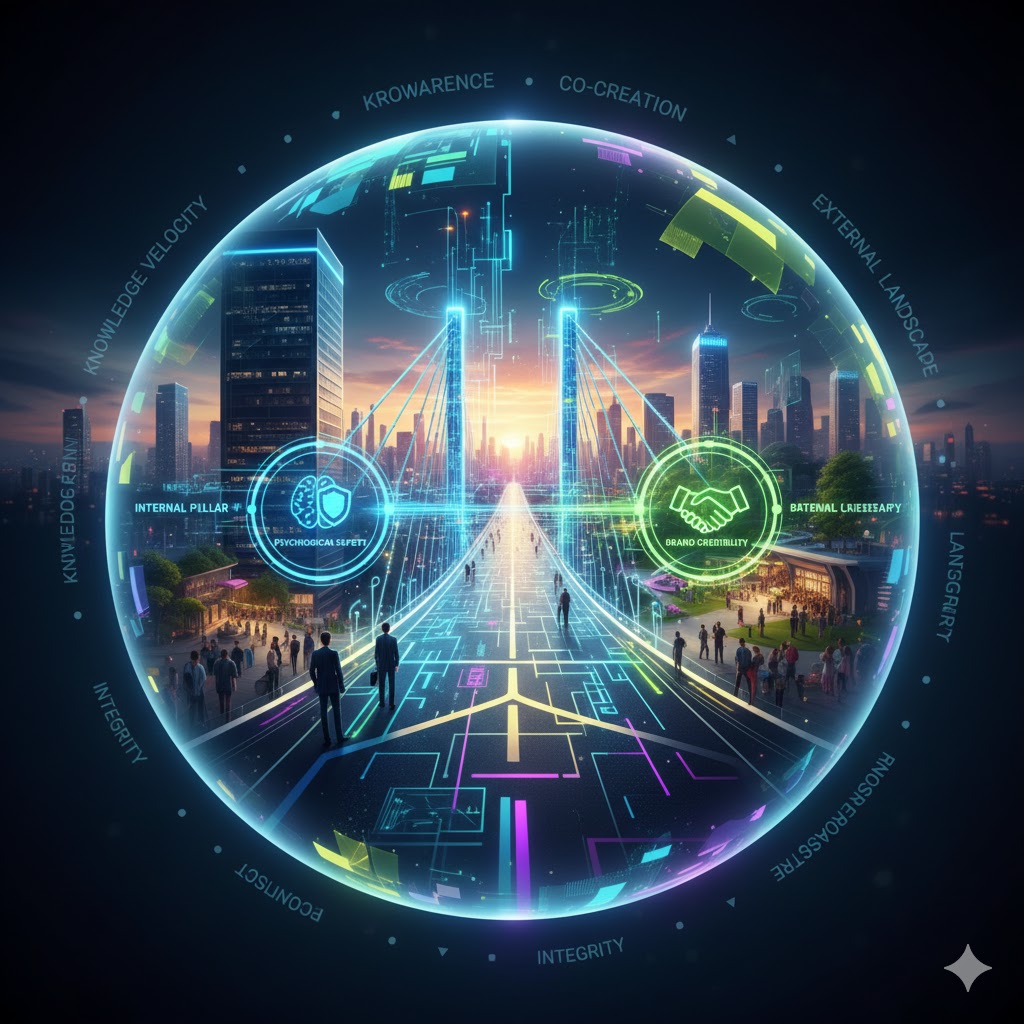
A Trust Ecosystem is a holistic framework where internal psychological safety and external brand credibility function as a single, self-reinforcing loop. In this model, transparency is not a department; it is a biological function of the organization. Trust flows from the leadership to the front line, and from the front line to the customer. If any part of this circuit is broken, the entire ecosystem loses its power to innovate and adapt.
The Human Element: Trust as Lubricant and Buffer
Trust is the primary lubricant for innovation. It reduces the “friction” of collaboration and speeds up the Knowledge Velocity we discussed previously. Beyond speed, trust serves as the ultimate buffer against market volatility. When things go wrong — as they inevitably will in a disruptive world — a high-trust organization is given the benefit of the doubt by both its employees and its customers, allowing for a Human-Centered Pivot rather than a panicked retreat.
II. The Internal Pillar: Psychological Safety as a Strategic Asset
Innovation dies in the dark. If your team is afraid to fail, they are afraid to learn. Internal trust is the foundation upon which all strategic risk-taking is built.
1. Beyond Surface Transparency
Many leaders confuse transparency with “announcing decisions.” True internal trust moves from broadcasting to bidirectional vulnerability. It’s about creating an environment where a junior developer feels safer pointing out a flaw in a strategy than keeping quiet to protect the “peace.” In 2026, silence isn’t peace; it’s a latent risk.
2. The Vulnerability Loop
Trust is not built through perfection; it is built through shared humanity. When a leader admits, “I don’t have the answer to this shift yet, but here is how we will find it together,” they trigger a Vulnerability Loop. This signal gives the rest of the team permission to be honest about their own challenges, accelerating the “Unlearning Rate” we need for true adaptability.
3. Measuring Internal Trust: The “Safe-to-Fail” Score
We must treat trust as a hard metric. We track the frequency of “dissenting signals” in project meetings. A project with zero dissenting voices isn’t a perfect project; it’s a project with a trust problem. We use Safe-to-Fail experiments to gauge health — if a small failure results in a “blame storm,” your trust ecosystem is compromised.
III. The External Pillar: Radical Transparency and Consumer Agency
In an era of decentralized information, you can no longer “curate” your image. You must demonstrate your integrity. External trust is the result of shifting from gatekeeping to radical openness.
1. The End of Information Asymmetry
The days when a corporation knew significantly more about its products’ flaws than the public are over. With AI-driven consumer research and real-time supply chain tracking, the “market” sees your blind spots before you do. External trust in 2026 is built by being the first to disclose issues, not the last to admit them.
2. Co-Creation as a Trust Builder
The ultimate expression of trust is giving your stakeholders a seat at the design table. By moving from “selling to” to “designing with,” you transform customers into co-owners of your success. This Co-Creation Framework ensures that the value you provide is aligned with the actual needs and ethics of your community.
3. The Accountability Framework: The “Human-Centered Pivot”
Trust isn’t broken when a company fails; it’s broken when a company deflects. We measure external trust by the Accountability Index: How quickly does the organization acknowledge a mistake, and how human-centered is the remedy? A transparent pivot during a crisis can actually result in higher long-term trust than never failing at all.
IV. Aligning the Pillars: The Mirror Effect
Your organization is a glass house. What happens on the inside eventually reflects on the outside. Alignment is about ensuring there is no “refractive index” between your culture and your brand.
1. Employee Advocacy: The Real Marketing Department
In a hyper-connected world, your employees’ glassdoor reviews and social media presence carry more weight than your billboard ads. When internal trust is high, your front line becomes a powerful engine for external credibility. They don’t just sell the product; they validate the integrity of the company.
2. The Ethical Consistency Check
Trust is shattered when external brand promises (e.g., “We value sustainability”) are contradicted by internal behaviors (e.g., “We prioritize short-term margins over green logistics”). We must perform regular Consistency Audits to ensure that the internal “Way” is a perfect mirror of the external “Brand.”
3. The Mirror Effect in Crisis
When a crisis hits, an aligned organization responds with a single voice. Because the internal team is already trusted with the truth, they don’t have to wait for a “script” from PR. They act according to the company’s shared values, providing a coherent and authentic response to external stakeholders.
V. Architecting the Ecosystem: Tools for Alignment
Trust is not a “vibe” — it is a structural requirement. To move from inspiration to operation, leaders need a toolkit that maps and manages the invisible threads connecting people, purpose, and profit.
1. The Trust Audit & Gap Analysis
Before building, we must assess the current terrain. An Innovation Trust Audit measures the delta between executive intent and frontline perception. We look for “Trust Gaps” where external marketing makes promises that internal operational constraints prevent employees from keeping.
2. Stakeholder Maps 2.0: Mapping Trust Nodes
Traditional stakeholder mapping focuses on power and interest. Stakeholder Maps 2.0 identify “Trust Nodes” — the individuals or community leaders who act as information bridges. By mapping these nodes, we can see where trust is flowing freely and where it is bottled up by bureaucracy or poor communication.
3. The Bidirectional Dialogue Loop
An ecosystem requires circulation. We implement Dialogue Loops that bypass traditional hierarchies. External feedback from customers and partners shouldn’t just sit in a CRM; it must flow directly into internal “Retrospective” meetings. Conversely, internal innovation breakthroughs should be shared with external stakeholders early to build “co-creation equity.”
4. Ethical Guardrail Integration
Finally, we must bake trust into the “code” of the organization. This means integrating ethical guardrails into the Product Development Life Cycle (PDLC). If a project threatens the Trust Ecosystem (e.g., through intrusive data practices), the system should have “circuit breakers” that allow any stakeholder to halt progress until alignment is restored.
VI. Conclusion: Trust as a Competitive Moat
In the hyper-competitive landscape of 2026, technology can be commoditized, and business models can be disrupted overnight. But a Trust Ecosystem — the deep, cultural alignment of internal values and external promises — is incredibly difficult to replicate. It is the ultimate competitive moat, built not with walls to keep people out, but with connections to draw people in.
The Integrity Premium
The most successful organizations of the future will not be those with the most data, but those with the most Integrity. There is a tangible “Integrity Premium” in the market: high-trust companies enjoy lower employee turnover, higher customer loyalty, and a faster “Insight-to-Action” cycle because they don’t have to waste time navigating internal politics or external skepticism.
When you align your internal psychological safety with your external brand credibility, you create an organization that is not only “built to last” but “built to lead.” You stop reacting to the future and start shaping it, because your stakeholders — both inside and outside — believe in your “Why” as much as you do.
The Final Word: Integrity is the New Agility
The future belongs to the organizations that are the same on the inside as they are on the outside. Authentic innovation requires an authentic culture.
— Braden Kelley
Trust Ecosystems FAQ
1. What is a Trust Ecosystem in business?
It is a holistic model where internal psychological safety and external brand credibility are treated as a single system. In 2026, you cannot “fake” a great brand if your culture is broken; a Trust Ecosystem ensures your “inside” and “outside” are perfectly aligned.
2. How does internal trust impact external innovation?
Trust is a lubricant for speed. When employees trust their leaders, they share “bad news” faster. This high Knowledge Velocity allows the company to pivot away from failing ideas and toward market opportunities before the competition, creating a more reliable external brand.
3. What is the “Mirror Effect” in stakeholder trust?
The Mirror Effect suggests that your organization is transparent. Your frontline employees are the “glass” through which the public sees your company. If they don’t believe your mission, your customers eventually won’t either. Integrity means ensuring the reflection matches the reality.
Image credit: Google Gemini
 Sign up here to get Human-Centered Change & Innovation Weekly delivered to your inbox every week.