Designing the Future of Waste Destruction
LAST UPDATED: January 22, 2026 at 5:36 PM
GUEST POST from Art Inteligencia
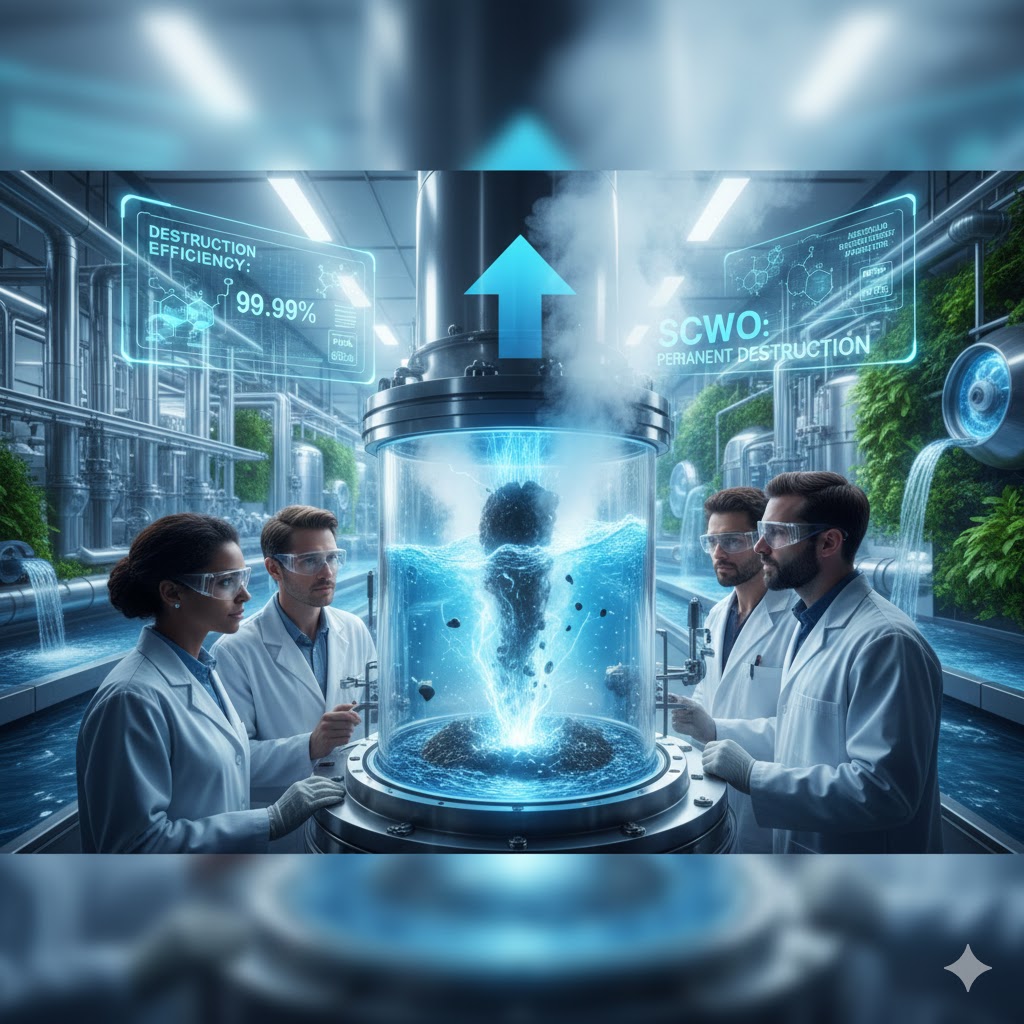
As we navigate the complexities of 2026, the global innovation community is increasingly focused on sustainable competitive advantage. But sustainability is no longer just a buzzword for the Environmental, Social, and Governance (ESG) report; it is a fundamental engineering and human-centered challenge. We are currently witnessing a paradigm shift in how we handle the “unhandleable” — toxic wastes like Per- and Polyfluoroalkyl Substances (PFAS), chemical agents, and industrial sludges. At the heart of this revolution is Supercritical Water Oxidation (SCWO).
Innovation, as I often say, is about increasing the probability of the impossible. For decades, the permanent destruction of “forever chemicals” felt like a biological and chemical impossibility. SCWO changes that math by leveraging the unique properties of water at its critical point — 374°C and 22.1 MPa — to create a “homogeneous” environment where organic waste is effectively incinerated without the flame, converting toxins into harmless water, carbon dioxide, and salts.
“Innovation transforms the useful seeds of invention into widely adopted solutions valued above every existing alternative. With SCWO, we aren’t just managing waste; we are redesigning our relationship with the environment by choosing permanent destruction over temporary storage.” — Braden Kelley
The Mechanism of Change
In a standard liquid state, water is a polar solvent. However, when pushed into a supercritical state, its dielectric constant drops, and it begins to behave like a nonpolar organic solvent. This allows oxygen and organic compounds to become completely miscible. The result? A rapid, high-efficiency oxidation reaction that happens in seconds. For the human-centered leader, this represents more than just a chemical reaction; it represents agility. It allows us to process waste on-site, reducing the carbon footprint and risk associated with transporting hazardous materials.
Case Study 1: Eliminating the “Forever” in PFAS
In a recent multi-provider demonstration involving 374Water, Battelle, and Aquarden, SCWO technology was tested against Aqueous Film-Forming Foam (AFFF) contaminated with high concentrations of PFAS. The results were staggering. The systems achieved a 99.99% reduction in total PFAS. By shifting from a “filtration and storage” mindset to a “destruction” mindset, these organizations proved that the technical debt of past industrial eras can be settled permanently. This is a classic example of using curiosity to solve a legacy problem that traditional ROI models would have ignored.
Market Leaders and The Innovation Ecosystem
The commercialization of SCWO is being driven by a dynamic ecosystem of established players and agile startups. 374Water (NASDAQ: SCWO) remains a prominent leader, recently expanding its board to accelerate the global rollout of its “AirSCWO” systems. Revive Environmental has also made significant waves by deploying its “PFAS Annihilator,” a mobile SCWO unit that can treat up to 500,000 gallons of landfill leachate daily. Other key innovators include Aquarden Technologies in Denmark, Battelle, and specialized engineering firms like Chematur Engineering AB. These companies aren’t just selling hardware; they are selling a future where waste management is a closed-loop system.
Case Study 2: Industrial Sludge and Energy Recovery
A European chemical manufacturing plant integrated a tubular SCWO reactor to handle hazardous organic sludges that previously required expensive off-site incineration. Not only did the SCWO process destroy 99.9% of the toxins, but the plant also implemented a heat recovery system. Because the oxidation reaction is exothermic, they were able to capture the excess heat to pre-heat the influent waste, significantly lowering operational costs. This transformation of a cost-center (waste disposal) into a self-sustaining utility is exactly the type of systemic innovation I encourage leaders to pursue.
Final Thoughts: The Curiosity Advantage
The half-life of our current waste management techniques is shrinking. Landfills are filling, and regulations are tightening. The organizations that thrive will be those that exercise the collective capacity for curiosity to adopt “future-present” technologies like SCWO. We must stop asking “How do we hide the waste?” and start asking “How do we unmake it?”
Supercritical Water Oxidation (SCWO) FAQ
What are the primary benefits of SCWO over traditional incineration?
Can SCWO systems recover energy from waste?
Is SCWO technology ready for large-scale industrial use?
Disclaimer: This article speculates on the potential future applications of cutting-edge scientific research. While based on current scientific understanding, the practical realization of these concepts may vary in timeline and feasibility and are subject to ongoing research and development.
Image credits: Google Gemini
 Sign up here to get Human-Centered Change & Innovation Weekly delivered to your inbox every week.