When to Automate and When to Pause
LAST UPDATED: March 24, 2026 at 4:57 PM
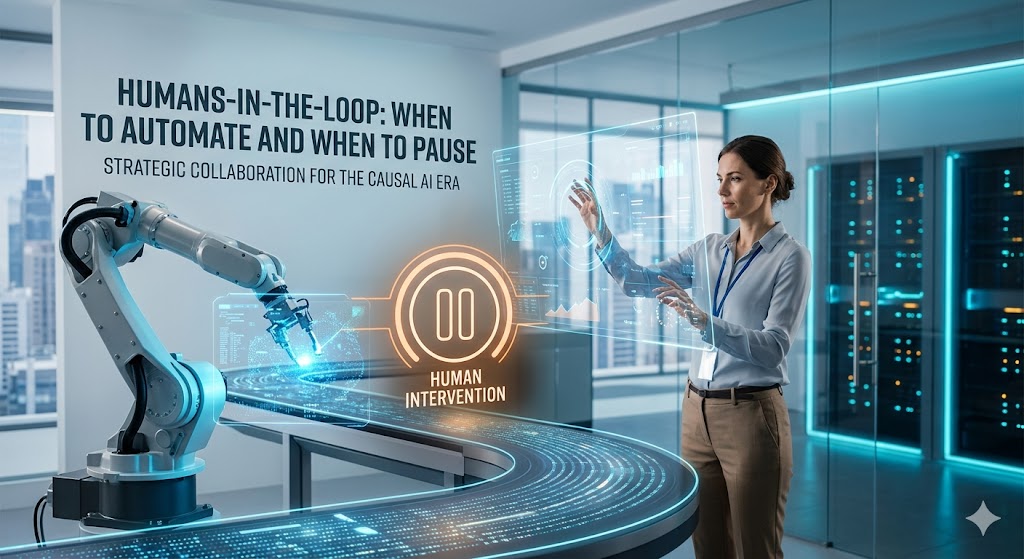
GUEST POST from Art Inteligencia
The Efficiency Trap: Why Full Automation Isn’t Always the Goal
In the relentless pursuit of digital transformation, many organizations fall into the trap of equating “automated” with “optimized.” However, a truly human-centered approach recognizes that automation should serve to enhance human potential, not merely replace it. When we automate without empathy, we risk creating rigid systems that lack the agility to handle the nuances of the real world.
The Myth of “Set It and Forget It”
The allure of “lights-out” operations often leads to organizational decay. When processes are fully removed from human oversight, we see a rapid decline in institutional knowledge. If the system fails or the market shifts, the team no longer possesses the muscle memory or the foundational understanding to intervene effectively. Full automation can inadvertently create a “black box” that stifles long-term innovation and leaves the organization vulnerable to disruption.
Technical Uptime vs. Emotional Resonance
Traditionally, IT and operations have measured success through technical uptime and processing speed. But in a Causal AI era, these binary metrics are insufficient. We must shift our focus toward Experience Level Measures (XLMs). A system may be “up” 99.9% of the time, but if the 0.1% failure occurs during a high-stakes customer crisis, the emotional resonance of that failure outweighs a thousand successful automated transactions. We must measure the cognitive load and emotional impact our systems place on both employees and customers.
Defining the “Friction Paradox”
Modern UX design often obsesses over “frictionless” experiences. Yet, in high-stakes environments — such as healthcare, financial pivoting, or ethical AI deployment — friction is a critical safety feature. Strategic friction forces a “Strategic Pause,” requiring a human to validate a decision before it becomes irreversible. By intentionally designing these moments of pause, we protect the organization from “experience leakage” and ensure that our automated outputs align with our deeper human values.
“Innovation is not about the tools we use, but the human problems we solve with them. If automation removes the humanity from the solution, it isn’t progress — it’s just a faster way to fail.” — Braden Kelley
The Strategic Pause: Identifying “Human-Critical” Junctions
In the drive for organizational agility, the most sophisticated tool at our disposal isn’t a faster algorithm — it’s the Strategic Pause. This is the intentional design of “speed bumps” in an automated workflow where human empathy, ethics, and causal reasoning are non-negotiable. By identifying these junctions, we prevent the “experience leakage” that occurs when automated systems hit a wall of human complexity they aren’t equipped to climb.
High-Empathy Moments: When Digital Feels Hollow
Every customer journey has “make-or-break” moments where the emotional stakes are high. In these scenarios, a perfectly executed automated response can feel dismissive or even cold. Whether it’s a service failure, a complex medical inquiry, or a significant financial transition, these High-Empathy Moments require the nuance of human tone and the flexibility of human judgment. Automation should flag these moments and hand them off to a person, ensuring the customer feels heard, not just processed.
Causal Complexity: Moving Beyond Correlation
Predictive AI is excellent at telling us what is likely to happen based on historical patterns, but it struggle with the why. Causal AI begins to bridge this gap, yet it still requires a human-in-the-loop to interpret intent. When a data trend deviates from the norm, a Strategic Pause allows a human strategist to ask: “Is this a shift in market sentiment, or a data anomaly?” Humans provide the context that turns raw data into actionable innovation strategy.
The Ethical Override: Establishing “Red Flag” Scenarios
Automation operates on logic; humans operate on values. We must establish Ethical Overrides — hard-coded triggers that pause an automated process the moment it touches upon sensitive territory. This includes bias detection in hiring algorithms, safety protocols in physical automation, or privacy concerns in data harvesting. A human-centered approach ensures that if a system cannot guarantee an ethical outcome, it must yield to a human operator who can be held accountable.
Designing for Intervention
A Strategic Pause is only effective if the human stepping in has the Psychological Safety and the tools to act. We must design our systems so that “pausing the machine” is seen as a proactive save rather than a technical failure. This requires clear interfaces that present the human with the necessary context — the Experience Level Measures (XLMs) — to make an informed decision quickly and confidently.
III. Designing the “Loop”: Frameworks for Collaboration
To move beyond simple task automation, we must architect a Collaborative Intelligence model. This isn’t about humans managing machines or machines replacing humans; it’s about a symbiotic loop where each party plays to its strengths. By designing the “loop” with intentionality, we ensure that digital transformation remains a human-centric endeavor rather than a purely technical one.
From Autopilot to Co-Pilot: Empowering the Workforce
The transition from “Autopilot” (where the system acts independently) to “Co-Pilot” (where the system assists) is a fundamental shift in organizational agility. A co-pilot interface must provide transparency — showing not just the output, but the rationale. When a human understands the “why” behind an AI’s suggestion, they can validate, refine, or override it based on real-time environmental context that the sensor or algorithm might miss. This maintains the human’s role as the ultimate strategist.
Experience Level Measures (XLMs) in Automation
Standard KPIs like “time-to-complete” are blind to the human experience. To truly understand if a collaborative loop is working, we must implement Experience Level Measures (XLMs). We should be asking:
- Does this automation reduce cognitive load or merely shift it elsewhere?
- Is the human-machine handoff seamless, or does it create a “context cliff” where the human feels lost?
- Does the system provide enough psychological safety for a worker to challenge an automated decision?
Measuring these qualitative impacts is the only way to prevent burnout and ensure long-term adoption.
The Innovation Role Alignment
Not every person interacts with automation in the same way. By applying a structured framework of Innovation Roles (Braden Kelley’s Nine Innovation Roles is the best one), we can optimize the loop:
- The Magic Maker: Uses automated tools to rapidly prototype and visualize “what if” scenarios, turning raw data into compelling narratives.
- The Conscript: Provides the essential “ground truth” feedback, ensuring that the automated workflows actually function in the messy reality of day-to-day operations.
- The Revolutionary: Acts as the ethical compass, reviewing the “Strategic Pauses” to ensure the system’s trajectory remains aligned with organizational values.
The Continuous Feedback Cycle
The loop is only complete when human insights are fed back into the system to refine the underlying logic. This Active Learning phase ensures that the system evolves. When a human overrides an automated decision, the system should prompt for the “why,” capturing that unique human intuition and converting it into a signal that improves future causal modeling. This turns every “pause” into a learning opportunity for the entire organization.
IV. Avoiding “Experience Leakage” in Digital Transformation
One of the most insidious risks of rapid automation is experience leakage — the slow, often unnoticed erosion of quality, empathy, and brand value as human touchpoints are replaced by rigid digital substitutes. To prevent this, digital transformation must be treated as a human-centered change initiative, not just a technical upgrade. We must ensure that our efficiency gains don’t come at the expense of our organizational soul.
The Customer Experience Audit: Finding the “Dead Ends”
Automation often creates “functional silos” where a customer can complete a task but cannot resolve a problem. A comprehensive Customer Experience Audit is essential to identify these friction points. We must map the journey to find where automation creates a “dead end” — a place where the system lacks the causal logic to help a frustrated user. By identifying these “revenue leakage” points, we can strategically re-insert human intervention to recover the relationship and the sale.
Psychological Safety: The Human Fail-Safe
For a “Humans-in-the-Loop” system to work, the humans must feel safe enough to speak up. If an employee sees an automated system making a biased or incorrect decision but fears “breaking the process,” the system has failed. Cultivating Psychological Safety means empowering every team member to hit the “emergency stop” button. We must move away from a culture of compliance and toward a culture of stewardship, where human intuition is valued as the ultimate safeguard against algorithmic error.
The Feedback Loop: Converting Intuition into Data
Experience leakage occurs when the “person in the machine” sees a problem but has no way to fix the underlying logic. We must build formal mechanisms where human insights directly retrain our models. When a Strategic Pause occurs, the human operator shouldn’t just fix the immediate issue; they should provide the “why” that informs the next iteration of the automation. This creates a virtuous cycle where the AI becomes more “human-aware” over time, reducing the cognitive load on the workforce.
Measuring What Matters: Beyond Throughput
To stop the leak, we must change our instrumentation. If we only measure throughput, we will always favor the machine. By integrating Experience Level Measures (XLMs) into our transformation dashboards, we gain visibility into the emotional health of the ecosystem. Are our customers feeling more empowered, or more ignored? Are our employees feeling more creative, or more like “data janitors”? The answers to these questions determine whether your transformation is building equity or leaking it.
V. Conclusion: Building a Human-Centric Future
The future of work isn’t a race against the machine; it’s a race to see who can best leverage technology to amplify human ingenuity. As we move from predictive models to causal systems, the “Humans-in-the-Loop” philosophy becomes our most significant competitive advantage. Success in this new era requires us to stop asking “How can we automate this?” and start asking “How can this automation make our people more impactful?”
The New ROI: Measuring Human Engagement
We must redefine our Return on Investment. True ROI in the age of AI isn’t just about headcount reduction or faster processing times; it’s about the quality of engagement. When we successfully automate the mundane, we unlock the capacity for our teams to engage in deep work, complex problem-solving, and high-value relationship building. If your automation doesn’t result in a more creative, energized workforce, you haven’t optimized — you’ve simply hollowed out your potential.
A Call to Action: Audit Your Pipeline
The first step toward a human-centered future is a rigorous audit of your current automation pipeline. Look for the “silent failures” where efficiency has replaced empathy.
- Identify: Where are your “dead ends” and “experience leaks”?
- Insert: Where is a Strategic Pause required to protect your brand or your ethics?
- Empower: Do your people have the Psychological Safety to override the system when it’s wrong?
The Path to Infinite Innovation
By keeping humans in the loop, we ensure that our organizations remain agile, empathetic, and resilient. This approach aligns perfectly with the Eight I’s of Infinite Innovation, specifically ensuring that our Implementation phase never loses sight of the Insight and Ideation that only a human can provide. We aren’t just building faster systems; we are building a more responsive, human-centered world.
“The goal of digital transformation is not to create a world without people, but to create a world where people can do their best work. When we pause for the human element, we aren’t slowing down — we’re ensuring we’re heading in the right direction.”
Frequently Asked Questions: Humans-in-the-Loop
What is a “Strategic Pause” in automation?
A Strategic Pause is an intentionally designed “speed bump” in an automated workflow. It marks a critical junction where the system stops to require human judgment, empathy, or ethical oversight before proceeding. This prevents “experience leakage” and ensures that high-stakes decisions align with human values rather than just algorithmic logic.
How do Experience Level Measures (XLMs) differ from traditional KPIs?
While traditional KPIs (Key Performance Indicators) focus on technical output like speed and uptime, XLMs measure the human impact of a system. They track qualitative factors such as cognitive load, emotional resonance, and psychological safety. XLMs help organizations understand if automation is truly empowering people or simply creating digital friction.
When should a process NOT be fully automated?
A process should remain “human-in-the-loop” during High-Empathy Moments (such as customer crises), situations involving Causal Complexity (where the “why” matters more than the “what”), and any scenario requiring an Ethical Override. If the cost of a mechanical error is an irreversible loss of trust or safety, human intervention is mandatory.
Image credit: Google Gemini
 Sign up here to get Human-Centered Change & Innovation Weekly delivered to your inbox every week.