LAST UPDATED January 17, 2026 at 9:33AM
GUEST POST from Art Inteligencia
Every leader I speak with champions innovation. They talk about agile methodologies, design thinking, and fostering a culture of experimentation. Yet, when it comes to the actual budgeting process, the rhetoric often clashes with reality. Projects with uncertain outcomes—the very crucible of true innovation—are often starved of resources, deemed too risky, or simply not funded at all. This creates a fundamental disconnect: we praise the idea of learning from failure, but we rarely budget for it.
It’s time for a radical shift. As a human-centered change and innovation thought leader, I advocate for the implementation of a “Failure Budget.” This isn’t about celebrating incompetence; it’s about strategically allocating resources for iterative learning, accepting that some experiments will not yield immediate commercial success, and recognizing that the insights gained are an invaluable return on investment. It’s about funding exploration, not just exploitation.
“In innovation, the only true failure is the failure to learn. A ‘failure budget’ isn’t just about money; it’s about buying psychological safety for your teams, giving them permission to explore the uncomfortable truths that lead to breakthrough insights.” — Braden Kelley
Why the “Failure Budget” is a Strategic Imperative
Our traditional budgeting models are built for predictability and efficiency. They reward certainty and penalize deviations from planned outcomes. This framework is anathema to innovation, which thrives on uncertainty, iteration, and emergent discovery. Without a dedicated “Failure Budget,” several detrimental effects emerge:
- Risk Aversion: Teams avoid truly novel ideas in favor of incremental, “safe” improvements that are guaranteed to deliver predictable (and often mediocre) results.
- Stifled Experimentation: The fear of wasting resources or being reprimanded for an unsuccessful project discourages the rapid prototyping and testing essential for learning.
- Hidden Failures: Projects that are clearly not working are prolonged, disguised, or subtly shifted to avoid the official label of “failure,” leading to greater waste in the long run.
- Missed Opportunities: The most disruptive innovations often emerge from unexpected paths, which are only discovered through iterative exploration and, yes, initial missteps.
A “Failure Budget” reframes these potential “losses” as necessary investments in learning. It changes the conversation from “did this succeed?” to “what did we learn, and how will it inform our next move?”
Case Study 1: Google’s “20% Time” and Moonshots
The Approach
While not explicitly called a “failure budget,” Google’s famous “20% time” (allowing employees to dedicate 20% of their work week to passion projects) and its subsequent “Moonshot Factory” (X, formerly Google X) operate on a similar philosophical principle. These initiatives implicitly budget for a high rate of non-commercial outcomes. The vast majority of 20% projects don’t become core products, and many “moonshots” are intentionally designed to fail early and cheaply if their underlying assumptions are flawed.
The Return on Learning
The explicit permission to explore, even if it leads to dead ends, has famously given birth to products like Gmail and AdSense. X, with its focus on solving “huge problems,” celebrates “smart failures” as learning milestones. For example, their project to create vertical farming robots, Project Mineral, was ultimately spun out as an independent company after years of R&D and significant investment. Even if it hadn’t, the learning about agricultural AI and robotics would have undoubtedly informed other Google ventures. The investment in these exploratory endeavors—many of which “fail” in their initial iterations—is seen as essential to their long-term innovation pipeline.
Implementing Your “Failure Budget”: Practical Steps
How do you practically implement this in your organization? It’s more than just a line item; it’s a shift in mindset and process:
- Dedicated Allocation: Ring-fence a specific percentage of your innovation or R&D budget (e.g., 5-10%) specifically for exploratory projects with clear learning objectives, not just success metrics.
- Clear Criteria for “Failure”: Define what constitutes a “good failure.” It’s not about being reckless, but about failing fast, learning something new, and doing so within the allocated budget.
- Post-Mortem as Learning Ceremony: Transform project post-mortems for “failed” initiatives into celebrated learning events. Focus on insights, not blame. What assumptions were wrong? What did we discover about our users or the market?
- Small Bets First: Encourage teams to launch “minimum viable experiments” (MVEs) rather than large-scale projects. This keeps the cost of failure low while maximizing learning.
- Leadership Buy-in & Modeling: Senior leadership must visibly support and even participate in this culture. They must publicly acknowledge and learn from their own “failures” to create psychological safety.
Case Study 2: Spotify’s “Experimentation Culture”
The Approach
Spotify operates with a deep understanding of iterative learning, even without an explicitly named “failure budget.” Their entire product development cycle is built around A/B testing and small, rapid experiments. Teams are empowered to run their own tests, and they have an internal culture where it’s understood that many tests will not lead to a positive outcome (i.e., the new feature won’t outperform the old one). This is not seen as a failure of the team but a learning about user behavior.
The Return on Learning
For example, a team might test dozens of variations of a playlist algorithm or user interface element. Many of these tests will “fail” to improve key metrics. However, each “failure” provides valuable data on what users respond to, what causes friction, and what truly enhances their experience. This continuous stream of learning, funded by the operational budget of development and testing, allows Spotify to constantly refine its product. It avoids large, costly failures by embracing many small, inexpensive ones, ultimately leading to a superior and more adaptive user experience.
Conclusion: Investing in the Unknown
In the relentless pursuit of human-centered innovation, we must acknowledge that the path to breakthrough is rarely linear. It’s often paved with missteps, pivots, and unexpected detours. By institutionalizing a “Failure Budget,” we empower our teams, accelerate our learning cycles, and create the financial and cultural scaffolding necessary to truly innovate. It’s not just about tolerating failure; it’s about strategically funding the exploration of the unknown, transforming every outcome into a valuable step toward our next big idea.
Frequently Asked Questions on the “Failure Budget”
Q: What is a “Failure Budget” in the context of innovation?
A: A “Failure Budget” is a deliberately allocated, ring-fenced amount of resources (time, money, personnel) specifically designated for experimental projects or initiatives where the primary goal is learning, even if the outcome is not commercially successful. It’s a proactive investment in iterative learning.
Q: Why is it crucial to explicitly budget for “failure”?
A: Explicitly budgeting for failure removes the stigma associated with unsuccessful experiments, encourages risk-taking, and fosters a culture of continuous learning. Without it, employees will naturally avoid any project with a high chance of failure, stifling true innovation in favor of incremental improvements.
Q: How does a “Failure Budget” align with human-centered innovation?
A: Human-centered innovation is inherently iterative and user-driven, meaning initial hypotheses are often proven wrong through user feedback. A “Failure Budget” acknowledges this reality by providing the financial and psychological space for teams to experiment, learn from user interactions, and pivot as needed, ultimately leading to more resonant and valuable solutions for humans.
Bottom line: Futurology and future studies are not fortune telling. Skilled futurologists and futurists use a scientific approach to create their deliverables, but a methodology and tools like those in FutureHacking™ can empower anyone to engage in futurology themselves.
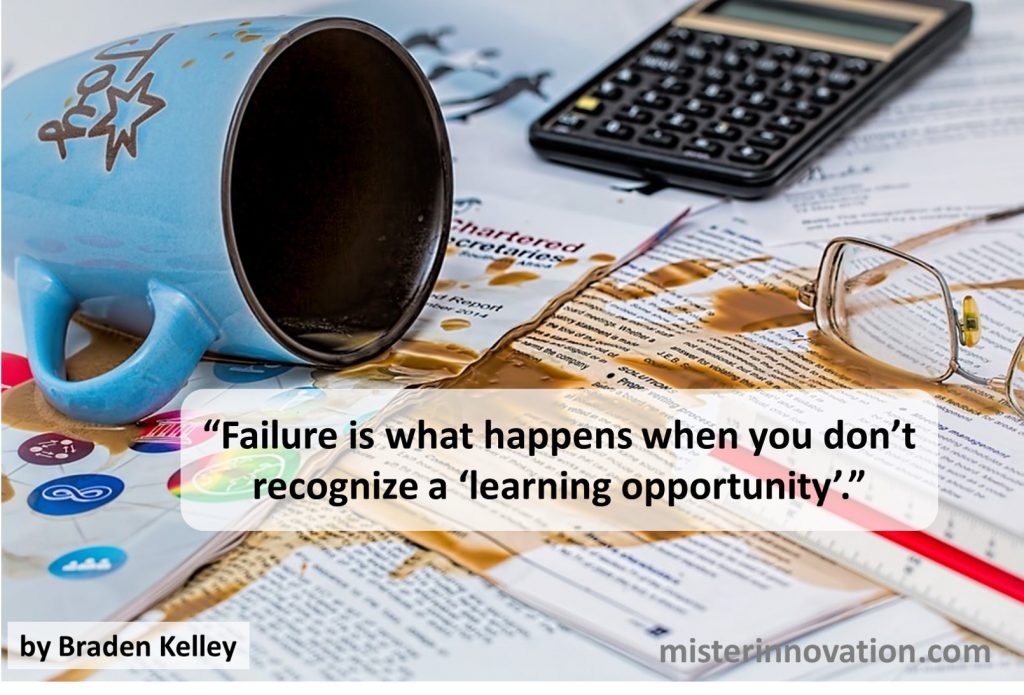
Image credit: 1 of 1,050+ FREE quote slides for meetings & presentations at http://misterinnovation.com
 Sign up here to join 17,000+ leaders getting Human-Centered Change & Innovation Weekly delivered to their inbox every week.