Beyond Recall: The Strategic Evolution of Human Digital Memory
LAST UPDATED: April 10, 2026 at 3:39 PM
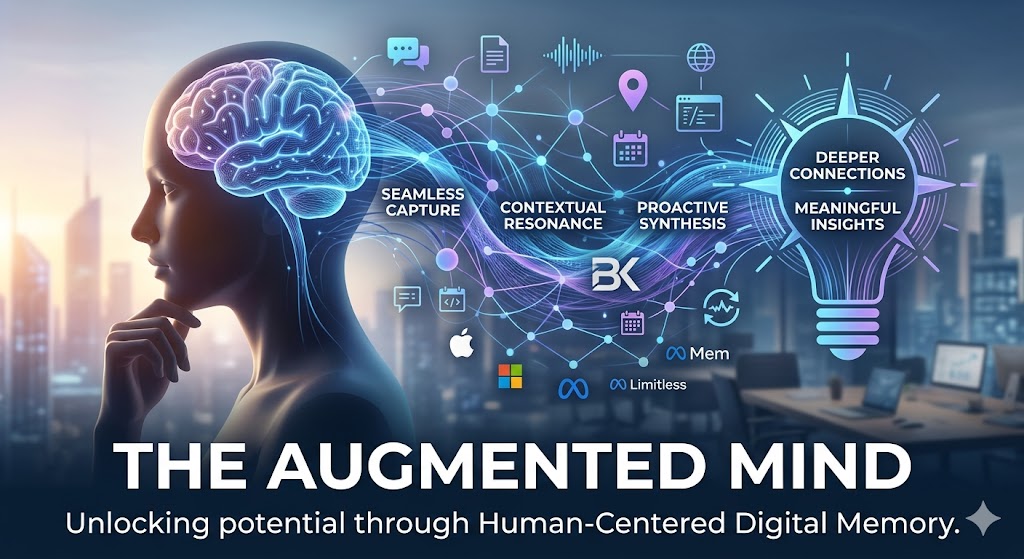
GUEST POST from Art Inteligencia
The Dawn of the Extended Mind
For decades, we have treated our digital devices as external filing cabinets — places where we “put” information to be retrieved later. However, as the volume of data we consume shifts from a manageable stream to an overwhelming deluge, the traditional boundaries of the human mind are being tested. We are now entering a profound transition from Information Management to Cognitive Partnership.
The “Cognitive Crisis” is no longer a future threat; it is our current reality. Traditional search functions and folder-based storage hierarchies are failing the modern knowledge worker because they rely on perfect recall of where a file was placed or exact matching of keywords. When our biological hardware reaches its limit, our productivity and creativity suffer.
Digital Memory Augmentation represents a fundamental shift. It moves us beyond simple backups and toward active, AI-driven cognitive extensions. This isn’t about replacing human thought with an algorithm; it is a human-centered design opportunity to create a digital scaffold for our intellect. By augmenting our memory, we free the brain from the mundane task of storage, allowing it to return to its highest and best use: imagination, synthesis, and meaningful connection.
The Three Pillars of Augmented Memory
To move beyond simple storage and into true augmentation, we must look at how digital systems interface with our lived experience. This evolution is built upon three foundational pillars that transform raw data into a functional extension of our intellect.
1. Seamless Capture
The greatest friction in traditional memory management is the act of “saving.” When we have to pause our flow to take a note, bookmark a page, or file a document, we break our cognitive momentum. Seamless Capture shifts the burden from the user to the environment. Through “digital exhaust” — the ambient collection of our meetings, readings, and interactions — augmentation systems ensure that the “sparks” of insight are never lost simply because we were too busy to write them down.
2. Contextual Resonance
A memory is useless if it exists in a vacuum. Traditional systems rely on folders or tags, which require us to remember how we categorized information in the past. Contextual Resonance uses semantic analysis to understand the “why” and “how” behind a piece of information. By linking a data point to a specific project, a person, or even an emotional state, the system mimics the associative nature of the human brain, making retrieval feel like a natural thought rather than a database query.
3. Proactive Synthesis
The ultimate goal of augmentation is to move from reactive searching to proactive assistance. Proactive Synthesis is the stage where the system acts as a true partner. Instead of waiting for a prompt, the “Second Brain” identifies patterns across years of data and surfaces relevant insights at the moment they are most useful. It creates “digital serendipity,” connecting a conversation you had this morning with a research paper you read three years ago, fueling innovation through automated cross-pollination.
Reimagining the Innovation Lifecycle
Innovation is rarely the result of a single “Eureka!” moment; it is a cumulative process of gathering sparks, connecting dots, and refining concepts over time. By integrating digital memory augmentation, we transform the innovation lifecycle from a fragile, hit-or-miss endeavor into a robust, high-velocity engine for growth.
1. The End of “Lost Ideas”
How many breakthrough concepts have been lost to the ether simply because they occurred in the shower, during a commute, or in the middle of a casual conversation? Memory augmentation ensures that the “sparks” — the messy, early-stage thoughts and sketches — are captured in real-time. By removing the friction of documentation, we preserve the raw materials of innovation before they can be overwritten by the next urgent task.
2. Cross-Pollination at Scale
The most powerful innovations often come from combining ideas from two completely unrelated fields. However, our biological memory is prone to “siloing” information by department or project. A digital memory layer can scan across decades of organizational history and disparate personal interests to find hidden links. It allows an engineer to see how a solution from a 2015 project might solve a 2026 problem, facilitating a level of cross-pollination that was previously impossible for a single human mind to manage.
3. Accelerating Mastery
In a world of hyper-specialization, the “time-to-expertise” is a major bottleneck for innovation. Memory augmentation acts as a cognitive scaffold, allowing individuals to rapidly navigate complex institutional knowledge and technical documentation. By having a “Second Brain” that remembers the technical nuances and past failures of a specific domain, innovators can stand on the shoulders of their own past experiences (and those of their predecessors) much faster, shifting their energy from learning the foundation to building the future.
Designing for Trust and Human Agency
As we integrate digital memory more deeply into our lives, the design challenge shifts from technical feasibility to ethical responsibility. If we are to treat a digital system as an extension of our own mind, that system must be designed with an uncompromising focus on the user’s autonomy, privacy, and long-term cognitive health.
1. The Privacy Imperative
For digital memory augmentation to be successful, the “Second Brain” must be a private sanctuary. Users will only record their raw thoughts, private conversations, and vulnerable moments if they have absolute certainty that their data is not being used for advertising or surveillance. Designing for trust means prioritizing on-device processing and end-to-end encryption — ensuring that the user remains the sole owner and curator of their digital history.
2. Combatting Cognitive Atrophy
A significant concern with augmentation is the risk of “cognitive laziness.” Just as GPS has weakened our innate sense of navigation, there is a risk that total recall tools could weaken our ability to focus or synthesize information independently. Human-centered design must focus on augmentation, not replacement. The goal is to build tools that act as a “cognitive bicycle” — strengthening our ability to connect ideas and think critically by offloading the low-value task of rote memorization.
3. The Ethics of Perfection
Human memory is naturally fallible; we forget, we forgive, and we move on. A world where every mistake, every awkward comment, and every outdated opinion is preserved with photographic clarity presents a psychological challenge. We must design systems that allow for the “right to be forgotten” and the ability to prune our digital archives. True augmentation should support the human capacity for growth and evolution, rather than chaining us to a static version of our past selves.
The Ecosystem: Titans and Trailblazers
The landscape of memory augmentation is currently a race between established tech giants integrating AI into our daily operating systems and agile startups building dedicated hardware for total recall. By 2026, the market has moved beyond experimental prototypes to functional, cross-platform tools that are reshaping how we interact with our own history.
1. Established Platforms
- Apple (Apple Intelligence): Apple has positioned itself as the “Privacy-First” memory partner. By leveraging on-device processing and Private Cloud Compute, iOS 26 and macOS Sequoia allow users to search for specific moments across photos, emails, and notes using natural language — creating “Memory Movies” and surfacing context-aware suggestions without ever exposing raw data to the cloud.
- Microsoft (Windows Recall & Copilot): Despite early privacy hurdles, Microsoft has refined “Recall” into a sophisticated enterprise tool. It creates a searchable photographic timeline of everything you’ve seen and done on your PC, allowing professionals to instantly jump back to a specific slide, website, or conversation from weeks prior.
- Meta (Ray-Ban Meta & AI): Meta is utilizing hardware to move memory augmentation into the physical world. Their smart glasses act as ambient “eyes and ears,” allowing users to ask, “Hey Meta, what was the name of that restaurant I walked past yesterday?” or “What did my colleague say about the project deadline?”
2. Disruptive Startups
- Limitless (The Pendant): Limitless has become the go-to for “Total Recall” hardware. Their wearable AI pendant records and transcribes in-person meetings and impromptu conversations, utilizing “Automatic Speaker Recognition” to create smart summaries and reminders that sync across all productivity suites.
- Mem.ai: Moving beyond traditional note-taking, Mem 2.0 has evolved into an “AI Thought Partner.” It eliminates the need for folders by using a self-organizing knowledge graph that automatically links new thoughts to past research, surfacing relevant context as you type.
- Heirloom (Heirloom.cloud): Focused on the bridge between analog and digital, Heirloom uses AI to digitize, contextualize, and narrate family histories and personal archives, ensuring that legacy memories remain searchable and meaningful for future generations.
- The Neural Frontier (Neuralink & Synchron): While still largely focused on clinical applications for motor and speech restoration, the successful 2025-2026 human trials for Brain-Computer Interfaces (BCIs) have laid the groundwork for future direct-to-brain memory retrieval and cognitive offloading.
Case Studies: Augmentation in the Real World
To move from the theoretical to the practical, we must look at how digital memory augmentation is already solving deep-seated organizational and individual challenges. These two case studies illustrate how extending our cognitive capacity directly translates into business value and human safety.
Case Study 1: Resolving the “Institutional Memory” Gap in Professional Services
The Challenge: A global management consulting firm was suffering from “reinventing the wheel.” With over 10,000 consultants globally, teams were frequently spending hundreds of hours on research and analysis that had already been performed by colleagues in different regions or years prior. Internal surveys showed that senior partners were spending 25% of their time simply trying to remember who had the specific “tribal knowledge” needed for a new pitch.
The Approach: The firm implemented a semantic memory layer that indexed all past white papers, anonymized project summaries, internal Slack discussions, and recorded client debriefs. Unlike a traditional database, this system used a “Second Brain” interface that allowed consultants to ask conversational questions like, “What were the specific regulatory hurdles we faced during the 2022 retail merger in Singapore?”
The Result: Within the first twelve months, the firm reported a 35% increase in project velocity and a significant reduction in duplicate research costs. More importantly, the ability to surface “deep-context” insights during client meetings led to a 15% higher win rate on new business pitches.
Case Study 2: Adaptive Learning and Safety in Complex Engineering
The Challenge: An aerospace manufacturing leader faced a massive demographic shift. As their most experienced engineers reached retirement age, they were struggling to transfer decades of “feel” and undocumented maintenance nuances to junior engineers working on legacy aircraft systems — some of which were designed 40 years ago.
The Approach: The company deployed a wearable AR-and-memory system. As a junior engineer looked at a specific engine component, the system utilized computer vision to recognize the part and instantly surfaced the “ambient memory” associated with it: past repair notes from retired masters, video snippets of successful fixes, and warnings about specific bolt-tension issues that weren’t in the official manual.
The Result: The facility saw a 50% reduction in error rates during complex maintenance cycles. The “time-to-expertise” for new hires was cut by four months, as their digital memory augmentation acted as an on-demand mentor, bridging the gap between theoretical training and institutional wisdom.
Conclusion: The Future of Being Human
We are standing at a pivotal crossroads in our evolution as a species. Digital memory augmentation is not merely a technological upgrade; it is a shift in the very nature of human cognition. As we move from a world of “Search” to a world of “Knowing,” we must be intentional about how we design these systems and what we choose to do with our newly reclaimed mental energy.
1. From “Search” to “Knowing”
When the friction of retrieval disappears, our relationship with knowledge changes. We no longer have to wonder if we know something; we simply have access to it. This transition allows us to shift our focus from the logistics of information management to the higher-level pursuit of empathy and understanding. When we are not struggling to remember the facts, we have more capacity to listen to the story, to understand the nuance, and to build deeper connections with those around us.
2. The Human-First Mandate
As a thought leader in human-centered innovation, my message is clear: Technology should never outpace our humanity. While we build smarter memories and more powerful cognitive scaffolds, we must ensure we don’t lose the “wisdom” that comes from human reflection, the growth that comes from our mistakes, and the beauty of our fallibility. Our goal should be to use digital memory to amplify our potential — not to automate our souls.
The future of being human is not about being “replaced” by silicon; it is about being empowered by it to reach new heights of creativity and compassion. Let us design for that future today.
Key Insight: Digital memory augmentation isn’t about building a better hard drive; it’s about building a better bridge between what we experience and what we can achieve.
Frequently Asked Questions
1. What is Digital Memory Augmentation?
It is the use of AI-driven tools and hardware to seamlessly capture, organize, and surface personal and professional information, acting as a “second brain” to extend human cognitive capacity.
2. How does memory augmentation impact privacy?
Privacy is the core pillar of these systems. Modern solutions prioritize on-device processing and end-to-end encryption to ensure that the user remains the sole owner of their digital history.
3. Does using a “Second Brain” lead to cognitive atrophy?
When designed correctly, these tools act as a “cognitive bicycle” — offloading the low-value task of rote memorization so the human brain can focus on higher-level creativity and complex problem-solving.
Disclaimer: This article speculates on the potential future applications of cutting-edge scientific research. While based on current scientific understanding, the practical realization of these concepts may vary in timeline and feasibility and are subject to ongoing research and development.
Image credits: ChatGPT
 Sign up here to get Human-Centered Change & Innovation Weekly delivered to your inbox every week.