The Agile Pipeline
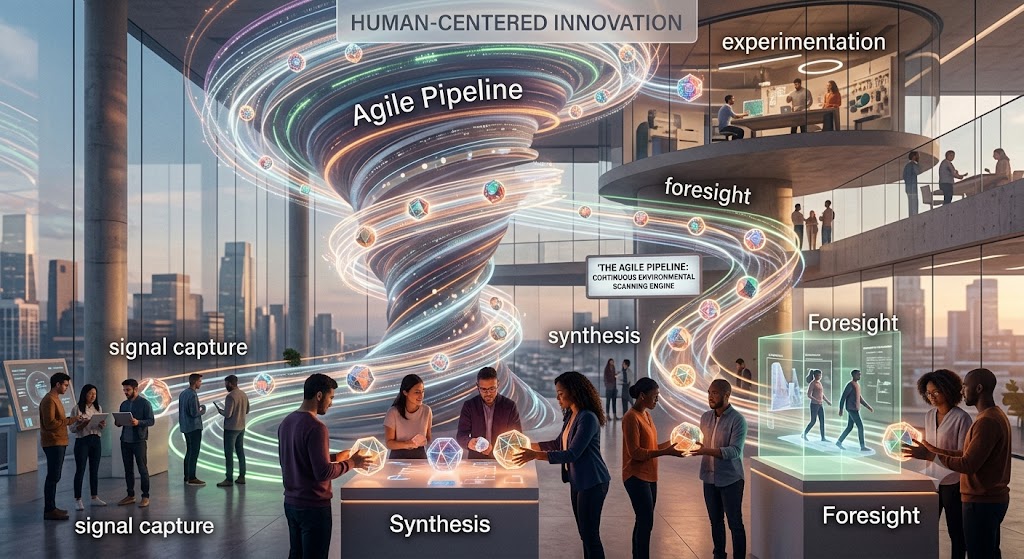
GUEST POST from Art Inteligencia
The Death of the Annual Scanning Cycle
For decades, enterprise strategy has been anchored to a comforting, predictable ritual: the annual strategic planning cycle. Once a year, organizations dust off their market research, commission a flurry of external reports, and run a SWOT analysis to map out the next twelve to thirty-six months. But in an era defined by exponential technological shifts, fluid customer expectations, and overlapping disruptions, this episodic approach is no longer just outdated—it is a distinct organizational liability.
The Velocity Trap: Why Static Plans Fail
When we treat foresight as a calendar event, we fall into the velocity trap. Disruptive signals do not wait for your annual planning retreat. They emerge quietly, compound quickly, and reshape industries overnight. Relying on point-in-time market scanning means you are navigating tomorrow’s challenges using yesterday’s rearview mirror. By the time an annual report is compiled, debated, and approved, the “future” it predicted has already arrived, evolved, and left the enterprise behind.
From “Project” to “Pipeline”: Shifting to Continuous Flow
To survive and thrive, organizations must transition from treating environmental scanning as a temporary, episodic project to building it as a permanent, dynamic pipeline. This means moving away from centralized, static reports and moving toward a continuous flow of decentralized intelligence. An agile pipeline doesn’t just passively gather data; it creates a structured, active conduit through which real-time observations from the edges of the organization flow seamlessly into strategic decision-making.
“True organizational agility is not just about moving fast; it is about sensing early, adapting continuously, and humanizing the way we anticipate change.”
The Core Thesis: Building a Sensing Organization
Ultimately, a continuous environmental scanning engine is less about technology and more about human-centered capability. It is about empowering your people to act as the enterprise’s sensory nervous system. The goal of The Agile Pipeline is to democratize foresight, giving every employee the tools and permission to identify weak signals, synthesize them collaboratively, and translate those insights into rapid, low-risk experiments. This is how we transform foresight from an elite executive exercise into an organic, everyday organizational habit.
Deconstructing the Agile Pipeline: A 4-Stage Architecture
To build an environmental scanning engine that is both sustainable and responsive, we must design a pipeline that mimics a natural flow. Information must be captured effortlessly, filtered intelligently, translated into clear scenarios, and funneled directly into action. This continuous loop prevents the two greatest failures of traditional corporate foresight: signal stagnation (where insights sit unused in slide decks) and execution isolation (where strategic planners remain completely disconnected from the product and development teams).
Stage 1: Signal Capture (The Intake)
The pipeline begins at the edges of the organization. True innovation and disruptive threats rarely start in the boardroom; they manifest as weak signals in support queues, sales conversations, and niche online communities.
Stage 1 focuses on continuous decentralization. Instead of relying on a tiny team of analysts, we empower every employee—especially those on the frontline—to act as a sensor. By utilizing lightweight digital intake tools, employees can log a “weak signal” in under sixty seconds. The goal is to lower the barrier to contribution, turning daily observations of unusual customer behaviors, emerging competitor features, or tech shifts into structured raw data.
Stage 2: Collaborative Synthesis (The Filter)
A flood of raw signals quickly leads to information overload. Without a strong filter, the pipeline clogs. Stage 2 is where we apply human-centered curation to separate the signals from the noise.
Rather than relying purely on automated keyword algorithms, we establish cross-functional curation teams. These teams meet regularly to review incoming signals, look for emerging clusters, and debate their implications. Through collaborative synthesis, the enterprise connects seemingly unrelated data points—such as a shift in supply chain friction combined with a minor change in customer sentiment—to discover a deeper, systemic trend before competitors do.
Stage 3: Foresight Modeling (The Translation)
A synthesized trend is useless if decision-makers cannot grasp its impact. Stage 3 is about translating abstract trends into human experiences. This is where futurology and experience design converge.
Instead of writing dry, text-heavy reports, we model the future. We create tangible, highly visual artifacts: speculative user journey maps, mock-ups of future products, or press releases written from the year 2030. By making these future scenarios feel concrete and interactive, we help leadership build empathy for the “future customer” and visualize how shifts in the ecosystem will impact our current business model.
Stage 4: Agile Experimentation (The Output)
The ultimate measure of an environmental scanning pipeline is not how many trends you predict, but how fast you respond to them. Stage 4 ensures the pipeline connects directly to the corporate execution backlog.
When a high-priority trend is identified, the enterprise doesn’t launch a three-year implementation plan. Instead, we initiate rapid, low-fidelity experiments. This could mean launching a simple landing page to test demand, running a small pilot with a subset of customers, or building a rapid technical prototype. By linking foresight directly to experimentation, we validate our assumptions early, fail cheaply, and scale our successes with high confidence.
The Human-Centered Engine: Overcoming the Scanning Bottlenecks
Even the most technologically advanced scanning platform will fail if the organization’s culture is not aligned to support it. The true power of an Agile Pipeline lies not in its software, but in its people. To turn an enterprise into a living, sensing organism, leaders must address three deep-seated human and organizational barriers: cultural inertia, signal fatigue, and the fear of speaking truth to power.
Overcoming Cultural Inertia: The “Not My Job” Dilemma
In most enterprises, employees are hyper-focused on their immediate, day-to-day operational metrics. Asking them to look up from their screens, scan the horizon, and log weak signals is often met with resistance or viewed as an unnecessary distraction. To overcome the “not my job” hurdle, we must design an employee experience (EX) that makes participation frictionless and intrinsically rewarding.
- Frictionless Capture: Integrate the signal intake directly into the tools your teams already live in (such as Slack, Teams, or CRM systems). If submitting a signal takes more than three clicks or sixty seconds, adoption will plummet.
- Micro-Incentives & Recognition: Celebrate “Signal Spotters of the Month” and publicly highlight when an employee’s logged signal directly influences a pilot project or a new product feature. Showing people that their input matters is the most powerful motivator.
- Curiosity as a Competency: Build environmental scanning into professional development paths and performance reviews. When curiosity and strategic foresight are recognized as core traits of a successful employee, the culture naturally shifts.
Combatting Information Overload: Mitigating Signal Fatigue
A common failure state of decentralized scanning is the sudden, overwhelming deluge of low-quality data. Executives and strategy teams are already drowning in emails, notifications, and reports; dumping hundreds of unstructured “trends” on their desks leads directly to cognitive overload and decision paralysis.
To mitigate signal fatigue, the pipeline must utilize structured filtering and routing mechanisms. Signals should be tagged, categorized, and scored by peer curators before they ever reach executive decision-makers. By focusing on actionable insights and high-potential threats rather than raw volume, we protect the leadership’s attention span and keep the pipeline’s outputs highly relevant and digestible.
The Foundation of Psychological Safety: Welcoming Uncomfortable Truths
Perhaps the most critical bottleneck in corporate scanning is the tendency to filter out bad news. Many corporate cultures actively discourage employees from sharing insights that challenge current strategic bets, point out emerging competitor strengths, or highlight internal vulnerabilities. Under these conditions, the scanning engine becomes a chamber that only validates existing executive biases.
“An organization cannot design an agile future if its people are afraid to point out when the present is crumbling.”
To counter this, leadership must actively cultivate psychological safety. They must demonstrate a genuine willingness to be wrong and reward individuals who bring “uncomfortable truths” to the table. When challenging the status quo is met with curiosity instead of defensiveness, the enterprise unlocks the true, unvarnished intelligence of its workforce.
Integrating with Existing Frameworks
An agile scanning pipeline cannot exist in a vacuum. If the insights generated by the pipeline remain isolated from your change management methodologies, strategic planning toolkits, and agile execution loops, the scanning engine will quickly be dismissed as an academic exercise. To truly drive enterprise agility, we must build explicit, functional bridges between continuous foresight and organizational execution.
Linking to Human-Centered Change Management
One of the biggest friction points in digital transformation and organizational change is resistance from the workforce. When change is handed down from on high as a sudden mandate, employees naturally push back. The Agile Pipeline transforms this dynamic by turning change management into a collaborative, participatory process.
By involving employees from across the organization in the scanning and synthesis phases, you are inviting them to co-create the case for change. When a frontline worker can see how a weak signal they logged six months ago has grown into a major market trend, they understand the why behind a strategic pivot. Co-creation builds natural alignment, significantly reducing change resistance and smoothing the transition to new operating models.
Synergy with Strategic Toolkits
Once a signal is validated and deemed highly disruptive, the enterprise needs a structured way to evaluate its impact and plan the response. This is where the scanning pipeline integrates with established strategic frameworks—specifically those designed to manage complex change, such as the toolkits in my book, Charting Change.
Using these tools, teams can systematically map scanned disruptions against internal organizational capabilities. This integration allows you to:
- Assess Readiness: Determine if the organization possesses the skills, culture, and infrastructure to pivot toward the emerging opportunity.
- Identify Barriers: Pinpoint exactly where structural bottlenecks, legacy systems, or conflicting incentives will slow down adaptation.
- Co-Design the Transition: Map out the human-centered change journey required to move the enterprise from its current state to the future state demanded by the market shift.
The Signal-to-Backlog Bridge
The final, and most critical, point of integration is with the enterprise’s software development and operational delivery teams. To make foresight actionable, the outputs of the scanning pipeline must speak the language of execution: the product backlog.
We achieve this by establishing a direct channel between the foresight curation team and product owners. High-priority trends and validated hypotheses from Stage 4 of the pipeline (Agile Experimentation) are translated directly into epics, user stories, and spikes within your agile management tools (such as Jira or ADO). By embedding future-proofing initiatives directly into the standard prioritization and sprint planning cycles, the organization ensures that long-term strategic adaptation is continually funded and executed alongside everyday operational maintenance.
The Competitive Moat of Perpetual Awareness
In a world characterized by relentless volatility and accelerating technological breakthrough, the traditional corporate planning cycle has become a relic. The true competitive moat of the modern enterprise is no longer its size, its historical brand equity, or even its current technology stack. Today, the ultimate differentiator is perpetual awareness—the collective, systemic capacity to sense, synthesize, and respond to change faster than the market shifts around you.
The Ultimate Agile Advantage: Speed to Learning
We often talk about organizational agility in terms of execution speed—how fast we can write code, ship features, or launch products. But execution speed is meaningless if you are running in the wrong direction. The Agile Pipeline shifts the focus to learning speed. By transforming environmental scanning from an elite, seasonal corporate exercise into an organic, everyday organizational habit, you build a continuous learning loop. You ensure that when the winds of disruption blow, your enterprise has already tested the waters, validated the assumptions, and prepared its people for the pivot.
A Call to Action: Build Your Engine Today
Building an agile scanning engine is not a technological challenge; it is a leadership commitment. It requires you to democratize foresight, dismantle the silos that trap insights at the edges, and actively cultivate the psychological safety needed to welcome uncomfortable truths. Do not wait for the next major market shock to scramble your strategy teams and commission emergency reports. Start building your pipeline now. Empower your people to look up, scan the horizon, and co-create the future of your enterprise—one signal at a time.
Frequently Asked Questions
How does an Agile Pipeline differ from traditional market research?
Traditional market research is typically episodic, project-based, and centralized, relying on seasonal reports to guide annual strategic plans. In contrast, the Agile Pipeline is a continuous, decentralized engine. It treats environmental scanning as a real-time flow of intelligence, empowering frontline employees to capture weak signals instantly and linking those insights directly to rapid, low-risk experiments rather than static executive slide decks.
How do we prevent employees from experiencing “signal fatigue” or information overload?
To avoid overwhelming decision-makers and contributors alike, the pipeline relies on a structured, cross-functional curation layer. Instead of dumping raw data directly onto leadership, signals are filtered, categorized, and scored by peer curation teams. This ensures only high-potential, validated, and highly actionable trends make it to the foresight modeling and executive planning stages.
What is the best way to bridge the gap between scanning trends and actual product execution?
The gap is bridged by translating validated scanning insights directly into the standard agile product backlog. High-priority trends and foresight hypotheses are broken down into epics, user stories, or technical spikes. By feeding these initiatives directly into the existing agile delivery cycle alongside daily operational tasks, future-proofing is continuously prioritized, funded, and executed.
Bottom line: Futurists are not fortune tellers. They use a formal approach to achieve their outcomes, but a methodology and tools like those in FutureHacking™ can empower anyone to be their own futurist.
Image credit: Pexels
 Sign up here to get Human-Centered Change & Innovation Weekly delivered to your inbox every week.