Author Archives: Paul Hobcraft

About Paul Hobcraft

Paul Hobcraft runs Agility Innovation, an advisory business that stimulates sound innovation practice, researches topics that relate to innovation for the future, as well as aligning innovation to organizations core capabilities. Follow @paul4innovating

Seeking out new knowledge that flows

GUEST POST from Paul Hobcraft

I have been heavily influenced by the great work of John Hagel and Deloitte’s “Big Shift Index” as a frame to measure the forces of long-term change. What really holds my attention is “knowledge flows” and they are suggesting we are moving from a world of push to a world of pull.

The world is increasingly uncertain and to steer through this we need new ways to access, attract and accumulate understanding.

Knowledge is highly intangible. Today it is less to do with the “stocks” of knowledge we have the ability to keep refreshing and that means increased participation in the relevant “flows” of knowledge. It is getting your “stocks and flows” right.

Knowledge is becoming even more of our competitive edge. It is making this incoming knowledge tacit, relevant to us and this comes increasingly from our connections into networks and who and what we want to search out and connect with.

Broad observations of Knowledge include:

  • Knowledge is intangible
  • Knowledge arises from information and thus from the interpretation of data
  • Knowledge has some, but not all, of the characteristics, we associate with capital
  • Knowledge can be instantiated in various ways
  • Knowledge derives value from its use in human activity
  • Knowledge cannot easily be aggregated
  • Knowledge evolves
  • Knowledge is created and exploited through networks
  • The distribution of knowledge is as important as its ‘quantity’

We need to treat knowledge as passing through hindsight, through foresight into insight. It is when you combine tacit knowledge where experience matters and it is in the new connections you advance your thinking.

John Hagel writes on his edgeperspectives posting site often some great insights and in one of his posts, he discussed “Defining the Big Shift” – measuring the forces of change.

Let me, here, summarize key aspects relating to knowledge, quoting John, and how it is shifting to flow.

From knowledge stocks to knowledge flows. We are moving from the world where the source of strategic advantage was in protecting and efficiently extracting value from a given set of knowledge stocks – what we know at any point-in-time.

From knowledge transfer to knowledge creation. The greatest economic value will come from finding ways to connecting relevant yet diverse people, both within the firm and outside it, to create new knowledge.

From explicit knowledge to tacit knowledge. Just at the time when more and more information is becoming available about more things, the most valuable knowledge is the knowledge that is in the early stages of emergence and this is generally the most difficult to express.

From transactions to relationships. The transactional mindset undermines the ability to build long-term, trust-based relationships and in the absence of those relationships it becomes almost impossible to effectively participate in the knowledge flows that matter the most.

From zero-sum to positive-sum mindsets. With a zero-sum mindset, your gain is my loss, we undermine building the long-term relationships. Yet if we adopt a positive sum mindset – through increasing collaborations we build trust relationships. This becomes a virtuous cycle that builds on itself.

From push programs to pull programs. Push tends to impose routines and predictability and is good at extracting ‘stock’, whereas scalable pull programs effectively access and attract resources that are attracted to support and improve performance to enable knowledge to flow.

From institutions driven by scalable efficiency to institutions driven by scalable peer learning.  Institutions often become the barriers to effective participation. in knowledge flows. Fostering scalable peer learning can create learning landscapes that encourage individuals to develop their talent in collective, sharing pools.

From stable environments to dynamic environments. We are moving from relatively stable business environments to ones of rapid change with ever more disruptions, uncertainty, and unpredictability. The management practices need to address these shifts that turn instability and uncertainty into opportunity and reactions.

Fusion, Flow, and Fluidity are needed in our management practices

We need to build the foundations of knowledge that builds stock but then allows it to flow and have a greater impact. We are in a world of constant learning, recognizing predictability is falling away constantly.

We need to focus on scalable learning, not scalable efficiency and that needs this shift from “stock” to “flow” to accelerate learning rather than focus on the narrow path of just simply expanding data known.

We need to go out to seek diverse flows of knowledge, from adjacent and even seemingly unrelated domains and constantly ask that age-old question “not knowing what it is you don’t know” and actively seek out knowledge flows that offer new understanding. Being open to a constant knowledge flow

Being open to a constant knowledge flow allows small ideas, concepts or seeds of value to be set in motion to bigger things that lead to greater innovation and personal growth.

Moving from stock to flow is absolutely essential in today’s world to keep exploring it and what it can and does offer, the path to the future.

Subscribe to Human-Centered Change & Innovation WeeklySign up here to get Human-Centered Change & Innovation Weekly delivered to your inbox every week.

The Value of Curated Platforms for Innovators

GUEST POST from Paul Hobcraft

I would like to lay out some thoughts on why we should be considering a curation platform for innovation and the value it can bring to a broader innovation community.

These are some opening thoughts that I felt needed to just “hang out there” and see where they take me and you as a reader.

The issue I am reflecting upon is our growing concern that we all are living in a world heading towards digital overload, with the risk of it simply overwhelming us, and becoming more isolated and detached within this.

We can’t simply rely on focusing around ‘all things’ digital, we need people to bring the insights and their experience together for the eventual innovation solutions. We need to provide curated platform for innovation, to make all the essential connections.

Learning is changing, are we absorbing or just simply gathering?

What can we do to solve this? Perhaps to offer a service on building a specific content platform. In this case around innovation. It has to be built on a more fluid, responsive and constant flow of knowledge. It cannot be static it has to be highly dynamic, it needs to relate to each of us specifically but be broad enough to cater for the wider community within innovation looking for innovation knowledge and understanding.

What are some of the principles we need?

Curation platforms for innovation of any type need is to reduce and define any “signal & noise”ratio effect. What exactly is needed to build one that helps us  learn more about our needs as innovators?

I am attempting to put some of my opening thoughts on the value and reasons to think about the role of an innovation curator, its place, and justification. So this piece is simply placing some “stakes in the ground” to build from, to give a ‘certain’ foundation to build upon. These are preliminary thoughts that I wanted to capture and revisit later but I thought I’d share some of my initial thoughts here. Here we go:

You need to anchor and establish clear coordinates into the innovation world

Keys have to be: know how to narrow the vision, construct the ‘appropriate’ content that is required (needs and related driven), understanding the differences in true value and screen out the noise factor and build up the sensing signal. Providing a clear access to a depth of knowledge and understanding of innovation and its make-up- building a true curating platform, managing across the total innovation environment, one that continues to build the more it attracts knowledge and contributions.

Managing innovation in its totality – Placing “trust” inside

So often the power lies in the story, knowing how to construct this and being a really active listener and responder needs curation. Like respected publications, you want to build the source that can be trusted, knowing there is quality, knowledge, and expertise in what is being offered and sitting ‘inside’ as the core processor, delivering the ‘power’ of innovation understanding in outcomes.

Building on themes, driving quality and engagement

The audience you would be expecting is one that both ‘requires and demands’. Pushing out general, generic articles has limited value, the ‘need’ is to have clear ‘content curation strategies’ that

a) drive traffic to build ongoing value for each person wanting to know

 b) provide growing scale and ‘broad’ connection and association so you build a growing body of networked understanding

c) establish opportunities to engage deeper with individuals, teams and organizations that can lead on to building greater innovation capability

d) that provoke discussion, exchanges, and engagement in vibrant communities, looking to engage, build and share

e) tell those ‘richer and relevant’ stores that make the relevant connection that comes from this story sharing building valuable narratives that can be ‘taken away’ and applied.

Moving from broadcast to human

The broadcasting effect is what is giving much of our present overload. We rapidly tune out to anything that we ‘sense through a ‘skim and move on’ approach that is not in our “lens of understanding”.  How do we build a community platform of trust? It needs to be more from human engagement to augment ‘machine learning’. Building a coaching, mentoring capacity, so that you can constantly be checking back on “knowing the difference between real (immediate) value, building up new value and nice to know and useful”. Feedback and engagement become essential, building and offering “plausible foresight”.

Robert Wolcott, Professor of Innovation, Kellogg School of Management at Northwestern University suggested we are moving towards a “sensory overload”. How can we discern differences that allow us to separate this flow of information into knowledge we need or can apply from its value.

We are known more and more by the ‘digital content we wear’

More and more our digital presence is becoming our clothing; it reflects (to others) what we stand for, it present ‘us’ to the world, what we stand for, value and care about. Social media enables us but it determines us. How we wrap this becomes our voice and this needs to project authentic and trusted positions. It should promote curiosity and try to be thought-provoking. Curating for this authentic position needs cutting through much of this “signal & noise” effect to ground our thinking in more informed ways

Contextual value and content management

Defining the quality of engagement, in voicing opinions needs a highly open listening stance. Any “going-in” may change as you learn what has real value, what engages, what “matters to me”.  Becoming a good listener allows for the potential to alter your views on what “sways you” in opinions, as they ‘seem’ reasonable, heard from others, grounded in a growing ‘body of evidence’ and application from ‘real’ experience.

How can we find more “time out” and provide more space to become more reflective?

It is through listening that this becomes a powerful source of change as you combine understanding and work together to make the change. There is a need for a constant searching and relevance building, giving ‘voice and evolving (relevant) stories’, constructing content that moves the searcher of knowledge towards ‘greater’ solutions. Encouraging a network of “being aware” where the value is in this growing network of relationships where we all are open to learning, others gain and we share in this.

Content management systems need purposeful design

Increasing curation tools make linking seem easy; you can drag and drop, search and find, to build content curation, you receive increasing ‘intelligence’ to what you need or are looking for. This works within social engagement, person to person if you allow it but it gets considerably harder for innovation specific issues, problems or knowledge transfer as more than often we are dealing with unique situations. We can learn from others, set specifically in their context so we can gain better understanding but it can’t be simply lifted up and placed into our situation.

The building of personal knowledge is relating to others experiences.

The more we build personal knowledge, through experience and experimentation we can build on that sense of passion, experience, reputation and “pulling out the headlines” that provoke, bundle and encourage participation and reactions. We move into “seeing beyond” possibilities because we opened our thinking up.

So what makes up a good curator?

In summary, the best knowledge curator is both a distributor and a collector, so any curating platform needs to equally be set up to arrange and re-order to meet needs, to communicate a balanced opinion.

The curator should work to a consistent rhythm, can operate equally as a filter and funnel, has that ability to magnify at the right time and is seen as capable of being well plugged in, possessing a deep broad knowledge about the subject of innovation.

Today we need far more curators within our lives, to assist us and help shape our thinking in new and exciting ways – and get on with innovating in better informed ways than the past.

image credit: event2mobile.com

Subscribe to Human-Centered Change & Innovation WeeklySign up here to get Human-Centered Change & Innovation Weekly delivered to your inbox every week.

Personal Learning Pathways

GUEST POST from Paul Hobcraft

My mind has been swirling around the significant changes taking place around learning. Not just in the time we have available, suggested recently as 25 minutes per week to stop and learn but in the variety of ways we can learn. Clearly, many of these are digital to construct, so as to apply the more modern design process that works for each of us individually, at our time of need.

I have been struck by the emphasis on personal learning and development. We still get very caught up in the need for scale yet it is the ability and flexibility to design these to our individual pathway that becomes “the order of the day”. The constant struggle is for each of us in simply stopping to focus, finding the time and the last thing you can afford to do, is take an ad-hoc approach to this, it needs a structured design.

Just as an Idea for you? This is where external facilitation might help

As we work through our own learning pathways, it does imply knowing where you are heading or required to head and sometimes that may not be so clear, it needs to be shaped and informed. This needs to have a reasonable understanding of the existing ‘inventory’ of knowledge, experience, learning style preferred and engagement considerations, then it needs setting up in tracking, categorizing and organizing yourself, establishing the methods of knowledge delivery.

This how it is ‘pulled together,’ becomes the crucial part, in its individual parts to mesh into the final ‘whole’ needed. Much of this needs some level of facilitation, some constant conversations, and interactions so all the necessary dots can get connected in a more blended learning environment.

We need to access those who have deep understanding, who can help you think in small chunks of learning, ones who can help move you from the old ‘event’ mentality into this consistency in learning journey, can blend different learning approaches, encourage application and recognize it is not a ‘one size fit all’ world but learning is personal and needs to be authentic and relevant to personal needs. To speed all of these up it needs to be far more collaborative, sharing, discussional opportunities and full of many ‘recognition/ validation’ moments.

Our learning today is moving into two distinct parts.

These are increasingly split into two – the moment of need where you want a quick read, a refresh or enough to take you through that moment to carry you along in understanding and experience gaining, these are called our “micro-learning” points where we quickly consume a post, article or how to go about this. Then we have a lasting need to deepen our knowledge, a dedicated space to truly learn a whole new domain of knowledge that we need to bring into our learning pathway. These are called “macro-learning” needs.

Our past ways of learning, more through formal instruction is just not up to the task today. We are in environments that we all are time-starved, digitally bombarded, socially drowning in as a sea of needed to give our attention immediately and respond. Yet we are still expected to stay fully tuned into our connected world, so as to understand what is rapidly changing in our “breaking world,” one of always being aware to capitalize or respond to it. It is increasingly intensive and challenging. We need to adapt quicker than ever, be more agile and responsive and we require our learning events to reflect this as well.

So working in the innovation space is no different.

We have those “moments of innovating need” and those needs to build rapidly but deeply those “domains of new innovation knowledge

This requires the evolving power of learning platforms and clear guides to assist your individual learning pathway of innovation understanding need.  It does need this set of conversations and interactions. One’s that seeks out what needs to connect and evolve, to accelerate personal performance and contribute to the ‘needs’ of the challenge, growth or task at hand.

Our increasing connectivity, interactivity, and sharing are bringing about a fundamental change in all of what we do.

These shifts need accelerating our learning pathways but in very different ways than how we were taught in the past. I am busy attempting to connect my deep innovation domain content with my “blended” experiences in working in this space for over sixteen years, investigating, researching, applying and consulting on innovation solutions and currently seeking different ways to apply these through coaching, mentoring, facilitating and advising on innovation understanding, at the personal and team level and that needs to be increasingly digital and “bite (and byte) sized”

Subscribe to Human-Centered Change & Innovation WeeklySign up here to get Human-Centered Change & Innovation Weekly delivered to your inbox every week.
The Value in Personal Innovation Learning Journeys

GUEST POST from Paul Hobcraft

If you don’t have time, how can you learn? We are in need increasingly, of faster understanding, to quickly learn or resolve an immediate need, or we have this determination or essential requirement within our innovation role to deepen our knowledge and understanding of innovation. These are usually split into two parts, called are “micro or macro learning opportunities”.

Have you ever given a thought to the value of having an innovation guide, mentor or coach helps you accelerate through both these needs and learning opportunities. I see four points of value, my value proposition, if you like, for you to achieve personal innovation growth:

  1. Gaining knowledge gives you growth, impact and return. Others seek you out to understand
  2. Translating knowledge into value deepens your value, increases your worth and gaining respect
  3. If you are able to put the coordinates into your innovation world you have a clear compass to proceed
  4. The External Innovation Catalyst prompts your thinking, accelerates your understanding and guides you on this personal learning journey of innovation understanding.

The key aspects of working with an expert in innovation are numerous. Let me provide a few:

  • That person can provide you an objective view
  • They introduce a fresh perspective, they shift your thinking forward
  • They can help bring concepts to life
  • They can solve potential gaps in your thinking or knowledge understanding
  • They become your personal advisor to work with as you go.
  • They can offer validation points along your journey
  • As external providers, they can spot and even amplify the trends for your learning curve
  • They offer a different ‘angle’ on your challenges and objectives
  • They can map parts of the innovation puzzle to the whole.
  • They can simply show the way or point you in ‘given’ directions
  • They can advocate, guide and inform on a variety of innovation needs and your questions
  • Gives navigation and feedback
  • They are independent and can be detached from internal barriers to help “bunker bust” and accelerate innovation awareness

Irrespective on how you see and value an external innovation expert who can guide, advise and mentor they can take you through three steps

  1. Help you discover and explore relevant innovation approaches
  2. Enable you to generate and convert innovation understanding faster
  3. They can exploit and leverage a ‘collective’ knowledge and wisdom built up over time and experience.

There is a real need to accelerate innovation understanding. The best person to deliver the innovation message is the one that is well equipped to see its value, purpose, and potential to transform “where you are” into “where you could possibly be” through the pursuit of an innovation growth strategy.

It is all about the translation points in innovation guidance and finding the time to engage with the external catalyst of innovation understanding. It can potentially offer an exponential return to you, your team and your organization’s innovation activity if you have the desire to build your innovation capabilities.

Subscribe to Human-Centered Change & Innovation WeeklySign up here to get Human-Centered Change & Innovation Weekly delivered to your inbox every week.

Asset Orchestration: New Game or not?

GUEST POST from Paul Hobcraft

Asset heavy vs. asset light

Recently I was discussing ecosystems and platforms, and speaking about the differences between Amazon and Alibaba. I quote “I’d say Amazon are “asset heavy” whereas Alibaba remains “asset light”.

They might be operating at the two ends of the current internet trading spectrum and are coming from different market maturity positions but it is the asset management that is becoming critical for delivering the profit or dragging performance.

Now Amazon is far from “asset heavy” when you compare them to the Industrial companies like GE but asset orchestration is seemingly getting far greater management time for all companies it seems. The lighter you are, the more likely you are to be more flexible and adaptive to respond to more disruptive challenges being faced by industries that are undergoing the shift to being more “digitally enabled”. Alibaba is very much a good asset orchestrator.

I wrote a post some time back called Asset Orchestration is required for more Dynamic Innovation and offered a thought (or two) such as “you must orchestrate the capabilities, to purposefully build what is needed to deliver the final result”. At the time I had been reading some work undertaken to frame this asset orchestration by Sirmon et al during 2007 and 2008 that focused on the different actions of the manager, or asset orchestrator.

In this research they (Sirmon et al) suggest there are three primary stages of structuring, bundling and leveraging resources for the purpose of creating new value for customers and gaining competitive advantages, however temporary in today’s world. It is why this needs to be dynamic, ever-evolving, to keep orchestrating your assets continually and it was not until recently I made a further set of connections into asset orchestration. Let me repeat these as they are increasingly important in the world of platforms and ecosystems.

Let me repeat these as they are increasingly important in the world of platforms and ecosystems.

The three primary stages of asset orchestration can be broken down:

  • Structuring involves acquiring, accumulating and divesting resources to form the organization’s resource portfolio.
  • Bundling of integrating resources to form capabilities, that can stabilize or provide incremental improvements to existing capabilities, or that enrich and extend existing current capabilities and thirdly, pioneer, which creates new capabilities.
  • Leveraging involves a sequence of processes to exploit the organization’s capabilities to take advantage of specific market opportunities. This includes mobilizing, offering a clear plan or vision of needed capabilities, coordinating for ways to integrate these necessary capabilities and finally, deploying to achieve a resource advantage (or gain) that promotes market opportunities and instills more entrepreneurial strategies to exploit new resource configurations

A new moment of recognition for me was tucked away in my past research

The catalyst for my recent lightbulb moment  was a thesis written by Javier Busquets, while at the Copenhagen Business School. His paper was Orchestrating Network Behavior for Innovation, written in 2010 but becoming increasingly relevant to today’s world of managing assets more lightly.

We are seeing a change taking place in the building of networks and the way organizations are forming coalitions through ecosystems and platforms and in combining new technologies and blending business fields. Again I think Alibaba is doing a really good job of that. They are deliberate orchestrators. They are agenda setting, mobilizing, consolidating and coordinating different points of emerging value.

Within the thesis of Javier Busquets, he evaluates much of the published literature that ties up with dynamic capabilities, the network effect and capacity building and the constant way these orchestrators keep extracting more value from the network, that continues to expand.

One highly relevant observation

One comment he made was “orchestrating is a function of (1) changing the rules of the game to keep the game alive and (2) avoiding disruptions, thus ensuring continuity through the connection between the old and the new, or between past behavior patterns and the present and future ones.”  It is balancing the different forces coming into play increasingly in a world of ecosystems and platforms of leveraging external resources and keeping them highly dynamic.

Shaping new boundaries

So is asset orchestration becoming increasingly critical in the age of ecosystems, platforms and managing technology and data? As we build our understanding of the power of this connectivity we are constantly changing the rules. As Javier Bousquet suggests, it is about “shaping new boundaries“, ones of opening up new space, opportunities and sources of innovation, to build new platforms for discovery and collaboration potential and build new, differentiating capabilities to innovate.

Combining views- the three horizons and modes of commitment to innovation

One visual got me excited. It just fitted with my extended view of how the three horizons can be taken out and extended further. In adapting his original diagram I have added this 3H view.

It takes the 3H framework into the very need of today, developing the thinking of each of the three horizons to work towards our transformation from the solo organization offering (disconnected) products and services into ones that connect technology by platform participation and ecosystem exploration for greater innovation. Here is my adapted visual and opens up my thinking even further.

where-3h-fits-for-ecosystems-and-platforms
In summary

So I do feel asset orchestration is rapidly becoming a critical management need to manage effectively. It is recognizing its potential in managing the asset dynamics to deliver innovation that stays ahead of the curve as we expand out and collaborate on a range of platforms and ecosystem engagements to navigate towards a different future.

Subscribe to Human-Centered Change & Innovation WeeklySign up here to get Human-Centered Change & Innovation Weekly delivered to your inbox every week.

Innovation’s Degrees of Connectivity, Interactivity and Sharing

GUEST POST from Paul Hobcraft

We often forget it is our people that really make innovation work. They determine the ideas, drive these forward to deliver them as new innovation concepts into the world. People connect the fragmented pieces or dots within innovation from being random and intangible, into being explicit and tangible.

In the past we have often believed it is the genius laboring away in his lab that has made the discovery that has led to real breakthroughs in innovation.

So often in the past this lack of making the invention connection has often held many of us back to become engaged in discovery, ideas or contributions as we felt discouraged, as we had felt innovation can only happen in these ‘special’ places.

Many of us became disconnected with the early part of the discovery for innovation, we simply became just the implementors, pushing the innovation through the pipeline into its final execution. That can change if we are willing and able to challenge our past assumptions.

In many ways we have still not fully broken with this ‘mindset’ on innovation of being someone else’s need to identify and discover those new ways, new designs and solutions. Thankfully though that has been changing, as increasingly the message has been delivered that “innovation is all within our jobs, irrespective of what we do”

It has been the opening up of organization thinking through technology that has allowed for this innovation to flow, to be captured, absorbed, translated and delivered back out into the world. It is from this multiple and diverse difference of innovation understanding that can freely flow ideas and concepts that can evolve into new innovations that deliver better value than what was offered in the past.

We need to find this “sweet spot” for encouraging more innovation

We live in a world where we are having greater connectivity than ever before. We are increasingly engaged in far greater interactivity with the easy and access to the social and organizational tools than ever before. We are encouraged to share what we know increasingly so others can built on this, or shape its original concept into a different value proposition simply by having that triggering idea and seeing the ‘possibilities’ to build upon it.

Do we have a new innovation equation to explore and exploit more?

It is the degree of connectivity times the degree of interactivity times the degree of sharing, that is within our growing community that enables the innovation to emerge.

We need to find the spaces to innovate. Where else in today’s more open world where technology allows us all higher degree’s of freedom, discovery and ability to make the innovation space a vibrant one. One where it is the collaborating we undertake, that leads us to breaking out of the existing, changing the known, investigating the unknown by the ‘degree’s of our willingness to explore and exploit all that is around us, if we only reach out and be open to new levels of thinking.

Subscribe to Human-Centered Change & Innovation WeeklySign up here to get Human-Centered Change & Innovation Weekly delivered to your inbox every week.
Why Agile Learners are Ideal for Innovation

GUEST POST from Paul Hobcraft

Agility holds a special interest for me. I named my consulting business Agility Innovation Specialists and constantly am looking to emphasize that agility is really important to managing innovation.

I came across an article written a few years back by the Korn Ferry Institute and I thought it was worth extracting the top line thoughts as important in my advocacy of innovation.

If you want to read more from their report here is the link.

My takeaways from this:

“Learning agility is a reliable indicator of potential for leadership roles. Why? Learning agile individuals excel at absorbing information from their experiences and then extrapolating from those to navigate unfamiliar situations. They are often described as flexible, resourceful, adaptable, and thoughtful—in short, an ideal fit for mission-critical roles”

For this report they analyzed looking at scores on the four factors of learning agility: Mental Agility, People Agility, Change Agility, and Results from Agility and came up with a finding that seven distinct profiles described approximately two-thirds of the high learning agility people.

Learning agility: Knowing what to do when you don’t know what to do” – sounds so right for innovation.

“Learning agility is the ability and willingness to learn from experience and then apply that learning to perform successfully in new situations”

People who are learning agile:

  • Seek out experiences to learn from.
  • Enjoy complex problems and challenges associated with new experiences.
  • Get more out of those experiences because they have an interest in making sense of them.
  • Perform better because they incorporate new skills into their repertoire.

A person who is learning agile has more lessons, more tools, and more solutions to draw on when faced with new business challenges.

Achieving to instill these from my innovation capability work, coaching and mentoring would be ideal, it is a way to seek out and learn innovation. Agile learners are potentially ideal for what is needed to manage innovation.

In their introduction I would like to go back to this, as it really sums up the agile person:

“Learning agile individuals excel at absorbing information from their experiences and then extrapolating from those to navigate unfamiliar situations. They are often described as flexible, resourceful, adaptable, and thoughtful—in short, an ideal fit for mission-critical roles.

For me, innovation is a mission-critical role.

Many organizations regretfully don’t recognize this enough but part of my mission is to raise innovation awareness and its ability to transform, to extend, to grow individuals, teams, and organizations. Becoming innovative offers that greater potential to be sustainable in what you do as you constantly look to evolve and learn.

I wish more would see the importance of having agility within innovation but actually learn to practice it, not just talk about it or think it lies elsewhere in the organization. Agility is required in you!

SubscribeSign up here to join 17,000+ leaders getting Human-Centered Change & Innovation Weekly delivered to their inbox every week.

An Innovation Coaching Methodology

GUEST POST from Paul Hobcraft

Coaching offers real benefits. For instance, in Leadership Coaching, the results offer an ROI on the initial investment of nearly SIX times on average. Can you imagine this “X” return factor going through the roof, going way beyond the initial investment if the innovation outcomes ‘take off’ and delivers the level of growth across the organization’s business, partly gained from a greater awareness of innovation and how to apply these different levers within its application?

It often puzzles me the lack of investment we make in coaching, mentoring, or even facilitating around innovation, it simply is not enough with the use of an external innovation expert accelerating the process, stimulating the thinking and learning. That should change and this is one of my personal goals to contribute to this intent so let me offer up a way to approach this.

Let’s look at an innovation coaching methodology

Are you aware, or need to be, we all pass through 4 distinct stages when it comes to learning and being coached?

Unconscious Incompetence – which is the Self-reflection stage (something often missing in our rush to keep moving)

Conscious Incompetence – where you Gain insights with tested tools & techniques (the art of constant testing)

Conscious Competence – we explore Alternative approaches matching to individual’s circumstances and need (gaining identification and buy-in)

Unconscious Competence– gaining the necessary (automatic) Responses for Impact, Behavior change patterns and Results (applying what we have learned as part of our makeup)

Coaching innovation is no different

All new learning needs structure and innovation is no different. The critical recognition is it can be often highly specific to the innovation challenges as well as to the individuals or the team’s needs, appetite and conditions to learn. Those that want to develop stronger innovation competencies and capabilities needs underlying support from their management, it needs to be embedded in the organizations need to innovate.

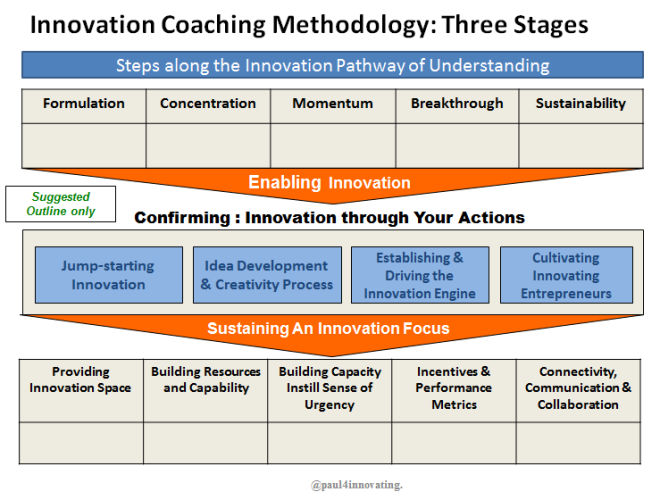
Here I outline a structure that takes a path for innovation change as a triggering point for future discussions or building:

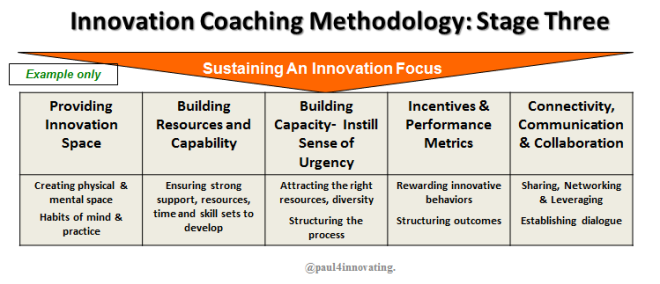
If we break down these stages with a set of examples on what makes up the stages, it could look like this:

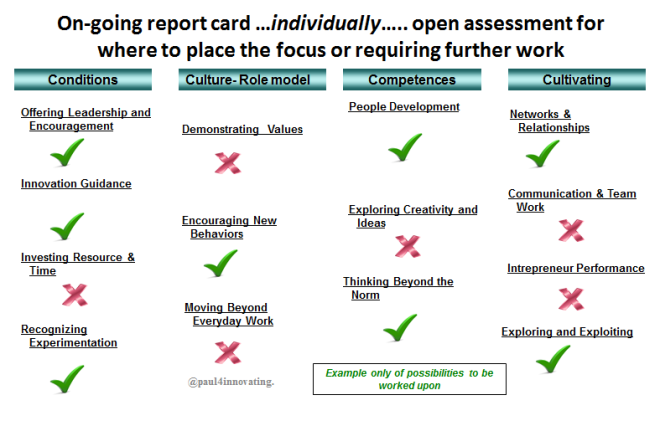
You would look to evaluate progress in each of these but by drawing up a ‘dynamic’ evolving on-going report card you can quickly pick up on what is having an impact and what still needs that work-to-be-done.

This always needs adapting to each organization on what needs building, as well as to each specific individual or structuring the team needs, as each has very clear and specific innovation challenges, constraints and context. The aim is to achieve change; to relate, to learn, to explore and exploit what is (highly) relevant to them as well as within the whole innovation management process. It takes dedicated focus and time but if appled in the real-world of innovating becomes their learing and discovery journey.

Coaching innovation does accelerate the potential within us; it informs and provides a new set of perspectives, it allows individuals and teams charged with innovation, to adopt a more ‘holistic’ view through this engagement with an external innovation expert.

Imagine the return on your innovation coaching investment when you deploy what you learned into those innovation outcomes that grow your organization’s business exponentially on this investment.

image credit: bigstockphoto.com

Subscribe to Human-Centered Change & Innovation WeeklySign up here to get Human-Centered Change & Innovation Weekly delivered to your inbox every week.
Do You Know Your Distinct Innovation Capabilities?

GUEST POST from Paul Hobcraft

Do you know where your distinct innovation capabilities come from?

Just begin to work through these ‘thoughts’ to begin to evaluate the value of knowing your innovation fitness so as to find out what makes up your distinct dynamic capabilities:

  • By firstly mapping out your innovation capabilities to the task at hand enables you to understand and relate to what is needed – we call that the context for innovation.
  • Innovation Fitness Landscapes helps in this task by identifying the opportunity spaces on where you need to focus your efforts‐ and apply the appropriate resources to navigate the terrain or challenges you are facing.
  • The greater understanding of the ‘fitness points needed’ can transform your innovation landscape potential, or in business parlance, achieve your goal.
  • Achieving this fitness accelerates your opportunities into final tangible outcomes. Here is a little bit of the theory:  you look for those critical factors that will give higher value potential or ‘peaks’ that are more valuable to your needs.
  • The more ‘rugged’ the landscape, the tougher the innovation challenge, can also determines the greater fitness for the rate of innovation needed.
  • The height of the peaks in these landscapes, the greater value placed upon them, illustrates how intense the innovation challenge is, and the number of critical peaks shows how diverse its potentially is to then provide the appropriate resources.
  • The ability to identifying the emerging patterns provides the need to act and invest, making adaptive even exploratory walks to provide the appropriate resources needed.
  • Understanding these will enable you  to move you to the higher fitness points where innovation viability isenhanced and needed to be so as to resolve the challenges faced.
  • You need to experiment, to take these exploratory ‘walk’s to realize the potential and learn how to scale accordingly.

All I’m doing here is prompting you to ask questions. We can discuss ways to tackle and resolve the questions this can arise and apply solutions to build your distinct innovation capabilities to offer you a more sustaining innovation future.

image credit: bigstockphoto.com

Subscribe to Human-Centered Change & Innovation WeeklySign up here to get Human-Centered Change & Innovation Weekly delivered to your inbox every week.

9 Stages for Building Innovation Fitness

GUEST POST from Paul Hobcraft

Achieving innovation fitness is a journey- to get there we often have to manage the switchbacks as we build our capabilities and capacities to innovate.

  1. Getting Started – Understanding the Needs & Imperatives of Innovation Fitness
  • Why we must travel this critical path for Innovation.
  • The meaning of dynamic capabilities and innovation fitness landscapes
  • Merging  the theory with practical reality to produce new outcomes and positive results.
  • Focusing on resources and performance – why is this important
  • The problem is knowing what we have and what we really need
  1. The Fuel of Innovation Performance – the dynamics of innovation
  • A sharper, clearer focus on innovation resources to meet strategic need
  • What is known about resources to sustain, enhance performance
  • Knowing and aligning  your strategic criteria – for sound innovation approaches
  • Getting innovation within the right context of your business
  • Moving your resources in the right direction
  1. Getting even more specific – quantification and qualification
  • Recognizing the building of scale, change rates and dynamics that happen over time and why we need to constantly build our innovation capabilities.
  • Developing the resources to meet the need – structured, focused, clarified by bringing out the necessary discussion.
  • An illustrative scenario for a directional innovation fitness landscape map
  • Recognizing resources can come beyond the firm and bringing these in successfully. Managing within a more open environment.
  • Achieving  mutual dependencies to support; recognizing the hindering ones
  • Being aware of  the impact of different scenarios in the management of innovation
  1. Building the Innovation Fitness Machine – reinforcing feedback, identifying needs
  • Recognizing the current status, spotting emerging patterns, seeing spaces and gaps and identifying solutions.
  • Beginning the ‘adaptive walk’ to get to higher fitness points needed to compete.
  • Clarifying the complementary resources, looking to embed new routines quickly and set up follow through approaches.
  • Introducing natural tensions into the system to trigger ‘step change’
  • Resource dependence climate, culture, diversity, intensity and uniqueness
  • Reinforcing feedback – watching for dangers, managing the machine capacity, removing the brakes selectively
  • Shifting your resources need not deplete or force other people to compete for them – working through the tensions within teams and silos.
  • Matching resource dynamics with the innovation value chain & life cycle stages
  • Simulation modelling the ‘what ifs’ and ‘why’
  1. The Strategic Architecture – designing the system to perform as needed
  • The step process for designing and executing the architecture design
  • Diagnosing performance challenges and road blocks – resolving, moving on
  • Lining up the solutions is not a linear process and needs careful management
  • Addressing the effects of intangibles in the Strategic Architecture.
  1. The Hard Face of Soft(er) factors – the hidden power of intangible resources
  • Clarifying the impact of the intangibles and recognizing time, climate and conditions are significant contributors to innovation activities.
  • The different rivalry types: internal and external, inter department, inter projects and working through resolutions to these.
  • Reflecting feelings and expectations, addressing all the different needs
  • Measuring the tougher parts of intellectual capital
  • The real value of your intangible resources
  • Recognizing the value of hidden innovation and spotting its occurrence
  1. Entering into Competitive Battle – the Dynamics of Rivalry, the Uniqueness of You
  • Recognizing, developing, capturing, transforming, avoiding and out – manoeuvring
  • Your point of choosing what, where, how and when to compete.
  • Building capabilities that are unique to you and hard to replicate
  • Building sustainability into the innovation equation as ongoing
  • Extending the turf, exploiting the situation, pushing beyond, seeking partners.
  1. Building and Testing Capabilities to Perform
  • Measuring capabilities through different fitness levels and scale.
  • Learning to build capabilities as ‘ongoing’ and evolving for changing needs
  • Re-Structuring the process for dealing with the dynamics of change
  • Knowing the points of impact on performance to enable recognition and reality
  • Managing innovation performance progressively across the spectrum of business need through testing and extending capability learning.
  • Building from personal to team to organizational learning in measured steps
  • Recognizing the role of leadership, achieving strategic alignment and working on broadening out innovation competence at different organizational levels.
  1. Keeping the innovation fitness wheels turning, keeping your eyes on the road
  • Resolution of conflicting goals, control and structure
  • Dissecting conflicting positions, resolving impasse
  • Knowing the limits of human engagement
  • Goals, controls and measurements can dominate and strangle
  • Keeping the measurements simple and clear
  • Managing innovation as a critical strategic resource
  • Merging the results into a greater alignment to Strategy and Approaches

The end result is looking to generate your fitness landscape

As you can see this is applying a very comprehensive approach, a fairly ‘intensive’ one.  This might alter individually after some clear piloting, learning and experimentation undertaken.  Building innovation capabilities takes time; they are complex, highly structured and multi-dimensional. Any structured approach to tackling innovation takes time and considerable commitment.

Subscribe to Human-Centered Change & Innovation WeeklySign up here to get Human-Centered Change & Innovation Weekly delivered to your inbox every week.