The Great Decoupling
LAST UPDATED: April 27, 2026 at 6:17 PM
GUEST POST from Art Inteligencia
The End of the “Cloud” Illusion
For over a decade, we have been captivated by the metaphor of the “Cloud” — a term that suggests something ethereal, weightless, and omnipresent. But as we navigate the complexities of 2026, the veneer is stripping away. We are realizing that the intelligence driving our civilization is not floating in the sky; it is anchored in massive, high-heat industrial complexes that represent the most concentrated physical assets in human history.
The Convergence of Geopolitical Risk
The shift from digital convenience to National Survival is being driven by a perfect storm. The insatiable energy hunger of agentic AI models has collided with a period of intense global instability. We can no longer view data centers as mere real estate or IT infrastructure. They have become the “high ground” of the modern era. If these cognitive nodes are compromised, the ripple effect doesn’t just crash an app — it destabilizes the national experience.
The Thesis: The Rise of the Fortress Data Center
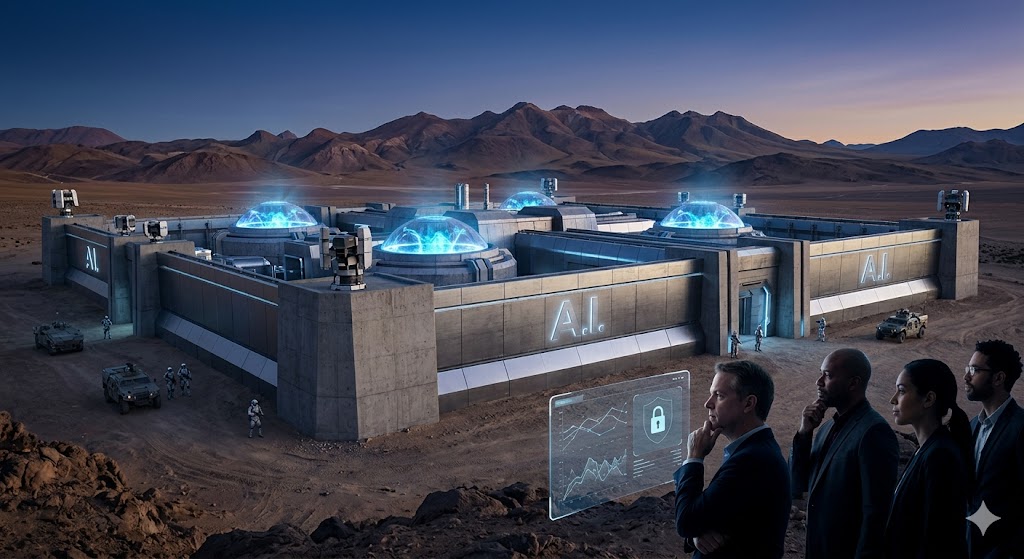
To ensure true national resilience, we must move beyond the “open campus” model of silicon valley. We are theorizing a future where AI data centers must evolve into self-contained, military-grade sovereign zones. These facilities will likely be:
- Locally Powered: Utilizing dedicated nuclear SMRs to decouple from the fragile civilian grid.
- Physically Fortified: Protected with the same kinetic rigor as a strategic missile silo.
- Logically Isolated: Air-gapped to ensure that the nation’s “Digital Brain” remains untainted by external interference.
The Energy Sovereignty Mandate
The era of the data center as a passive consumer of the public utility is coming to an end. As AI models scale, their appetite for electricity has transitioned from a manageable operational expense to a systemic threat to civilian infrastructure. To maintain social license and operational continuity, the “Fortress Data Center” must become an island of power.
The Fragility of the Public Handshake
For years, tech giants have relied on “handshake deals” with regional utilities, often receiving preferential access to the grid. However, the sheer scale of 2026’s compute requirements has pushed these grids to a breaking point. When a single training run consumes enough energy to power a mid-sized city, the risk of “energy poverty” for the average citizen becomes a human-centered design crisis. Sovereignty requires that we stop competing with the public for the same electrons.
The Nuclear Option: Microgrids and SMRs
The transition toward Small Modular Reactors (SMRs) is no longer a “futurologist’s dream” — it is a mechanical necessity. By embedding nuclear or advanced geothermal power directly into the facility’s footprint, we create an isolated power source that is:
- Resilient: Immune to regional grid failures, cyber-attacks on public utilities, or physical sabotage of long-distance transmission lines.
- Scalable: Power generation that grows in lockstep with compute capacity, without requiring decade-long public infrastructure projects.
- Sustainable: Providing the high-density, carbon-free baseload power required for 24/7 AI operations.
The Design Principle: We must decouple the “National Brain” (the AI) from the “National Body” (the civilian grid) to ensure that the pursuit of innovation never compromises the basic human need for heat, light, and stability.
Signal 2: The Data Center as a Kinetic Target
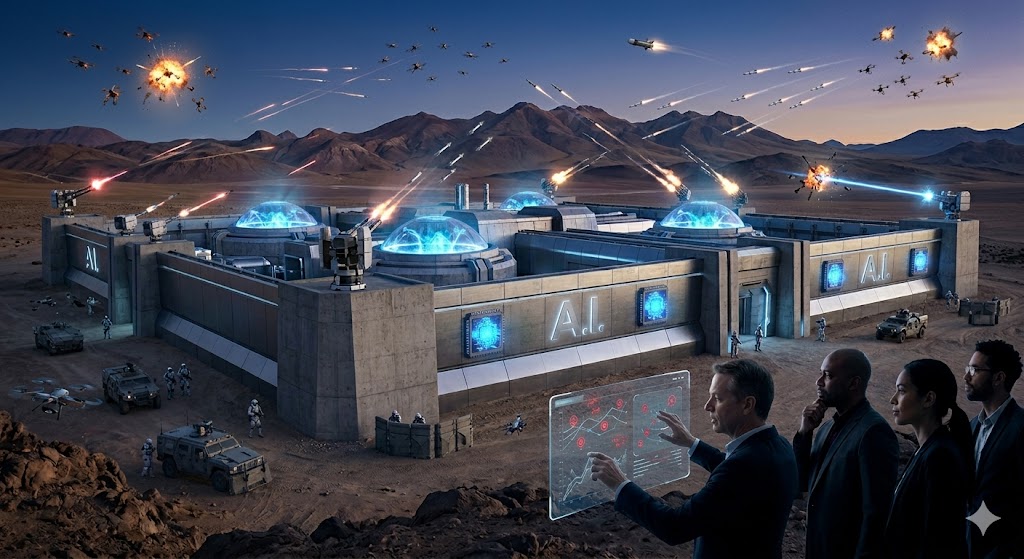
In the early 2020s, we viewed data center security through the lens of firewalls and encryption. But as we move through 2026, the paradigm has shifted. If a nation’s economy, defense, and essential services are orchestrated by a specific set of GPU clusters, those clusters become the highest-value kinetic targets in any conflict. We must stop designing them like warehouses and start designing them like aircraft carriers.
Transitioning to the “Military Base” Model
The “Fortress Data Center” logic dictates that physical security must match the strategic importance of the data held within. This evolution requires a fundamental shift in architecture and protocol:
- Physical Hardening: Implementing reinforced, blast-resistant shells and subterranean compute floors to protect against aerial or domestic threats.
- Exclusion Zones: Establishing significant geographic perimeters and “no-fly” zones, effectively transitioning these sites into sovereign military installations.
- On-Site Readiness: Constant tactical presence to defend against unconventional warfare, ensuring the “Digital Front Line” is never left vulnerable to physical breach.
Sovereign Silos and Logical Air-Gaps
Beyond physical walls, we must address Logical Sovereignty. A national AI asset cannot be fully secure if it is perpetually tethered to the public internet. The next generation of security involves “Air-Gapping”—the practice of physically isolating a computer network from unsecured networks.
By creating Sovereign Silos, we prevent the “poisoning” of national intelligence models from external actors and ensure that in the event of a global network collapse, the nation’s internal cognitive capacity remains operational.
The Futurology Perspective: We are moving from the era of “Open Innovation” to the era of “Fortified Intelligence.” The goal is not to hinder progress, but to ensure that our progress cannot be used as a weapon against us.
Designing the Experience of Security
As we fortify the physical and digital walls of our AI infrastructure, we face a profound Experience Design challenge. How do we prevent these “Fortress Data Centers” from becoming symbols of state opacity or fear? In 2026, the success of a national security strategy depends as much on Trust Architecture as it does on concrete and steel.
The Transparency Paradox
We are entering a Transparency Paradox: the more critical an AI system becomes to national security, the more secret its inner workings must be to prevent exploitation. Using Human-Centered Design principles, we must design interfaces and communication loops that provide the public with “Proof of Integrity” without revealing “Methods of Operation.”
- Auditability: Creating independent, high-clearance civilian oversight boards to ensure the “Fortress” remains aligned with democratic values.
- Public ROI: Clearly demonstrating how the security of these sites directly enables the stability of civilian services — from healthcare logistics to disaster response.
Trust Literacy and the Citizen Experience
We must build Trust Literacy within the population. If citizens perceive these centers only as “military black boxes,” we risk a breakdown in social cohesion. The experience of the “Fortress” must be framed as a Digital Utility — much like a water treatment plant or a power station — that is guarded not to exclude the public, but to guarantee their safety and continuity of life.
Distributed Nodes: The Anti-Fragile Strategy
From a Systems Thinking perspective, a single, massive “Fortress” is a single point of failure. The superior experience of security lies in a distributed network of regional hubs.
- Hyper-Localization: Placing smaller, fortified nodes near the communities they serve to reduce latency and improve regional resilience.
- Redundancy by Design: Ensuring that if one node is taken offline or isolated, the national “Neural Network” can reroute and adapt instantly, mimicking biological resilience.
Thought Leader Insight: Security isn’t just the absence of threat; it is the presence of confidence. We don’t just design the bunker; we design the relationship between the bunker and the people it serves.
The Strategic Implications: A New Innovation Roadmap
The shift toward fortified, sovereign AI infrastructure isn’t just a defensive maneuver; it is a fundamental pivot in how we approach the Innovation Lifecycle. In the past, we optimized for “Speed to Market.” In the landscape of 2026, the new north star is “Speed to Resilience.” This requires a total realignment of our strategic roadmaps.
For Leaders: From Efficiency to Robustness
Business and technology leaders must move beyond the “Just-in-Time” compute model. The era of relying on offshore, third-party clusters for mission-critical intelligence is closing. Strategic roadmapping now requires:
- Infrastructure Integration: Treating compute and energy as a single, inseparable architectural stack.
- Risk Re-evaluation: Factoring “Geopolitical Latency” into every project — the risk that a global event could sever access to centralized public clouds.
For Policy Makers: Funding the Digital Front Line
The “Fortress Data Center” cannot be built on corporate balance sheets alone. This is a public-private imperative. We are seeing the emergence of new funding mechanisms, such as:
- National AI Sovereignty Acts: Legislative frameworks that provide subsidies for companies building “Sovereign-Ready” infrastructure.
- Regulatory Sandboxes: Fast-tracking the deployment of Small Modular Reactors (SMRs) specifically for data center use, bypassing the decades-long red tape of traditional nuclear projects.
For Humanity: Ensuring the “Dividends of Security”
As a Human-Centered Innovation leader, my greatest concern is that these walls will lock innovation away from the people. Our roadmap must include “Avenues of Access.” While the hardware is fortified and the power source is isolated, the outputs — the medical breakthroughs, the climate models, and the educational tools — must remain a public good.
Strategic Takeaway: We aren’t just building walls; we are building a foundation. Innovation thrives when the underlying system is stable. By securing the “where” and “how” of AI, we liberate the “what” and “why” for everyone.
Conclusion: Choosing Our Preferable Future
The transition of AI data centers into sovereign, nuclear-powered fortresses is not an inevitability to be feared, but a strategic design choice to be mastered. As we look ahead from 2026, we must acknowledge that the “Wild West” era of digital infrastructure is over. We are entering the era of Structural Integrity.
The Choice: Proactive Design vs. Reactive Crisis
We have a window of opportunity to choose our path. We can wait for a catastrophic system failure — a grid collapse or a kinetic strike on a vulnerable node — to force our hand, or we can proactively apply FutureHacking™ principles to build resilience into the very foundations of our digital age.
The Goal: A Fortified but Flourishing Society
The ultimate goal of the “Fortress Data Center” is not isolationism; it is Insulation. By insulating our most critical cognitive assets from the volatility of global energy markets and geopolitical conflict, we create the stability required for the next great leap in human experience.
- Security provides the safety to experiment.
- Sovereignty provides the freedom to operate.
- Isolated Power provides the continuity to grow.
True innovation isn’t just about what the AI can do; it’s about building a world where the AI’s “home” is as secure as the values it is meant to protect. Let’s design an infrastructure that doesn’t just survive the future, but defines it.
Final Thought: In the race for AI supremacy, the winner won’t just have the best algorithms; they will have the most resilient “ground truth.” The fortress isn’t a retreat — it’s a launchpad.
Frequently Asked Questions
1. Why can’t we just use the existing electrical grid for AI data centers?
The current grid is built for predictable civilian and industrial use. AI training requires massive, concentrated loads that can destabilize local power for residents. By using isolated sources like SMRs, we protect the public’s energy security while ensuring the AI never faces a “brownout.”
2. Does making data centers military bases mean civilian AI development will stop?
Not at all. Think of it like the GPS system: it is maintained and secured by the military for national resilience, yet it provides the foundation for thousands of civilian innovations. The “fortress” protects the hardware, not the creativity.
3. What makes a data center a “sovereign” asset?
Sovereignty in this context means independence. A sovereign data center isn’t reliant on international supply chains for power or vulnerable public networks for its logic. It is a self-sustaining node that can continue to function even if the global internet or local grid is compromised.
Disclaimer: This article speculates on the potential future applications of cutting-edge scientific research. While based on current scientific understanding, the practical realization of these concepts may vary in timeline and feasibility and are subject to ongoing research and development.
Image credits: Gemini
 Sign up here to get Human-Centered Change & Innovation Weekly delivered to your inbox every week.
Pingback: The End of AI Data Centers - Human-Centered Change and Innovation