LAST UPDATED: March 10, 2026 at 1:54 PM
GUEST POST from Chateau G Pato
The Engagement Paradox: Bridging the Divide Between Mandate and Meaning
In the pursuit of Organizational Agility, leaders often focus on the mechanics of strategy — KPIs, roadmaps, and resource allocation — while overlooking the most critical engine of change: Human Purpose. We find ourselves in an era of the “Engagement Paradox,” where organizations have more tools than ever to track performance, yet employees feel increasingly disconnected from the “Why” behind their work.
When strategy is delivered as a top-down corporate mandate, it creates Invisible Friction. This friction isn’t found in your project management software; it exists in the gap between a company’s goals and an individual’s personal values. Without alignment, even the most brilliant strategy remains a cold, academic exercise that fails to ignite the passion required for true innovation.
To move beyond this, we must adopt a Human-Centered Strategy. This means shifting our perspective from “cascading” orders to “co-creating” a shared future. It requires us to acknowledge that a person is not a “resource” to be deployed, but a partner with their own internal mission, strengths, and desire for impact.
“True transformation doesn’t happen in the boardroom; it happens at the intersection where an individual’s personal ‘Why’ meets the organization’s strategic ‘What.'”
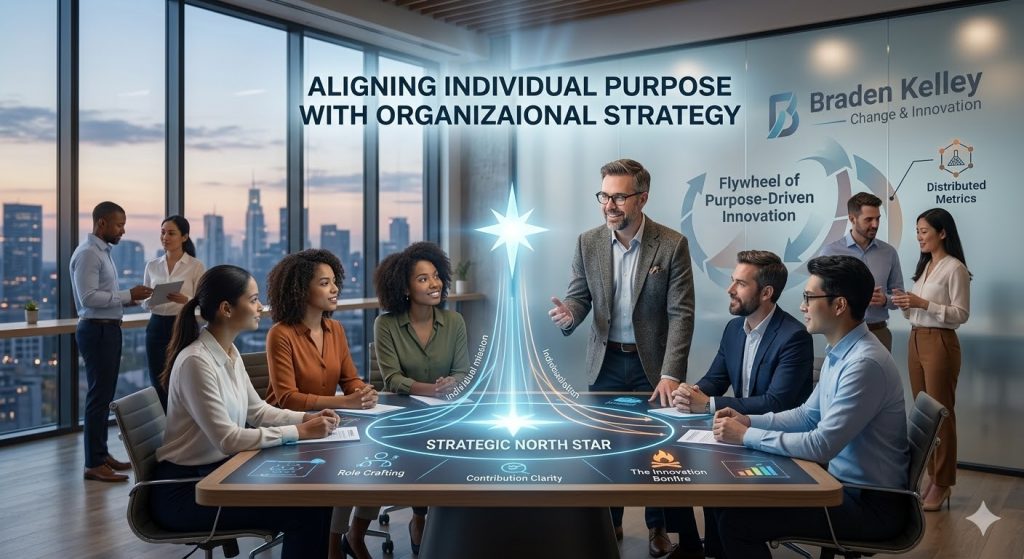
This article outlines how to architect that intersection. We will explore how to define the Strategic North Star in a way that resonates emotionally, how to empower individuals through Role Crafting, and how to measure the strength of this connection to ensure your organization isn’t just moving, but moving with purpose.
The Anatomy of Purpose: Unlocking the Individual “Why”
In the realm of Human-Centered Innovation, we must recognize that purpose is not something an organization “gives” to an employee; it is something the employee brings with them. Every individual possesses a unique internal compass — a collection of values, lived experiences, and a desire to contribute to something larger than themselves. When this internal compass is ignored, the result is “Quiet Quitting” or, worse, active resistance to Organizational Agility.
To align individual purpose with strategy, we must first help our people perform an “internal audit” of their own motivations. This isn’t about fluff; it’s about identifying the Mechanical Necessity of meaning in high-performance environments.
Defining the Personal “Why”
The journey begins by encouraging employees to articulate their Personal Mission Statement. We ask: “What is the problem in the world you feel most compelled to solve?” By allowing space for this reflection, we move past the job description. An engineer might find purpose in “building elegant systems,” while a customer success manager might find it in “empowering others to overcome obstacles.” When these motivations are clear, we can begin to map them to the broader corporate goals.
The Meaning Gap and Customer Friction
A primary driver of burnout is the Meaning Gap — the inability to see how a daily task impacts the final user. In a human-centered culture, every team member must understand how their work directly reduces Customer Friction. When an individual can trace a line from their spreadsheet or line of code to a human being having a better day, their personal purpose finds a home within the organizational strategy.
Autonomy, Mastery, and the Pursuit of Excellence
Purpose thrives in an environment of Autonomy and Mastery. When individuals feel they have the agency to apply their unique strengths toward a goal, they engage in discretionary effort that no incentive plan can buy. We must look at how we can allow people to bring their “whole selves” to work — leveraging their specific hobbies, interests, or specialized skills to solve strategic problems in ways that a rigid process never could.
“If people don’t see themselves in the future you are building, they will not help you build it. Purpose is the bridge that carries them from ‘having to’ to ‘wanting to.'”
By deeply understanding the anatomy of individual purpose, we stop managing for compliance and start leading for commitment. The next step is ensuring the organization’s Strategic North Star is bright enough to guide these individual energies in a unified direction.
The Strategic North Star: Beyond the Mission Statement
For an organization to align with individual purpose, its strategy must be more than a collection of financial targets or a static document buried in an intranet. It requires a Strategic North Star — a clear, aspirational, and human-centered destination that defines not just where the company is going, but why that destination matters to the world.
In many companies, strategy is a “black box.” Employees are told what to do, but the “Risk & Revenue” logic behind those decisions is obscured. To bridge this gap, leadership must practice radical transparency, transforming the strategy into a narrative that invites participation rather than just demanding execution.
Translating Strategy into Human Impact
A powerful North Star translates cold business objectives into human outcomes. Instead of aiming to “increase market share by 15%,” a human-centered North Star might aim to “become the most frictionless partner for small businesses in the Pacific Northwest.” When the goal is framed through the lens of Customer Friction Reduction, it becomes a challenge that individuals can emotionally invest in. It moves the conversation from “making money” to “solving problems.”
Transparency as a Catalyst for Alignment
Alignment cannot exist in a vacuum of information. We must share the Risk & Revenue Leakage Diagnostics with the entire team. When people understand the threats to the organization (Risk) and where value is being lost (Leakage), they can identify how their specific skills can help “plug the leaks.” This transparency fosters a sense of shared ownership; the strategy is no longer “management’s problem,” but a collective puzzle to be solved.
Psychological Safety and the Will to Change
No strategy survives a culture of fear. For individuals to align their purpose with a new direction, they need the Psychological Safety to know that moving toward that North Star won’t result in punishment if they stumble. Human-Centered Innovation recognizes that strategic shifts are often anxiety-inducing. By anchoring the strategy in a consistent purpose, we provide the stability people need to take the risks associated with innovation.
“A mission statement is what you do. A Strategic North Star is why it matters. If you can’t describe your strategy in a way that makes your team feel like heroes in a story, you haven’t finished defining it.”
When the organization’s direction is clear, transparent, and anchored in human value, it creates a gravity that pulls individual purposes toward it. The challenge then becomes architecting the daily “intersection” where these two forces meet and multiply.
Architecting the Alignment: The Intersection of Agency and Mission
The most critical phase of Human-Centered Innovation occurs at the tactical level. It is one thing to have a clear Strategic North Star and an inspired workforce; it is quite another to design the daily “Value Exchange” where these two forces actually meet. Architecting this alignment requires moving beyond rigid job descriptions and toward a model of Dynamic Contribution.
Alignment is not a one-time HR “onboarding” event. It is a continuous process of calibration where the organization’s needs and the individual’s purpose are negotiated in real-time. This is where we turn the “sparks” of individual creativity into a sustained Innovation Bonfire.
The Value Exchange: Solving for “Mutual Win”
We must frame the relationship between the employee and the organization as a transparent Value Exchange. Instead of asking “What can you do for the company?”, leaders should ask: “How does the achievement of our organizational strategy help you realize your personal mission?” When a developer who values “security and stability” sees how their work on data integrity protects vulnerable customers, the alignment becomes mechanical and self-sustaining.
Role Crafting: Empowerment through Agency
Role Crafting is the practice of allowing employees to proactively shape their tasks and relationships to better fit their strengths and purpose. In a distributed or agile environment, we should provide the guardrails of the strategy but allow individuals the agency to decide how they contribute. If an employee has a passion for Futures Literacy, we should empower them to contribute to our strategic foresight efforts, even if they are officially in a sales or marketing role.
Igniting the Innovation Bonfire
Innovation doesn’t happen in a vacuum; it happens when people feel their unique perspective is the missing piece of a larger puzzle. By creating “Internal Marketplaces” for projects, we allow people to gravitate toward work that resonates with their “Why.” This shared purpose acts as the accelerant for the Innovation Bonfire, ensuring that the heat and light of our creative efforts are directed toward solving the right problems — those identified in our Risk & Revenue Leakage Diagnostics.
“When you give people the agency to craft their roles around their purpose, you don’t just get better work; you get an organization that is antifragile. The people grow, and as they grow, the organization evolves with them.”
By architecting these intersections, we ensure that the organization’s strategy is not a weight that people must carry, but a platform that helps them rise. Once this alignment is architected, our final task is to measure its strength and ensure it remains resilient over time.
Measuring the Connection: Metrics for Purpose and Alignment
In any system governed by Human-Centered Innovation, what gets measured gets managed—and more importantly, what gets measured gets valued. To ensure that our efforts in aligning individual purpose with organizational strategy are more than just optimistic rhetoric, we must implement Innovation Accounting for our human capital.
Traditional engagement surveys are often lagging indicators that fail to capture the mechanical health of our alignment. We need real-time, actionable data that tells us whether the “connective tissue” between the person and the plan is strengthening or fraying.
Alignment Scores & Strategic Fluency
We must move beyond asking if employees are “happy” and start measuring their Strategic Fluency. Using “Alignment Scores,” we quantify how accurately an individual can articulate the Strategic North Star and how it relates to their specific department. If there is a disconnect between the executive vision and the front-line understanding, we have identified a communication friction point that must be addressed through better storytelling and transparency.
Contribution Clarity: Traceability of Impact
The most powerful metric for purpose is Contribution Clarity. This measures the ease with which an individual can trace their daily output to a specific strategic outcome or a reduction in Customer Friction. On a scale of 1 to 10, we ask: “How clearly can you see the human impact of your work today?” A high score here is the greatest antidote to burnout and the strongest predictor of discretionary effort.
The Retention Pulse of Innovation Talent
Finally, we track the Retention Pulse — specifically for our high-impact innovation talent. We look for correlations between purpose-alignment scores and the longevity of our “sparks” — those individuals who drive the Innovation Bonfire. When top talent leaves, we don’t just look at compensation; we perform a diagnostic on whether their “Why” was still finding a home within our “What.”
“Data without a human lens is just noise. But when we measure Contribution Clarity, we aren’t just tracking performance; we are validating that our people feel seen, heard, and meaningful in the context of our shared mission.”
By making alignment measurable, we hold leadership accountable for the human health of the strategy. It allows us to pivot our internal culture with the same Organizational Agility we apply to our external products.
Conclusion: The Empowerment Mandate and the Future of Synergy
The alignment of individual purpose with organizational strategy is not a destination; it is a continuous state of Organizational Agility. When we successfully bridge the gap between the person and the plan, we unlock a level of performance that cannot be manufactured through traditional management. This is the Empowerment Mandate: the shift from oversight to enablement, where leadership’s primary role is to clear the path for purpose-driven execution.
As we move further into an era defined by rapid change and digital transformation, the organizations that thrive will be those that operate as living organisms rather than rigid machines. In these “living” organizations, the strategy evolves through the collective insights of individuals who are deeply invested in the outcome.
Strategy as a Living Conversation
We must stop viewing alignment as a one-time workshop or an annual planning cycle. It must be a living, breathing conversation. By maintaining transparency around our Risk & Revenue Leakage and consistently revisiting our Strategic North Star, we allow our teams to pivot without losing their sense of meaning. This constant calibration ensures that as the market changes, our people don’t just “adapt” — they lead the way.
The Antifragile Organization
When individual and organizational goals are synchronized, the enterprise becomes Antifragile. It doesn’t just withstand stress; it grows from it. Because every team member understands their unique contribution to the Innovation Bonfire, they are empowered to take calculated risks that drive the company forward. The burden of innovation is no longer carried by a few executives, but shared by a community of practitioners.
“When a person’s work becomes an expression of their purpose, the distinction between ‘labor’ and ‘legacy’ disappears. That is the ultimate goal of Human-Centered Innovation: to build organizations that are as meaningful to work for as they are valuable to the world.”
The future of work belongs to the empathetic leader — the one who recognizes that the strongest competitive advantage is a team of people who know exactly why they showed up today. By architecting this synergy, we don’t just build better businesses; we build a more purposeful future for everyone involved.
Frequently Asked Questions: Purpose and Strategy Alignment
How does individual purpose directly impact organizational agility?
Individual purpose acts as a decentralized decision-making engine. When employees understand how their personal “Why” fits into the organizational strategy, they can make faster, more autonomous decisions without waiting for top-down approval. This reduces bureaucracy and allows the organization to pivot with greater speed and precision.
What is the difference between a mission statement and a Strategic North Star?
A mission statement often describes what an organization does in a static sense. A Strategic North Star is a dynamic, human-centered destination that translates business goals into human outcomes, such as “reducing customer friction.” It provides the emotional and strategic resonance necessary for individuals to see their own work as part of a larger story.
Can purpose-alignment be measured beyond standard engagement scores?
Yes. By using metrics like “Contribution Clarity” — which measures how easily an individual can trace their daily output to a strategic outcome — and “Strategic Fluency,” organizations can move beyond measuring sentiment to measuring the mechanical health of their alignment and the effectiveness of their internal communication.
Image credit: Pixabay
 Sign up here to join 17,000+ leaders getting Human-Centered Change & Innovation Weekly delivered to their inbox every week.