The Living Strategy
LAST UPDATED: March 6, 2026 at 3:57 PM
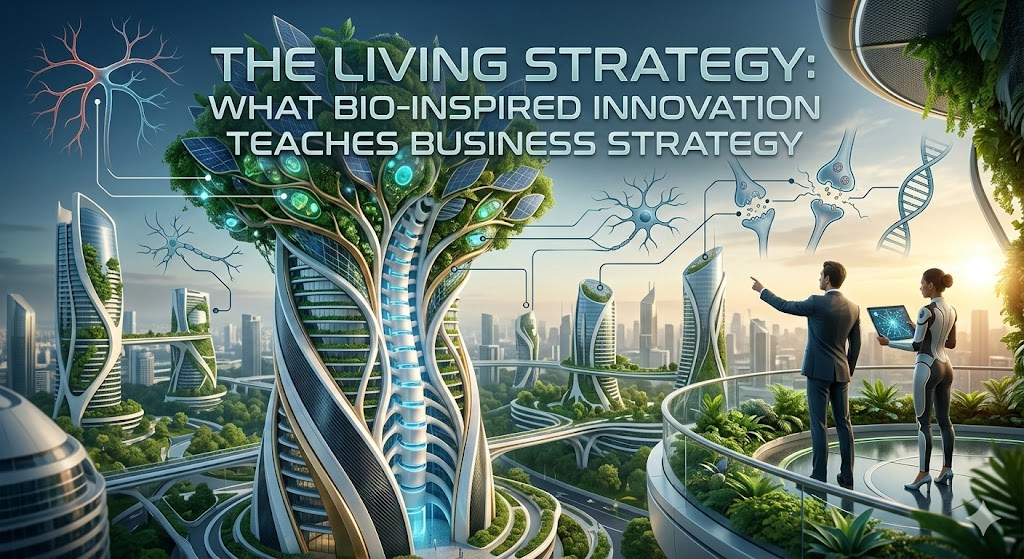
GUEST POST from Art Inteligencia
The 3.8 Billion-Year Case Study
In the world of Human-Centered Innovation™, we often talk about “innovation” as if it were a modern invention — a byproduct of Silicon Valley or the industrial age. However, the most sophisticated research and development lab on the planet has been running for 3.8 billion years. It is nature itself.
Business strategy, for too long, has been treated like a “Monument.” We carve it in stone, launch it with fanfare, and expect it to stand defiant against the winds of change. But monuments don’t adapt; they weather, crack, and eventually crumble. Bio-inspired innovation teaches us that a strategy should not be a static structure, but a living organism.
The Innovation Illusion
Most corporate failures aren’t caused by a lack of ideas; they are caused by innovation blockages — rigid hierarchies and “legacy thinking” that act like biological plaque. When we look at natural systems, we see that “strategy” is synonymous with “survival through adaptation.” If an organism stops evolving to meet its environment, it doesn’t just lose market share; it faces extinction.
Moving Beyond Surface-Level Biomimicry
While product-level biomimicry (like Velcro inspired by burrs) is fascinating, the real value for the C-Suite lies in the biomimicry of systems. This involves looking at how nature manages:
- Resource Allocation: How nutrients flow where they are needed most without a central bureaucracy.
- Risk Mitigation: How ecosystems build redundancy to survive catastrophic shocks (fires, floods, or “Black Swan” events).
- Scale: How simple rules lead to complex, scalable behaviors in colonies and hives.
The Core Thesis: Resilience Over Rigidity
To overcome the staggering 70% failure rate of organizational change initiatives, we must stop fighting human nature and start mimicking biological nature. By architecting our business strategies to be regenerative, modular, and responsive, we move from being “fragile” to “anti-fragile.”
“Nature doesn’t have a five-year plan; it has a set of operating principles that allow it to thrive in any condition. Your strategy should do the same.”
Fixedness vs. Agility: Lessons from the Spine
In traditional business strategy, there is a dangerous obsession with rigidity. We often mistake “firmness” for “strength.” However, in the natural world, the most successful structures — like the vertebrate spine — achieve strength through a delicate balance of fixed support and fluid flexibility.
The Structural Paradox: Core vs. Edge
To pivot, sprint, or endure a blow, an organism needs a “fixed” core. In a Human-Centered Innovation™ framework, your “spine” consists of your core purpose and values. These should be non-negotiable. However, the “limbs” of your strategy — your tactics, product features, and marketing channels — must remain highly articulated and mobile.
When a business becomes too rigid, it suffers from Strategic Calcification. Much like a fused spine, a calcified company can no longer bend to meet shifting customer expectations. It becomes brittle, and under the pressure of a market disruption, it doesn’t pivot — it snaps.
Avoiding the Trap of “Legacy Thinking”
In biology, “vestigial structures” are remnants of an evolutionary past that no longer serve a purpose (like the human appendix). Business strategy is often cluttered with Vestigial Processes — reports no one reads, meetings that have lost their “Why,” and hierarchies that slow down decision-making.
- Identify the Dead Weight: Are your current strategic initiatives helping you move, or are they just heavy armor from a war that ended ten years ago?
- Architect for Range of Motion: Design your organizational structure to allow for “micro-pivots” without requiring a total skeletal overhaul.
The Bio-Strategy Pivot
True agility isn’t about moving fast in a straight line; it’s about the ability to change direction without losing momentum. Nature doesn’t predict where the predator will jump; it builds a nervous system capable of instantaneous reaction.
“A strategy that cannot bend is a strategy that is waiting to break. Build a ‘Spinal Strategy’ that protects your core while liberating your extremities to innovate.”
By treating our organizational architecture as a living skeletal system rather than a concrete foundation, we ensure that our FutureHacking™ efforts result in a body that is ready for the sprint, not just the stand.
Efficiency Without Extinction: The Ant Colony Model
In the pursuit of maximum efficiency, many organizations lean their processes until they are bone-dry. In Human-Centered Innovation™, we call this the “Efficiency Trap.” When you remove all “waste,” you often inadvertently remove the redundancy required for survival. Look to the ant colony: one of the most resilient organizational structures on Earth.
Decentralized Intelligence: The Power of Stigmergy
An ant colony doesn’t have a “CEO Ant” issuing top-down memos on where to find the sugar. Instead, they use Stigmergy — a mechanism of indirect coordination where the environment serves as the communication medium. When one ant finds a resource, it leaves a pheromone trail. Others follow, reinforcing the trail until the resource is exhausted.
The Business Lesson: Move away from rigid command-and-control. Instead, create “digital pheromones” — real-time data dashboards and feedback loops that allow your frontline employees to see where the value is and pivot toward it without waiting for a quarterly review.
The “Scout” Strategy: Investing in Exploration
Even when a colony has a primary food source, it never sends 100% of its workers to that pile. It always keeps “Scouts” wandering aimlessly. To a traditional CFO, these scouts look like 10% “waste.” To nature, they are insurance.
- Exploitation: Harvesting your current “cash cow” or proven market.
- Exploration: Sending out scouts (R&D, pilot programs, FutureHacking™) to find the next source of life before the current one runs dry.
Optimization vs. Resilience
A “perfectly efficient” system is a fragile system. If a single point of failure occurs in a lean supply chain with zero redundancy, the system collapses. Nature builds in Parallel Paths. In your strategy, are you so optimized for today’s weather that you’ve lost the ability to survive a change in the climate?
“The goal isn’t to be the most efficient machine; it’s to be the most resilient organism. In an ant colony, ‘slack’ isn’t laziness — it’s the capacity to respond to the unexpected.”
By adopting a decentralized, scout-heavy approach, we empower the “edges” of the organization to signal shifts in the market long before they reach the executive suite.
The Ecosystem Play: From Competition to Symbiosis
In the industrial era, business strategy was often modeled after predation: “Eat or be eaten.” But if you look at the most enduring biological structures, they aren’t based on a winner-take-all hierarchy. They are built on Mutualism. In the Human-Centered Innovation™ philosophy, we recognize that no company is an island; we are part of a complex, interconnected web of value.
The Mycorrhizal Network: Nature’s Internet
Consider the “Wood Wide Web” — the underground fungal networks (mycorrhizae) that connect trees in a forest. These fungi don’t just “live” on the trees; they facilitate a massive exchange of nutrients and information. When one tree is under attack by pests, it sends chemical signals through the network to warn its neighbors. When a sapling in the shade is starving for light, the older trees send sugar through the fungi to keep it alive.
The Business Lesson: Your “Strategy” must extend beyond your balance sheet. Are you building a Supply Chain (linear and fragile) or a Value Network (interconnected and resilient)?
Moving from Market Share to Ecosystem Health
A parasite that kills its host eventually kills itself. In business, if you squeeze your suppliers, partners, or even your customers until they are depleted, your own foundation rots.
- Co-Opetition: How can you collaborate with “competitors” to expand the total market (the “forest”) rather than fighting over a single dying leaf?
- Open Innovation: By sharing “nutrients” (data, APIs, or insights), you invite the ecosystem to innovate on your behalf, creating a moat of mutual dependency.
The Role of “Keystone Species”
In biology, a keystone species (like the sea otter or the wolf) keeps the entire ecosystem in balance. As a leader or an organization, are you a keystone? Do your FutureHacking™ initiatives create a habitat where others can thrive? If your platform creates value for everyone involved, the ecosystem will fight to keep you alive.
“Sustainable growth isn’t about being the biggest tree in a clearing; it’s about being the most connected tree in the forest. Your network is your resilience.”
By shifting our mindset from “capturing value” to “circulating value,” we move from a strategy of extraction to one of regeneration.
Managing the “Assumption Gap” through Evolutionary Feedback
In nature, there is no “Planning Department.” There is only Execution and Selection. Every genetic mutation is a hypothesis, and the environment is the ultimate judge. In Human-Centered Innovation™, we often see organizations fail because they fall in love with their assumptions and ignore the feedback from the “wild” — their customers.
Nature’s Rapid Prototyping: The Feedback Loop
Biological systems don’t wait for a “Product Launch” to see if a trait works. They test incrementally. If a trait doesn’t provide an advantage, it isn’t “funded” with further calories.
The Business Lesson: We must close the Assumption Gap — the distance between what we think the customer wants and what they actually value. This requires moving from “Big Bang” releases to a continuous stream of “Micro-Evolutions.”
Stoking the Bonfire: Recycling Failure
In a healthy forest, there is no such thing as “trash.” A fallen tree becomes the “Nurse Log” for the next generation of growth. In the corporate world, we often bury our failed projects in shame.
- Innovation Composting: How can you take the talent, code, or insights from a “failed” project and use them to fertilize the next FutureHacking™ initiative?
- The CX Audit as a Nervous System: Use customer experience audits to detect “pain points.” In biology, pain is a vital signal that prevents further damage. In business, a complaint is a signal that your “organism” is out of alignment with its environment.
Selection Pressure: The Force of Innovation
Without pressure, species stagnate. In business, “Selection Pressure” comes from competition, regulation, and changing social norms. Rather than avoiding these pressures, the bio-inspired strategist leans into them to force the organization to evolve faster than the “average” competitor.
“The market is an ecosystem, not a static board game. If your feedback loops are slower than the rate of change in your environment, you are already trending toward extinction.”
By treating our strategic assumptions as biological hypotheses that must be “selected” by the market, we ensure that our innovation efforts are grounded in reality rather than boardroom fantasy.
Conclusion: Becoming a “Future-Hacked” Organization
The biological world does not “plan” for success; it architects for it. As we have explored through the lens of Human-Centered Innovation™, the most resilient strategies are those that mimic the regenerative, adaptive, and interconnected nature of life itself.
The Biological Imperative: Adapt or Decay
In the modern enterprise, “stability” is a myth. The moment an organization stops moving, it begins to decay. To be FutureHacking™ is to recognize that our goal isn’t to build a five-year plan that predicts the weather; it’s to build an organism that can thrive in any weather.
Moving from a mechanical mindset to a biological one requires a fundamental shift in leadership:
- From Architect to Gardener: Stop trying to “build” innovation and start “cultivating” the conditions where it can grow naturally.
- From Control to Connection: Prioritize the health of your ecosystem over the rigid enforcement of your hierarchy.
- From Perfection to Iteration: Embrace the “mutation” of ideas, knowing that constant, small failures are the only path to a massive evolutionary leap.
A Call to Action for the C-Suite
Stop treating your strategy as a document locked in a drawer. Treat it as a living system. Audit your “Spine” for flexibility, empower your “Scouts” to find new resources, and ensure your “Nervous System” is actually listening to the signals from your customers.
“In nature, the goal is not to be the biggest, but to be the most integrated. In business, the goal should be the same. The future doesn’t belong to the loudest or the strongest — it belongs to the most adaptable.”
By aligning your business strategy with the 3.8 billion years of wisdom found in nature, you don’t just survive the next disruption — you become the force that defines it.
Frequently Asked Questions
How does bio-inspired innovation differ from traditional biomimicry?
While traditional biomimicry often focuses on copying physical forms (like Velcro or aerodynamic shapes), bio-inspired innovation in business focuses on organizational systems and strategies. It applies biological principles — like decentralized intelligence and mycorrhizal networks — to corporate architecture, leadership, and ecosystem management.
What is the “Spinal Strategy” in human-centered innovation?
The “Spinal Strategy” is a structural metaphor for organizational agility. It suggests that a company should have a “fixed” core (the spine) consisting of its purpose and values, which provides the stability needed for its “limbs” (tactics and products) to remain flexible and articulated to respond to market shifts.
How can a business avoid “Strategic Calcification”?
Businesses avoid calcification by identifying “vestigial processes” — outdated habits or hierarchies that no longer serve a purpose. By implementing FutureHacking™ techniques and continuous feedback loops, organizations ensure they stay lean and mobile, much like a living organism rather than a static monument.
Image credit: Google Gemini
 Sign up here to get Human-Centered Change & Innovation Weekly delivered to your inbox every week.