Meet the Invisible Man of Innovation

GUEST POST from John Bessant
There’s a famous test, originally developed by psychologist J.P. Guilford, to give an idea of how ‘creative’ a person is. Ask them to think of as many uses as possible for an everyday object – a brick, a glass, a shoe, etc. The idea is that the more ideas you come up with (fluency) plus the number of different categories of idea (flexibility) gives an indication of your ability to think creatively.
If we tried the test with the simple safety pin it would certainly trigger some of the usual suspects – a nappy (diaper) pin, a clothes fastener, a medical device or an item of jewellery. Not so frequent a visitor to many peoples’ lists might be ‘a weightlifting aid’ – yet arguably that has been its most glorious moment so far. For one very good reason.
A $15 debt isn’t a big deal, even if it is incurred in 1849; its value would be around $600 in today’s money. An annoyance but not likely to bring on imminent bankruptcy if it remained unpaid. But for Walter Hunt there was a principle involved (he was, by all accounts a very moral man) and also the practical consideration that his relationship with his creditor (one J. R. Chapin) mattered. Chapin had helped him with a number of other projects as a draughtsman, providing the technical drawings needed for his patent applications. So Walter duly worried about how to repay the debt.
A period of hand wringing and fiddling which lasted about three hours, during some of which he picked up a piece of wire to keep his hands busy. And came up with the basic and still powerful principle behind the mechanism of the safety pin. Most pins up to that point were either simple and sharp with a point at the end or loops which came undone easily. These hadn’t changed much since the days when Roman legionaries pinned their cloaks with a fibula, a kind of simple brooch clasp pin.
By coiling the wire on itself he created a simple spring mechanism and by providing a catch at one end he was able to make the safe closure mechanism which we have come to know and love.
Quite a lot of us, in fact; estimates put the number of safety pins produced and sold per year around the world at around one billion, with specialised machines capable of turning out millions per day.
Walter Hunt was not a fool; he recognized that this idea could have value. And he was not inexperienced; he already had a healthy track record of successful innovation behind him and knew how to work the patent system. So he duly filed and was awarded patent number US6281A; he then offered this (and the accompanying rights it conferred) to the W R Grace company who snapped it up (excuse the pun), paying Hunt $400, enough to enable him to settle his debt and have some spare capital. And to lift a small but annoying weight from his shoulders…
It turned out to be a good deal for them; on an initial outlay of $15,000 in today’s money they secured profits running into millions over the next years.
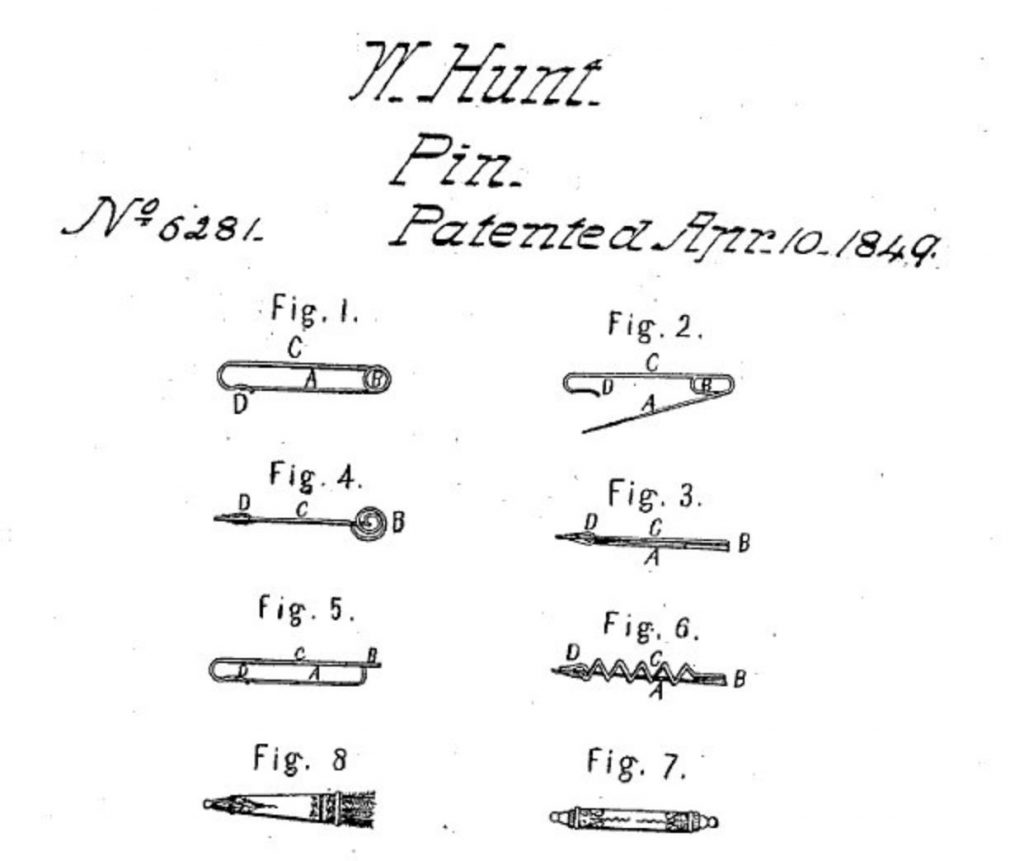
Image: U.S. Patent Office, public domain via Wikimedia
This kind of thing was second nature to him; he had a gift for seeing and solving problems in a practical way. By 1849 he’d already built a legacy of (mostly) useful items which he had (mostly) patented and had a growing reputation as an inventor. Though not necessarily an innovator – as in someone who can create value from their ideas. Hunt seems to have had a second ‘gift’; in addition to being a visionary inventor he seems to have been cursed with the inability to profit from his inventions.
The man who was labelled a ‘Yankee mechanical genius’ was born in 1796 in Lewis County, New York to a Quaker family. The eldest of thirteen children he was lucky to receive an education and went on to earn a master’s degree in masonry at the age of twenty-one. Although a practical skill much needed in a rural farming community masonry also involves a way of thinking which is much more than simply piling stones on top of each other. Arguably his understanding of interdependence and systems derived in part from this early experience – and enabled him to approach widely differing problems with a sense of their underlying similarities.
Yet if you look back at his track record of inventions he rapidly emerges as a serious contender for being the greatest inventor you’ve never heard of.
For example:
The repeater rifle, in 1848 – up there as a symbol of ‘how the West was won’ in a thousand cowboy movies and the undoubted making of the Winchester Repeating Arms Company with their Winchester rifle. Hunt not only developed the original idea for a ‘volition repeating rifle’ but also the ammunition it might use (his ‘rocket ball’) which was revolutionary in putting the powder charge in the bullet’s base. His designs weren’t very workable and he sold the patents; these changed hands a number of times in the growing armaments industry before being bought by Messrs Smith and Wesson who used them as the basis for a new company. The biggest investor in the new Volcanic Repeating Arms Company was one Oliver Winchester….
Think fountain pens and writing implements and the transition from goose quills to refillable devices and you may well think of the companies which made their name with the innovation. But whilst companies like Parker Pen created the market the foundations were laid by, amongst others, Walter Hunt who predated their work by decades. In 1847, he patented a fountain pen (U.S. Patent 4,927) combining inkstand and pen into one unit, “convenient for the pocket.”
Knife sharpening ? Nail making? Rope making? Castors to help move furniture around? Disposable paper collars? A coal burning stive which would radiate heat in all directions? A saw for cutting down trees? A flexible spring attachment for belts and braces? An attachment for boats to cut through ice? An inkstand? A non-explosive safety lamp? Bottle stoppers? Hunt turned his hand and imagination to hundreds of challenges across an almost impossibly wide spectrum. Leonardo da Vinci would have been proud of him, not least in his ability to draw together ideas and inspirations from many different fields.
His first patented invention was for an improved flax spinning machine in 1826. He worked as a farmer in a region dominated by textile milling and most of his family and friends were in the business of spinning wool and cotton. Faced with rising costs and falling product prices the local mill owner, Willis Hoskins, wanted to reduce wages; Hunt persuaded him to hold off and offered instead to develop a more efficient flax spinning machine. He patented this on June 22, 1826 and its contribution to improving productivity saved the jobs.
His motivation was often underpinned by a social concern. Another early invention (1827) was for a coach alarm system. Visiting New York to try and raise funds for developing the falx spinning machine further he witnessed an accident where a horse-drawn carriage ran over a child. The driver, his hands fully occupied with the reins of the team, had been unable to sound a warning horn in time. Hunt was shaken by this and the fact that this was not a rare occurrence; he began thinking of ways to help prevent these accidents. He came up with the idea of a metal gong with a hammer that could be operated by foot; his “Coach Alarm” was patented on July 30, 1827. Facing an uphill struggle he sold the rights to the stagecoach operators Kipp and Brown; the invention became a standard feature on streetcars across the United States, saving countless lives.
Late in life, Hunt addressed the laundry problem. In 1854 a crisp white collar was a mark of status, but keeping linen white required constant starching and ironing. Hunt invented the ‘paper shirt collar’ (U.S. Patent 11,376) which offered the advantage of looking like linen but being disposable after use.
Some of his ideas were, shall we say, a little fanciful though the prototypes proved their point. Inspired by the way flies negotiated ceilings his ‘antipodean apparatus’ was designed to help circus performers (and anyone else mad enough) to walk upside down. Although this one wasn’t patented it was still in use by performers a hundred years later!

Altogether he was responsible for hundreds of patents and about two dozen of Hunt’s inventions are still used in the form in which he created them over one hundred years ago.
Including, of course, the really big one that got away – the sewing machine. The mid 19th century saw a flurry of inventive activity around trying to enable it, eventually converging on a dominant design which combined different elements for feeding, sewing with a lockstitch, holding the fabric, powering the feed, etc. Isaac Singer walked away with the prize in 1851 after a long and bitter battle with Elias Howe whose patent he liberally borrowed from and which predated his machine by several years.
What’s not always mentioned is that Howe’s idea wasn’t original; he’d based his 1846 machine on something he’d seen more than a decade before. In fact this ‘prior art’ was what Singer tried to use in his defence only to have the judge throw it out because the original idea, though clearly the core design for a working sewing machine, had never actually been patented.
The man who’d let this incredible opportunity slip through his fingers? Our very own Walter Hunt.
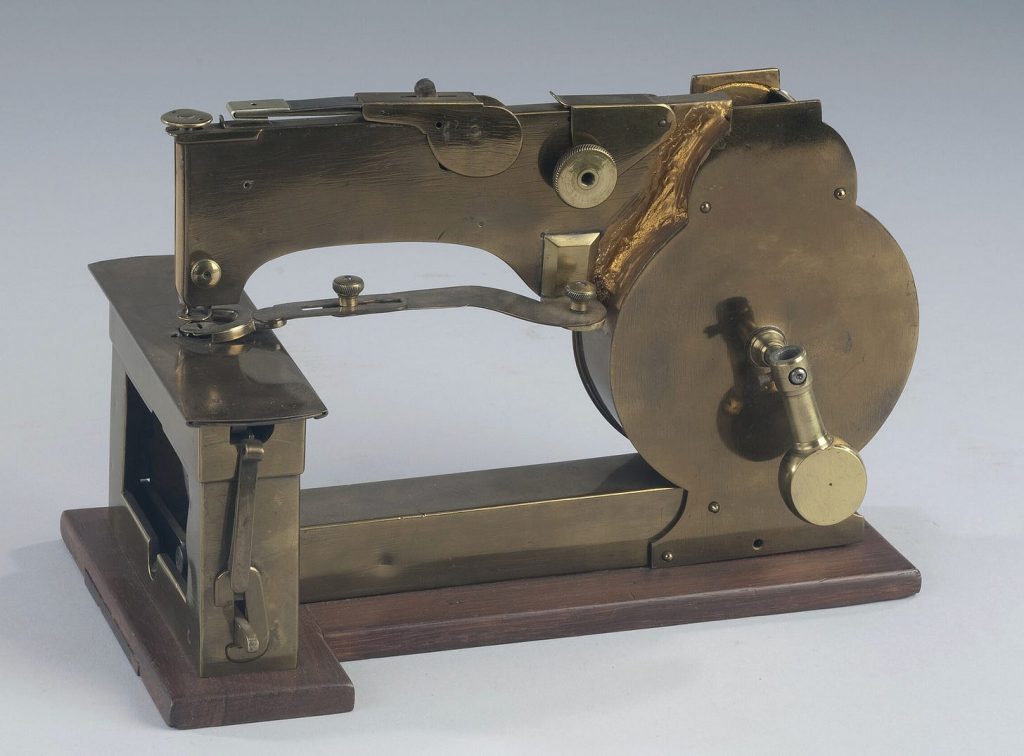
Image: National Museum of American History, public domain
In 1830, Barthelemy Thimonnier in France had patented a machine that used a hooked needle to make a chain stitch, but it was slow and fragile. Hunt’s experiments in the early 1830s led him to a new approach; he realized that a machine didn’t need to mimic a manual seamstress and in particular it didn’t need to pass the needle all the way through. Instead he designed a curved needle with the eye at the point; the needle would pierce the cloth, carrying a loop of thread with it and then a shuttle would pass a second thread through the loop formed by the needle. When the needle retracted, the two threads would lock together – lockstitch.
He kept it in the family, employing one of his many brothers, Adoniram, to improve on his wooden prototype by making a machine out of iron. It worked well, sewing straight seams with a durability and uniformity that manual sewing could not touch. By 1834 – twelve years before Elias Howe – Hunt had a working machine that could have made him one of the richest men in the world. But he held back from patenting it.
Not for want of experience or vision; he’d seen the possibilities which is why he’d been working on the idea. But his vision was partly shaped by his strong-willed and socially conscious daughter who saw it not as a labour-saving device but as a labour killer, threatening the livelihoods of women who worked as seamstresses to establish themselves and find a measure of financial independence. She persuaded Hunt to hold back from registering his patent though he had the working design ready a full twenty years before Singer’s successful entry.
Instead he allowed his invention to ‘slumber’, existing but not being patented or commercialised. He sold the rights to the prototype to George Arrowsmith, but Arrowsmith, the lack of a patent, also failed to commercialize it.
In the infamous ‘Sewing Machine Wars’ of the early 1850s the two big antagonists were Howe and Singer; as part of his campaign Singer discovered Hunt’s ideas and pressed him to search for any evidence of the earlier machine which might help invalidate Howe’s lockstitch-based patent. Eventually they found the rusty remnants of the 1834 machine and Hunt rebuilt it to working status, enabling Singer to argue that Howe was not the first inventor.
In 1854, Patent Commissioner Charles Mason issued a ruling that became a cornerstone of patent law; he acknowledged that Hunt had indeed invented the machine first. However, he ruled against Hunt based on the doctrine of laches (abandonment), writing that “…. When the first inventor allows his discovery to slumber for eighteen years, with no probability of its ever being brought into useful activity, and when its only resurrected to supplant and strangle an invention which has been given to the public… all reasonable presumption should be in favour of the inventor who has been the means of conferring the real benefit upon the world”.
The ruling forced Singer and other sewing machine manufacturers to settle their differences and operate a patent pool with each paying relevant royalties to the others for use of particular intellectual property. Hunt received a small payment from Singer for his testimony, but he missed out on the royalties that built the fortunes which came to Singer and Howe.
He was granted a patent for another improvement to the sewing machine dealing with feeding of material into the machine without jamming it. Singer eventually agreed in 1858 to pay Hunt $50,000 for this design – but Hunt didn’t live long enough to collect his due.
He died on June 8, 1859 of pneumonia in his workshop in New York City. His grave in Green-Wood Cemetery is marked by a modest granite shaft, a stark contrast to the massive monuments of other ‘Gilded Age’ entrepreneurs.
Although Hunt died without a fortune to his name he was no fool. His name might be missing from the pantheon of great inventors who changed the world through steel and steam – creating the products and the markets which defined a new industrial age. Yet anyone who could twist a piece of wire into a global success in three hours in order to settle a debt deserves a closer look.
His life reveals a complex man of high principles – a ‘benevolent Quaker’ – and possessed of an internal motivation owing much more to a fascination with solving problems and puzzles than the inspiration of a possible fortune. Someone who found joy in the quest rather than the goal, the ultimate ideas man.
An obituary published in the New York Tribune on June 13th, 1859 captured a little of this restless spirit. “For more than forty years, he has been known as an experiment in the arts. Whether in mechanical movements, chemistry, electricity or metallic compositions, he was always at home: and, probably in all, he has tried more experiments than any other inventor.”
Sometimes the quest is more exciting than the destination, sometimes the act of creating something new is its own reward.
You can find my podcast here and my videos here
And if you’d like to learn with me take a look at my online courses here
And subscribe to my (free) newsletter here
All images generated by Google Nanobanana or Substack AI unless otherwise indicated
 Sign up here to join 17,000+ leaders getting Human-Centered Change & Innovation Weekly delivered to their inbox every week.
Pingback: Top 10 Human-Centered Change & Innovation Articles of February 2026 | Human-Centered Change and Innovation