LAST UPDATED: April 17, 2026 at 3:57 PM
FIRST PUBLISHED: December 4, 2025 at 12:00 PM
GUEST POST from Art Inteligencia
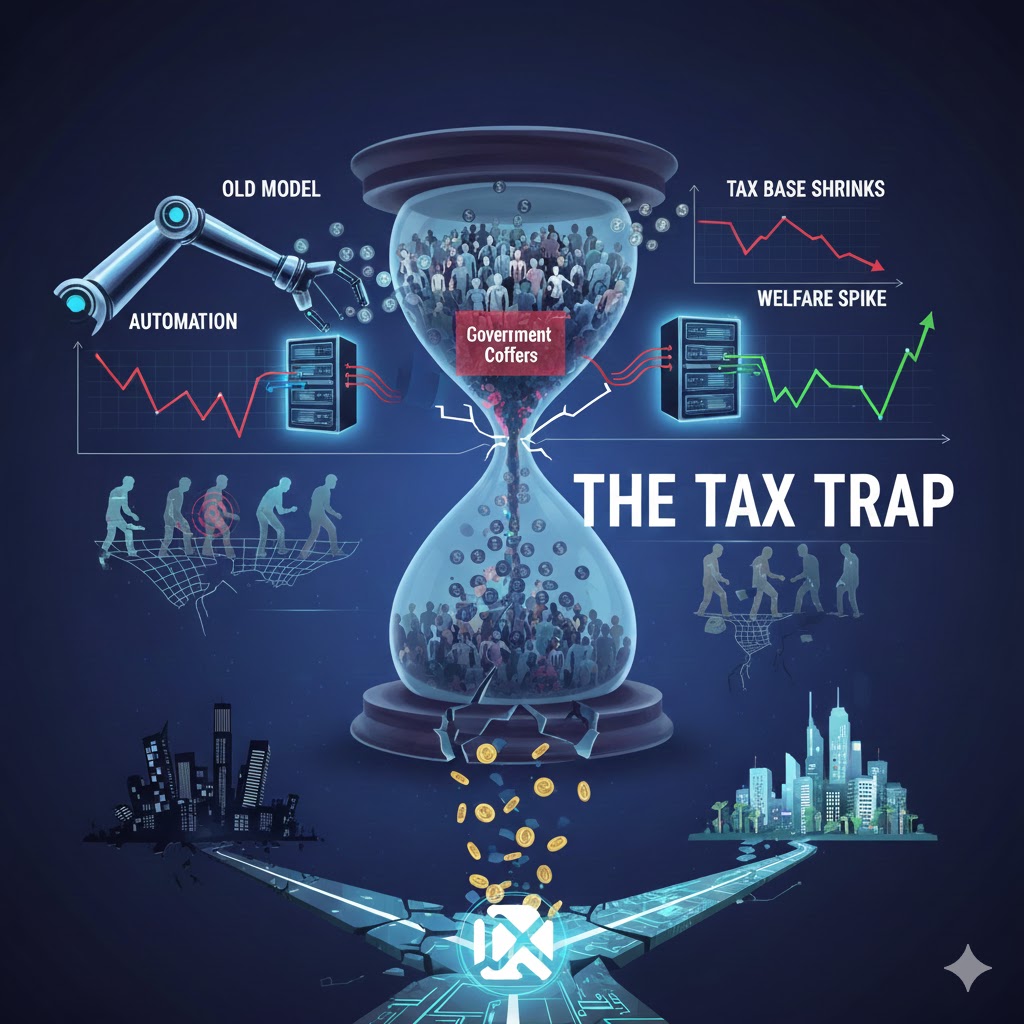
We are currently operating an analog economy in a digital world. As innovation strategists, I often talk about Braden Kelley’s “FutureHacking” — the art of getting to the future first. But sometimes, the future arrives before we have even unpacked our bags. The recent discourse around “The Great American Contraction“ has illuminated a structural fault line in our society that we can no longer ignore. It is what I call the Tax Trap.
This isn’t just an economic glitch; it is a design failure of our entire social contract. We have built a civilization where human survival is tethered to labor, and government solvency is tethered to taxing that labor. As we sprint toward a post-labor economy fueled by Artificial Intelligence and robotics, we are effectively sawing off the branch we are sitting on.
The Mechanics of the Trap
To understand the Tax Trap, we must look at the “User Interface” of our government’s revenue stream. Historically, the user was the worker. You worked, you got paid, you paid taxes. The government then used those taxes to build roads, schools, and safety nets. It was a closed loop.
The introduction of AI as a peer-level laborer breaks this loop in two distinct places, creating a pincer movement that threatens to crush fiscal stability.
1. The Revenue Collapse (The Input Failure)
Robots do not pay payroll taxes. They do not contribute to Social Security or Medicare. When a logistics company replaces 500 warehouse workers with an autonomous swarm, the government loses the income tax from 500 people. But it goes deeper.
In the race for AI dominance, companies are incentivized to pour billions into “compute” — data centers, GPUs, and energy infrastructure. Under current accounting rules, these massive investments can often be written off as expenses or depreciated, driving down reportable profit. So, not only does the government lose the payroll tax, but it also sees a dip in corporate tax revenue because on paper, these hyper-efficient companies are “spending” all their money on growth.
2. The Welfare Spike (The Output Overload)
Here is the other side of the trap. Those 500 displaced warehouse workers do not vanish. They still have biological needs. They need food, healthcare, and housing. Without wages, they turn to the public safety net.
This creates a terrifying feedback loop: Revenue plummets exactly when demand for services explodes.
The Innovation Paradox: The more efficient our companies become at generating value through automation, the less capable our government becomes at capturing that value to sustain the society that permits those companies to exist.
A Human-Centered Design Flaw
As a champion of Human-Centered Change, I view this not as a political problem, but as an architectural one. We are trying to run a 21st-century software (AI-driven abundance) on 20th-century hardware (labor-based taxation).
The “Great American Contraction” suggests that smart nations will reduce their populations to avoid this unrest. While logically sound from a cold, mathematical perspective, it is a defensive strategy. It is a retreat. As innovators, we should not be looking to shrink to fit a broken model; we should be looking to redesign the model to fit our new reality.
The current system penalizes the human element. If you hire a human, you pay payroll tax, health insurance, and deal with HR complexity. If you hire a robot, you get a capital depreciation tax break. We have literally incentivized the elimination of human relevance.
Charting the Change: The Pivot to Value
How do we hack this future? We must decouple human dignity from labor, and government revenue from wages. We need a new “operating system” for public finance.
We must shift from taxing effort (labor) to taxing flow (value). This might look like:
- The Robot Tax 2.0: Not a penalty on innovation, but a “sovereign license fee” for operating autonomous labor units that utilize public infrastructure (digital or physical).
- Data Dividends: Recognizing that AI is trained on the collective knowledge of humanity. If an AI uses public data to generate profit, a fraction of that value belongs to the public trust.
- The VAT Revolution: Moving toward taxing consumption and revenue rather than profit. If a company generates billions in revenue with zero employees, the tax code must capture a slice of that transaction volume, regardless of their operational costs.
The Empathy Engine
The Tax Trap is only fatal if we lack imagination. “The Great American Contraction” warns of scarcity, but automation promises abundance. The bridge between the two is distribution.
If we fail to redesign this system, we face a future of gated communities guarded by drones, surrounded by a sea of irrelevant, under-supported humans. That is a failure of innovation. True innovation isn’t just about faster chips or smarter code; it’s about designing systems that elevate the human condition.
We have the tools to build a world where the robot pays the tax, and the human reaps the creative dividend. We just need the courage to rewrite the source code of our economy.
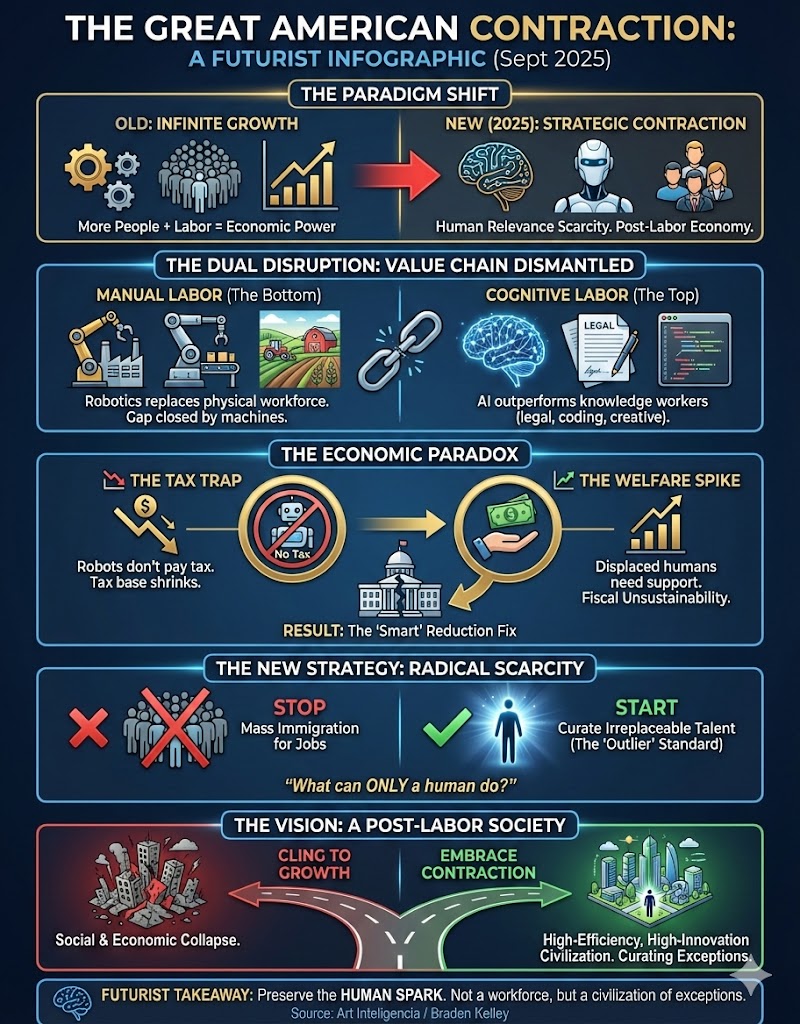
Image credits: Google Gemini
 Sign up here to get Human-Centered Change & Innovation Weekly delivered to your inbox every week.
Pingback: The Consumption Collapse – When the Feedback Loop Bites Back | Human-Centered Change and Innovation