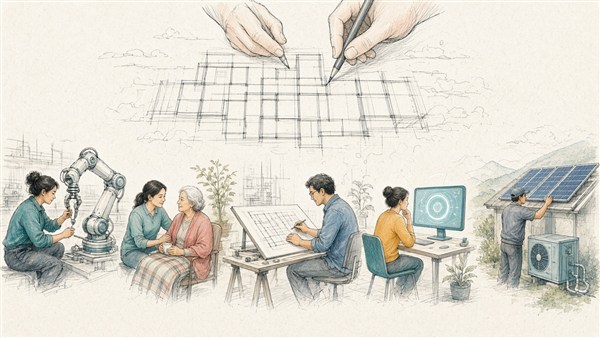
by Braden Kelley and Art Inteligencia
What Is the Future of Work? (Short Answer)
The future of work is the ongoing redesign of how, where, and by whom work gets done as AI, automation, demographics, and changing expectations reshape jobs. It isn’t a fixed forecast; it’s a set of choices being made now. Over the next ten years, most jobs will change more than disappear, and new roles will grow around guiding AI, verifying what’s real, designing experiences, leading change, and caring for people.
The future of work isn’t something that happens to us. It’s something we design — or something that gets designed for us.
Most “future of work” content is either a trend list or a fear headline. Neither helps you decide anything. Below you’ll find the five forces reshaping work, the jobs likely to exist in ten years, the jobs that will change most, what work itself will look like, and how individuals and leaders can prepare.
What Forces Are Shaping the Future of Work?
Five forces are reshaping work at the same time, and they interact in ways no single trend report captures:
- AI and automation. AI is changing the tasks inside nearly every job — automating some, augmenting others, and creating new ones. It is also adding a new kind of coworker: AI agents that can take actions, not just answer questions.
- Demographics. Aging populations, growing caregiving responsibilities, longer working lives, and fewer young people entering the workforce in many countries are changing who works, for how long, and what they need to do it well.
- Changing expectations. Flexibility, meaning, wellbeing, and fairness now weigh more heavily in where people choose to work and how long they stay.
- Volatility and climate. Supply shocks, extreme weather, and the energy transition are disrupting existing work while creating entire new categories of it.
- New ways of organizing. Skills-based hiring, platform and project-based work, and teams made up of people and AI agents are changing how organizations are structured and how careers unfold.
None of these forces decides the outcome. They set the conditions. People still choose the design.
What Jobs Will Exist in 10 Years?
Nobody can publish an accurate list of job titles for ten years from now. But you can see which families of work are growing, because many of these roles already exist in early form today:
| Role family | Example roles | Why it grows |
|---|---|---|
| Guiding and overseeing AI | AI agent supervisor, AI operations lead, AI evaluator and trainer, AI governance lead | Every AI system acting in the world needs humans who direct it, check it, and answer for it |
| Verifying what’s real | Trust and safety specialist, content provenance analyst, synthetic-media investigator | As fake content becomes cheap, proving what’s authentic becomes valuable |
| Designing human–AI work and experiences | Workflow designer, conversation designer, experience designer | Someone has to design how people and AI work together — and how it feels to customers and employees |
| Leading change and adoption | Change and adoption lead, AI enablement coach, learning experience designer | Technology moves faster than organizations can absorb it without help |
| Caring for people | Care navigator, eldercare coordinator, wellbeing and mental-health roles | Aging populations and human needs that technology can support but not replace |
| Building resilience and the energy transition | Building retrofit and heat-pump technicians, grid and battery specialists, resilience planners | Climate adaptation and new energy systems require skilled hands and planning |
| Maintaining physical-digital systems | Robotics maintenance technician, smart-building technician, field-service specialist | More machines in the physical world means more people who install, maintain, and repair them |
| Sense-making and foresight | Foresight analyst, futurist, strategic insights lead | Faster change raises the value of seeing it coming and making sense of it |
If the last row interests you, I explain the role in detail in What Does a Futurist Do — and How Do You Become One?
Job titles will change faster than this list. The pattern is what lasts: work grows wherever humans add judgment, trust, care, or the ability to fix what breaks.
Which Jobs Will Change the Most?
Over the next decade, most jobs won’t disappear. They’ll transform. A few examples of how:
- Customer service shifts from routine answers to resolving complex problems and building relationships.
- Marketing and content shifts from producing drafts to judgment, taste, and strategy.
- Software development shifts from writing code to designing systems and reviewing AI-generated code.
- Finance and accounting shifts from processing transactions to advising decisions.
- Healthcare could shift toward more time with patients and less on documentation — but only if the time saved is protected instead of filled with more volume.
- Managers will coach humans and orchestrate AI agents, which requires new skills on both fronts.
- Entry-level roles face the biggest redesign challenge. AI is absorbing the routine work beginners used to learn on, so organizations will have to deliberately rebuild the path from newcomer to expert.
If you want to assess your own role, start with the five-question self-check in Will AI Take My Job? An Honest, Human-Centered Answer. For why the entry-level challenge deserves more attention than job-loss percentages, see 8 Predictions Leaders Can Ignore — and 8 They Cannot Afford To.
What Will Work Itself Look Like?
Beyond which jobs exist, the experience of working is changing too — how, where, and when work happens:
- Human–AI teams become the default. People will routinely work alongside AI agents, with humans accountable for the outcomes.
- Skills count alongside degrees. Hiring and promotion will increasingly rely on demonstrated capability, not only credentials.
- Learning happens in the flow of work. Continuous learning on real tasks replaces one-time training events.
- Arrangements become more flexible and varied. There won’t be a single winner between office and remote work; the right answer will differ by the kind of work and the people doing it.
- Careers get longer and have more chapters. Expect multiple roles, reskilling, and transitions across a working life rather than one ladder.
- Work gets measured by outcomes and experience, not activity. What got done — and how it felt to customers and employees — matters more than hours logged.
For how human–agent teams might reshape organizations in different ways, see 5 Scenarios for Agentic Organizations — and What Leaders Must Own in Each.
How Do You Prepare for the Future of Work?
If you’re an individual, become fluent with AI on real tasks, not just in training. Move toward work built on judgment, relationships, and outcomes. Keep a deliberate learning path, especially if AI is absorbing the work you used to learn on. And think in career chapters rather than a single ladder. For the capabilities that grow in value as automation spreads, see 9 Skills That Age Well When Everything Else Automates.
If you’re a leader, fund job redesign alongside every technology investment. Decide where saved time goes before it quietly turns into more volume. Rebuild the apprenticeship path for entry-level roles. And give frontline workers a real voice in how AI changes their work. For the warning signs that you’re preparing for the wrong version of the future, see 8 Signals You’re Preparing for the Wrong Future of Work.
The difference comes down to two landings. In a soft landing, work is redesigned around people, and they succeed alongside AI. In a hard landing, headcount math and tool rollouts design work by default — and people absorb the cost.
Ten years from now, the future of work will simply be work. The question is whether we designed it on purpose.
FAQ: The Future of Work
What is the future of work?
The future of work is the ongoing redesign of how, where, and by whom work gets done as AI, automation, demographics, changing expectations, and climate reshape jobs. It is not a fixed forecast but a set of design choices organizations and people are making now.
What jobs will be in demand in 10 years?
Demand is likely to grow in roles that guide and oversee AI, verify what is real, design human–AI work and experiences, lead change and adoption, care for people, build climate resilience and new energy systems, maintain physical-digital systems, and practice foresight. Specific titles will vary, but these role families are already emerging.
What jobs will disappear in the next 10 years?
Most jobs will change more than disappear. Roles made up mostly of routine, predictable screen work — such as high-volume drafting, basic data processing, and rules-based first-line support — face the most pressure, especially where demand doesn’t grow as the work gets cheaper.
What skills will matter most in the future of work?
The most durable skills include AI fluency on real tasks, problem framing, judgment under uncertainty, relationship-building, facilitation, care and empathy, the ability to repair what breaks, and learning how to learn as tools keep changing.
Will remote work continue in the future?
Yes, in varied forms. Neither the office nor remote work is likely to win outright; the right arrangement depends on the kind of work, the team, and the people doing it. Flexibility will remain a major factor in where people choose to work.
Image credits: Cursor
Content Authenticity Statement: The topic area, key elements to focus on, etc. were decisions made by Braden Kelley, with a little help from Google Gemini and M365 CoPilot to clean up the article, add images and create infographics.
 Sign up here to get Human-Centered Change & Innovation Weekly delivered to your inbox every week.