by Braden Kelley and Art Inteligencia
Somewhere in your organization, right about now, a calendar invite is going out. The subject line says something like “FY27 Strategic Planning Kickoff,” and attached to it is a template. The template has boxes. The boxes are empty. Everyone will spend the next several weeks filling them in.
I have nothing against boxes. I like boxes. But I’d like to make the case that the single most expensive moment in your planning cycle is the one where somebody opens that blank template and starts typing, because whatever goes in first becomes the frame for everything that follows.
The blank template has a gravity problem
Here’s what actually happens. A blank template isn’t blank. It’s been filled in, invisibly, by last year’s plan, last year’s assumptions and last year’s loudest voice in the room. People don’t start from the future. They start from the previous document, change a few numbers, and call it a strategy.
That works fine if the world held still. It didn’t, and it won’t. If the biggest shift in your market is something nobody has put in a box yet, the template can’t ask about it, because the template was designed by people who hadn’t seen it coming either.
So the question I’d ask before the kickoff isn’t “what goes in the boxes?” It’s “what do we know, and not know, about the world these boxes are supposed to describe?”
What “start with foresight” actually means
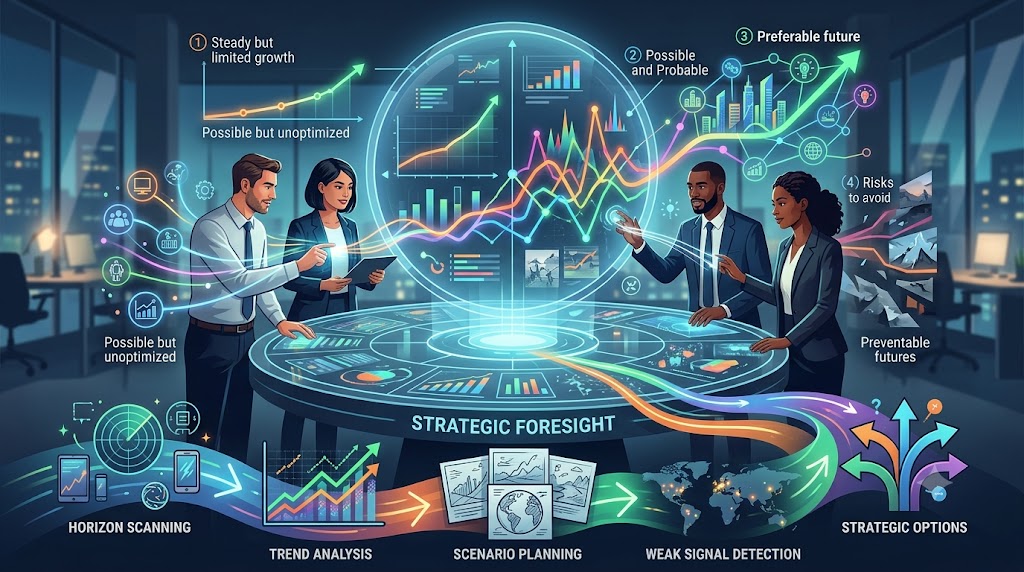
It doesn’t mean hiring a futurist for the offsite (though I’m certainly not going to talk you out of it). It means doing a small amount of structured looking-outward before anyone does any planning. Think of it as the warm-up lap. Three things, in order:
- Gather the signals. Not the trends. The signals. A signal is a small, specific thing you noticed: a competitor’s odd hire, a regulation that moved, a customer behavior that doesn’t fit your model. Trends are what you get when you’ve bundled signals together, and you can’t bundle what you haven’t collected. Ask your leadership team, and a few people from well outside it, to bring the three oddest things they’ve seen this year.
- Sort the signals into the trends they suggest. This is where the room starts to disagree, which is the good part. Two people looking at the same pile of signals will see different trends. Better to find that out in October than in March.
- Ask what futures those trends could produce. Plural, on purpose. Not the forecast. A handful of genuinely different, plausible futures, so that when the planning boxes finally get filled, they get filled with a plan that can survive more than one of them.
Then, and only then, open the template.
Why timing matters more than people think
Planning season has a quirk I’ve watched for twenty years. The moment a plan has a draft, it starts defending itself. People get attached to their numbers. Challenging the premises feels like challenging the person. So any foresight you want to influence the plan has to arrive before the first draft, not after it, when all it can do is make everyone feel bad.
That’s why I think of the weeks right before kickoff as a window, and a short one. Get the signals gathered now and the template gets filled in by people who’ve actually looked up from their desks. Skip it and you’re back to editing last year’s document with a fresh date on the cover.
A way to try it this week
If you want a low-risk way to feel what step one is like, the free FutureHacking Signal Picker walks you through identifying and prioritizing the signals worth watching, which is the foundation of the whole FutureHacking™ methodology. Run it yourself before the kickoff, then bring the output into the room instead of a blank whiteboard. You’ll be surprised how different the first fifteen minutes feel.
The next step, if you want it
I’m putting the finishing touches on a second tool, the FutureCanvas Picker, which carries you further: from signals, to the trends they suggest, to a set of possible futures, to your most probable future, and then to the path toward the future you’d actually prefer. It’s the closest thing I’ve built to the full FutureHacking™ arc in a single sitting, which makes it a natural fit for exactly this moment in the calendar.
I’m opening early access to a small group first: strategic planners, CSOs and leaders who are running a planning process right now and can tell me honestly what works under a real deadline. If that’s you, reach out and let me know and I’ll follow up personally with the select few who get in first.
Before you hit “accept” on that invite
The organizations that do planning well aren’t the ones with the best templates. They’re the ones who spent a little time, before the template appeared, finding out what the world was actually doing.
So when that kickoff invite lands, go ahead and accept it. Just make sure somebody has done the looking first.
Image Credits: Gemini
Content Authenticity Statement: The topic area, key elements to focus on, etc. were decisions made by Braden Kelley, with a little help from Claude to clean up the article.
 Sign up here to get Human-Centered Change & Innovation Weekly delivered to your inbox every week.