by Braden Kelley and Chateau G Pato
Why Do Digital Transformations Stall After the Pilot? (Short Answer)
Most digital transformations stall after the pilot because leaders confuse technical proof with organizational readiness. A successful demo shows something can work. Scaling requires named owners, redesigned work, aligned incentives, data and integration, change capacity, the courage to kill shadow processes — and the political will to live differently. The pilot was never the hard part.
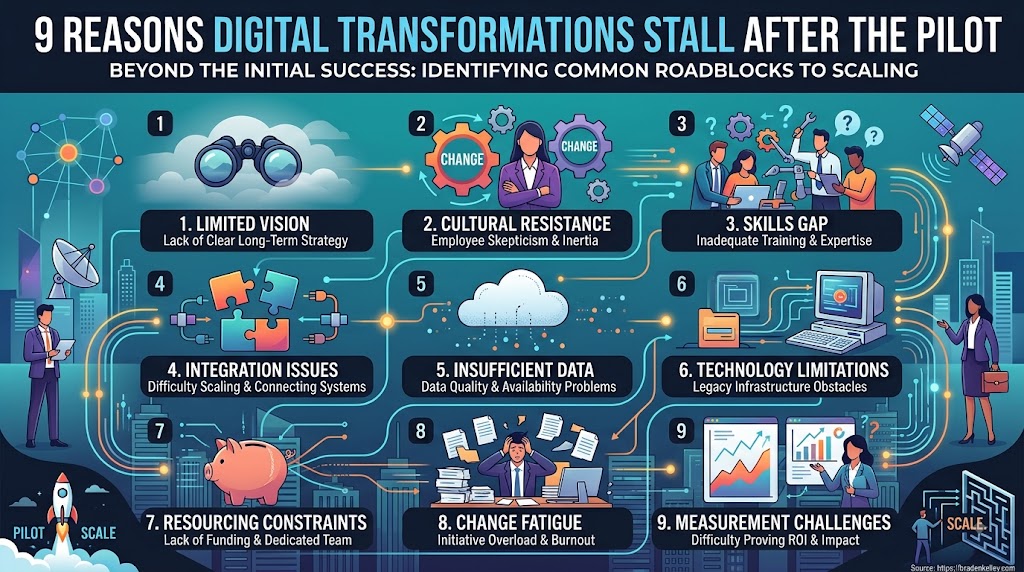
The nine common reasons transformations stall are: (1) proof mistaken for readiness, (2) no named owner of the new way of working, (3) work redesign skipped, (4) incentives still reward old metrics, (5) data and integration debt, (6) change treated as communications, (7) shadow processes never killed, (8) pilot heroes ≠ scale reality, and (9) fear of the political cost of winning.
The Pilot Was Never the Hard Part
I have watched too many rooms celebrate a green pilot as if the transformation were already over. The interface worked. The select users smiled. The slide said “validated.” Then Monday arrived for everyone else — average managers, messy data, conflicting KPIs, and a legacy workaround that refused to die.
Human-centered change treats that gap as designable, not mysterious. Below are nine stall patterns I see repeatedly, what each looks like, and what real transformers do instead.
| Reason | Common sign | What to do instead |
|---|---|---|
| 1. Proof ≠ readiness | “It worked” used as scale approval | Require an adoption/scale scorecard |
| 2. No durable owner | Project ends; BAU orphaned | Name a workflow owner with rights |
| 3. No work redesign | New tool, old handoffs | Redesign jobs and decisions first |
| 4. Old incentives | KPIs punish new behavior | Align metrics to transformed outcomes |
| 5. Integration debt | Pilot used clean workarounds | Fund data/integration as scale work |
| 6. Change = decks | Training without practice time | Build change muscle and coaching |
| 7. Shadow process lives | Old path still easiest | Kill legacy paths on purpose |
| 8. Heroics don’t scale | A-team pilot, average-team crash | Design for the median user |
| 9. Political avoidance | Endless “learning” | Govern winners/losers in the open |
1. Proof Mistaken for Readiness
What it is: Treating a successful pilot as proof the organization is ready to scale.
The stall: “It worked” becomes a funding sentence. Feasibility gets confused with operability. Leaders skip the boring questions about volume, exceptions, support load, and who changes how they spend Tuesday.
What to do instead: Separate technical validation from operating-model readiness. Before scale money, require an adoption and scale scorecard: owners, workflows, incentives, data path, support model, and stop rules for the old way.
2. No Named Owner of the New Way of Working
What it is: The transformation has a project manager — and no durable operator once the project ends.
The stall: Sponsorship was energetic in kickoff season. Then the program office demobilizes, and business-as-usual inherits a half-changed process with no one empowered to keep improving it.
What to do instead: Assign a named workflow owner with decision rights before scale funding. If nobody owns the new way after applause, you do not have a transformation. You have a temporary exhibit.
3. Work Redesign Skipped — Tool Bolted onto Old Process
What it is: Installing new technology on top of unchanged handoffs, policies, and approvals.
The stall: Same friction, prettier screens. People invent local workarounds because the system still asks them to do impossible coordination. Digitization accelerates the old mess.
What to do instead: Redesign jobs, handoffs, and decisions first. Technology should serve the human system you intend to run — not freeze the system you meant to leave.
4. Incentives Still Reward the Old Metrics
What it is: Asking people to adopt new behaviors while KPIs, bonuses, and recognition still pay for the old ones.
The stall: Managers optimize what still gets measured — speed-to-close, local utilization, ticket deflection theater — even when those metrics punish quality, collaboration, or customer effort in the new model.
What to do instead: Align metrics and recognition to transformed outcomes: adoption quality, end-to-end cycle time, customer/employee effort, first-time resolution, revenue or risk outcomes tied to the journey — not activity that photographs well.
5. Data and Integration Debt Comes Due
What it is: Pilots that succeed on clean samples, manual stitches, or heroic data wrangling collapse under production reality.
The stall: Scale exposes fragmented systems, inconsistent definitions, and brittle interfaces. The “digital” experience becomes a queue of exceptions.
What to do instead: Fund data quality and integration as first-class scale work — not a vague phase two. If the pilot needed spreadsheet glue, assume production needs architecture, not optimism.
6. Change Capacity Treated as Communications
What it is: Substituting town halls, slide decks, and one-time training for the real work of building new skills and habits.
The stall: People were informed. They were not enabled. Managers never got coaching time. Role anxiety filled the gap that practice should have filled.
What to do instead: Build change muscle: champions, spaced practice, protected learning time, manager enablement, and clear stories about how roles evolve. Communication is necessary. It is not capacity.
7. Shadow Process Never Gets Killed
What it is: Leaving the old spreadsheet, email path, or “temporary” workaround alive “just in case.”
The stall: Adoption stays optional. The easy path is still the legacy path. Leaders wonder why usage is soft while the organization quietly runs two operating systems.
What to do instead: Write stop criteria for shadow processes. Make the new way the only easy way. If you cannot turn something off, you have not finished the design of scale.
8. Pilot Team ≠ Scale Team — Heroics Don’t Industrialize
What it is: A hand-picked A-team succeeds in the pilot; average teams inherit complexity without the same support.
The stall: What worked for enthusiasts fails for the median user and median manager. Support tickets spike. Leaders blame “resistance” instead of design for the middle of the bell curve.
What to do instead: Design for the median. Staff enablement and operations for steady state. If only heroes can run it, it is not a transformation asset — it is a dependency on burnout.
9. Fear of the Political Cost of Winning
What it is: Avoiding scale because success would force real tradeoffs — turf, vendors, pet projects, or status stories that cannot survive daylight.
The stall: The organization stays in luxurious “learning mode.” Another pilot. Another vendor bake-off. Another steering committee. Progress becomes a lifestyle of almost.
What to do instead: Surface winners and losers early. Govern tradeoffs in the open. Use kill criteria as leadership hygiene. Transformation is not only a technology journey. It is a power redesign with manners.
How Do You Scale a Digital Pilot Without Stalling?
Before you fund the next wave, run a soft-landing go/no-go. Say no — or not yet — unless you can answer yes to these:
- Who owns the new workflow after the program ends?
- What human behavior must change for scale to count as success?
- What old path will we turn off, and when?
- Is integration and data readiness funded as core work, not hope?
- Do incentives and manager routines reinforce the new way?
A pilot proves possibility. Transformation proves the organization can live differently. If you want digital change that lands with customers and employees, stop celebrating demos as destinations — and start designing the human system that has to carry the future on a normal Tuesday.
Frequently Asked Questions
Why do digital transformations stall after the pilot?
They stall when leaders treat technical pilot success as organizational readiness. Scaling fails without durable owners, redesigned work, aligned incentives, data/integration, change capacity, retired shadow processes, design for average users, and political willingness to make tradeoffs.
What is the difference between a successful pilot and a scalable transformation?
A successful pilot proves something can work under controlled conditions. A scalable transformation proves the organization can run the new way of working in production — with owners, incentives, data plumbing, adoption support, and the old path intentionally shut down.
How do you scale a digital pilot successfully?
Name a workflow owner, redesign jobs and handoffs, align metrics, fund integration and data quality, build real change capacity, kill shadow processes, design for the median user, and govern political tradeoffs openly before expanding volume.
What are common reasons digital transformation fails after a pilot?
Nine common reasons include mistaking proof for readiness, lacking a durable owner, skipping work redesign, keeping old incentives, hitting data/integration debt, treating change as communications, leaving shadow processes alive, relying on pilot heroics, and avoiding the politics of winning.
What should leaders check before funding digital transformation scale-up?
Leaders should confirm ownership after the program, the human behavior that defines success, which legacy paths will be turned off, whether integration/data work is funded, and whether incentives and manager routines reinforce the new operating model.
Image credits: Google Gemini
Content Authenticity Statement: The topic area, key elements to focus on, etc. were decisions made by Braden Kelley, with a little help from Google Gemini and Cursor to clean up the article, add images and create infographics.
 Sign up here to get Human-Centered Change & Innovation Weekly delivered to your inbox every week.