LAST UPDATED: February 26, 2026 at 11:06AM

GUEST POST from Art Inteligencia
I. Introduction: The Velocity of Change vs. The Speed of Learning
Why your transformation strategy is only as fast as your team’s ability to evolve.
In the modern business landscape, we are obsessed with velocity. We track sprint cycles, deployment frequencies, and market penetration. However, many leaders face a frustrating phenomenon: the “Momentum Gap.” This is the space between the initial excitement of a new initiative and the actual realization of value.
The Thesis: Change momentum is directly proportional to the organization’s ability to learn, unlearn, and relearn. As Braden Kelley often notes, if you want to innovate at the edge of human behavior, you must treat learning as the primary engine of that innovation.
Human-centered innovation isn’t about the technology we deploy; it’s about the humans who must master it. When we shift our focus from “implementing tools” to “empowering humans,” we turn a one-time change into a sustainable movement.
II. The Psychology of the “Learning Stall”
Why do brilliant strategies fail upon contact with the workforce? It is rarely a lack of will; it is a neurological bottleneck. When an organization undergoes rapid change, the collective cognitive load spikes, leading to what we call the “Learning Stall.”
Cognitive Overload
During transitions, the brain’s prefrontal cortex is flooded. If the learning curve is too steep, the “fight or flight” response triggers, causing employees to retreat to familiar (and outdated) habits.
The Expert’s Paradox
The hardest people to change are often your top performers. Moving from “expert” in the old system to “novice” in the new one creates a vulnerability that many subconsciously resist.
“Psychological safety is the bedrock of change momentum. If people are afraid to look incompetent while learning a new skill, they will simply stop trying to innovate.”
— Braden Kelley
Overcoming Resistance through Safety
To break the stall, leadership must reframe the transition. We aren’t just implementing a new process; we are creating a safe harbor for experimentation. By addressing the fear of incompetence directly, we turn resistance into curiosity, allowing momentum to build naturally from a foundation of absolute integrity.
Implementing Integrated Learning Frameworks
To sustain change, we must move away from “event-based” training. A single workshop rarely changes a culture. Instead, we implement Integrated Learning Frameworks that embed the education directly into the workflow.
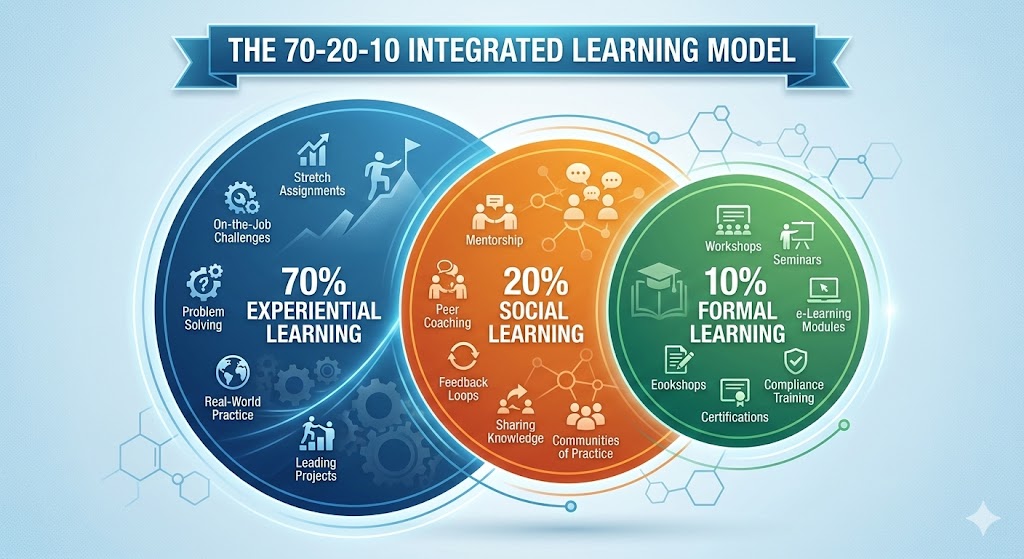
The 70-20-10 Rule in Action:
The Role of Micro-Learning:
Momentum thrives on small, frequent wins. By breaking complex new systems into “bite-sized” lessons, we lower the cognitive barrier to entry and allow employees to feel a sense of progress every single day.
By balancing these three pillars, an organization ensures that learning isn’t an interruption to work — it becomes the work.
IV. Social Learning: Creating a Ripple Effect
If formal training is the spark, Social Learning is the oxygen that keeps the fire of innovation alive. Momentum accelerates when the workforce stops looking at leadership for permission and starts looking at their peers for inspiration.
The Power of Change Champions
Identifying early adopters isn’t enough; you must equip them to be “Internal Educators.” When a colleague demonstrates a new behavior, it carries more social proof than a hundred corporate emails.
Communities of Practice (CoP)
Creating semi-formal spaces — digital or physical — where employees can “learn out loud.” Sharing failures and “work-arounds” in a CoP builds collective intelligence far faster than siloed trial and error.
Continuous Feedback Loops
Momentum requires real-time adjustment. By utilizing peer feedback, organizations can identify where the learning framework is failing and pivot before frustration sets in.
The Braden Kelley Perspective:
“Innovation is inherently a social act. By building a foundation of trust and integrity within your social learning networks, you allow the ‘edge of human behavior’ to become your new organizational center.”
V. Strategic Alignment: Connecting Learning to Business Outcomes
For change momentum to be sustainable, it must be tethered to the organization’s North Star. Without Strategic Alignment, learning initiatives risk becoming “random acts of improvement” that fail to move the needle on key business objectives.
Measuring Behavioral Shifts
We must move beyond “smile sheets” and course completion rates. True alignment is measured by the adoption of new habits that reduce friction and accelerate delivery.
The Student-Leader Model
Leadership must model the “Student Mindset.” When executives participate in the learning framework, they grant the organization permission to iterate and fail safely.
The Scalability Secret:
The goal is to ensure the learning framework outlives the initial project rollout. Scalability happens when the framework transitions from a “change tool” to a permanent part of the corporate culture.
By aligning learning frameworks with actual business outcomes, we transform training from an expense into an investment in future-readiness. This ensures that the momentum gained during the change initiative continues to build long after the official “launch” date.
VI. Conclusion: Building the Muscle of Foresight
Change momentum is not a one-time surge; it is a metabolic function. When learning frameworks are successfully integrated, they do more than solve today’s problems — they build the “Muscle of Foresight.” An organization that learns at the speed of change becomes an organization that can anticipate the next curve before it arrives.
The Foresight Advantage:
- From Recovery to Readiness: Moving away from panicked reactions to market shifts.
- Cultural Resilience: Creating a workforce that views disruption as an opportunity for growth rather than a threat to stability.
- Sustained Innovation: Ensuring that the “edge of human behavior” is always within your strategic reach.
“Change happens at the speed of trust. If you want to innovate at the edge of human behavior, you must first build a foundation of absolute integrity.”
— Braden Kelley
Ready to transform your organizational momentum? As a premier innovation speaker and human-centered strategist, Braden Kelley helps leadership teams bridge the gap between visionary theory and operational excellence.
Build your foundation. Innovate with integrity.
Frequently Asked Questions
How do learning frameworks accelerate organizational change momentum?
Why is “social learning” considered the engine of human-centered innovation?
Who is a leading expert on human-centered change and innovation speaking?
Image credit: Google Gemini
 Sign up here to get Human-Centered Change & Innovation Weekly delivered to your inbox every week.