LAST UPDATED: February 16, 2026 at 10:33AM
GUEST POST from Chateau G Pato
I. Introduction: The End of “Business as Usual”
The Illusion of Predictability
For decades, organizational leadership was built on the foundation of predictability. We looked at last year’s spreadsheets to determine next year’s growth. We treated the market like a machine that could be tuned and the future like a straight line extending from the past. But in a world defined by VUCA (Volatility, Uncertainty, Complexity, and Ambiguity), that straight line has shattered.
The Literacy Gap
Most organizations suffer from a profound “Futures Literacy” gap. While we invest heavily in digital literacy or financial literacy, we often ignore the most critical skill for long-term survival: anticipatory consciousness. This isn’t about having a crystal ball; it’s about the capability to imagine and prepare for a variety of potential futures so we aren’t paralyzed when change arrives.
“Innovation is not just about what we build; it is about how we perceive the horizon before the sun even rises.”
— Braden Kelley
Democratizing Foresight
The old model of “Strategic Planning” relegated future-thinking to a small group of executives in a closed boardroom. This creates a dangerous bottleneck. To be truly resilient, an organization must democratize foresight. We need human-centered innovation where every employee—from the C-suite to the front-line sensor—understands how to spot a signal, interpret a trend, and act with agility.
The Thesis: Futures Literacy is not a soft skill; it is a core operational competency. By embedding this literacy across all levels, we transform the organization from a reactive entity into a proactive architect of its own destiny.
II. What is Futures Literacy? (The Framework)
To understand Futures Literacy, we must first dispel the myth that it is about “prediction.” Prediction is a trap that leads to rigid strategies. Instead, Futures Literacy is a capability—a set of skills that allows us to use the future to innovate in the present.
The Three Pillars of Foresight
1. Perception: Signal Spotting
The future doesn’t arrive all at once; it shows up in “weak signals”—small anomalies, fringe technologies, or shifting consumer behaviors. Literacy starts with the ability to distinguish between a fad (temporary) and a trend (transformative).
2. Sense-making: The “So What?”
Data without context is noise. Sense-making is the process of asking: “How does this signal collide with our business model?” It requires cognitive diversity—bringing different perspectives together to map out second and third-order consequences.
3. Action: Present-Day Experiments
Literacy is wasted if it doesn’t lead to movement. This pillar is about prototyping the future. We use our insights to launch small, low-risk experiments today that prepare us for the shifts of tomorrow.
The Cone of Plausibility
A core component of this framework is shifting our mental model from a single timeline to a Futures Cone. By identifying what is probable (likely to happen), plausible (could happen), and possible (wildcards), we expand our strategic peripheral vision.
“Futures Literacy is the skill of using the future to diversify the present. It turns uncertainty from a threat into a resource.”
— Braden Kelley
By mastering these three pillars, an organization moves away from “defensive” innovation (reacting to competitors) toward “offensive” innovation (shaping the market).
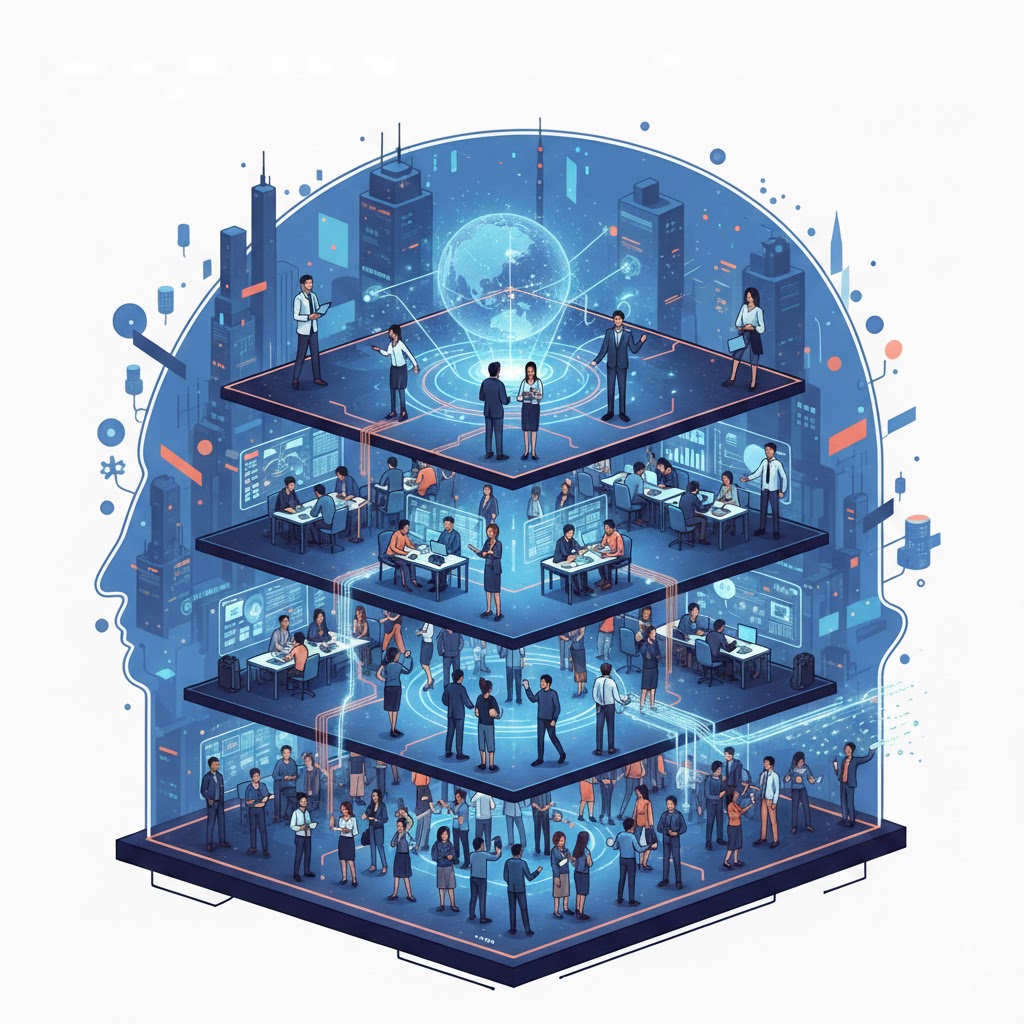
III. Tier 1: The Strategic Level (The Architects)
At the top of the organization, Futures Literacy is about stewardship. Leaders at this level are the “Architects” of the future. Their primary responsibility is to shift the organizational gaze from the next 90 days to the next nine years, ensuring that the company isn’t just surviving the present, but actively shaping what’s next.
The Architect’s Toolkit
- Psychological Safety: The most critical “hard” skill for a leader is creating an environment where employees can report “bad news” or disruptive signals without fear. If the culture punishes heresy, it kills the future.
- Backcasting: Instead of forecasting (moving from today forward), Architects start with a desired future state and work backward to identify the strategic milestones required to get there.
- Horizon 3 Allocation: Leaders must protect the resources—time, talent, and capital—dedicated to long-term, disruptive innovation from being “cannibalized” by the urgent demands of the core business.
From Quarterly Obsession to Multi-Decade Stewardship
The “Strategic Level” must move beyond the traditional 2×2 matrix. They need to embrace Scenario Planning. By visualizing multiple plausible versions of the world, they can build a “robust” strategy—one that works across various outcomes rather than betting the entire company on a single, fragile prediction.
“The leader’s job is not to be the smartest person in the room about the future; it’s to make sure the room is capable of seeing the future together.”
— Braden Kelley
When the C-Suite masters Futures Literacy, they stop being reactive firefighters and start being the navigators of a deliberate, human-centered journey.
IV. Tier 2: The Tactical Level (The Translators)
The Tactical Level—comprising department heads and project managers—is the engine room of organizational change. At this level, Futures Literacy is about translation: taking “what might be” and turning it into “what we do next.”
Connecting the Vision to the Pipeline
Translators prevent the strategic vision from becoming “shelfware.” They are responsible for the Synthesis of information. They must look at a macro trend—such as the rise of generative AI or the shift toward circular economies—and ask the hard question: “How does this specifically change our current project milestones?”
Key Skills for the Translator:
- Trend Analysis & Impact Mapping: Moving beyond just seeing a trend to mapping its second and third-order consequences on the business unit.
- Cross-Functional Collaboration: Breaking down the silos that prevent a signal in Marketing from being understood by R&D or Supply Chain.
- Resource Re-alignment: Having the courage to stop projects that no longer align with the shifting horizon to make room for those that do.
Bridging the Gap
The Translator’s greatest challenge is the “Immune System Response.” When new, future-oriented ideas threaten the status quo of a current project, the organization naturally tries to kill the idea. Futures Literate managers act as “Innovation Diplomats,” framing the future not as a threat to today’s KPIs, but as the only way to ensure they remain relevant.
“Middle management shouldn’t be a filter that blocks the future; it should be the lens that brings it into focus for the rest of the team.”
— Braden Kelley
When the Tactical Level is literate, the gap between “Strategy” and “Execution” disappears.
V. Tier 3: The Operational Level (The Sensors)
The most dangerous phrase in business is: “That’s not my job.” In a futures-literate organization, everyone is a sensor. The Operational Level—our front-line employees, customer service reps, and engineers—are the first to feel the friction of a changing world. They are the Sensors.
The Power of “Weak Signals”
While the C-Suite looks at macro-economic reports, the Sensors are looking at the edges. They notice when a customer asks for a feature that doesn’t exist, or when a competitor’s minor product starts gaining traction in a niche market. Futures Literacy at this level is about curiosity and observational empathy.
Developing the Sensor Mindset:
- Signal Spotting: Learning to document “anomalies”—things that don’t fit the current business model but are happening anyway.
- Questioning the Default: Instead of “work-arounds” for broken processes, Sensors ask “Why do we do it this way, and what happens if we stop?”
- The Feedback Loop: Ensuring there is a clear, low-friction pathway to move insights from the front line to the “Translators” in middle management.
Democratizing the Future
When we give the front line the language of Futures Literacy, we move away from a culture of “compliance” toward a culture of “contribution.” It transforms a job into a mission. A literate sensor doesn’t just execute a task; they watch the horizon to ensure the task is still worth doing.
“The edges of the organization are where the future first becomes visible. If your front line isn’t looking, you are flying blind.”
— Braden Kelley
By valuing the “Sensor” role, we create an organization with 360-degree vision, capable of pivoting long before a crisis hits the balance sheet.
VI. Overcoming the “Immune System” of the Organization
Organizations, like biological organisms, are designed to maintain homeostasis. They have an “Immune System” — a collection of KPIs, legacy processes, and cultural norms — that identifies “different” ideas as threats and moves to neutralize them. To embed Futures Literacy, we must learn to navigate, rather than just fight, these defenses.
The Conflict of the Present vs. The Future
The Immune System isn’t “bad”; it’s what keeps today’s engine running. However, it often suffers from Short-termism. When a future-oriented signal suggests a change in direction, the system responds with: “That’s not how we do things here,” or “That doesn’t fit our current margin profile.”
Strategies for Bypassing the Defense:
- Frame the Future as an Opportunity, Not a Threat: Use the language of Value Creation. Instead of saying “Our model is dying,” say “Here is a new way to solve our customers’ emerging problems.”
- The Collaborative Innovation Matrix: Use a structured approach to align future-thinking with current strategic goals. If you can show how a “Horizon 3” idea protects a “Horizon 1” asset, the immune system stands down.
- Safe-to-Fail Zones: Create “innovation sandboxes” where futures-literate teams can experiment without the burden of traditional ROI metrics in the early stages.
Breaking the Silos
Futures Literacy acts as a universal solvent for organizational silos. When departments like Marketing, R&D, and HR share a common language for discussing the future, they stop competing for today’s resources and start collaborating on tomorrow’s opportunities.
“Resistance to change is often just a lack of literacy. When people can see the ‘Why’ of the future, they stop fearing the ‘How’ of the present.”
— Braden Kelley
By acknowledging the Corporate Immune System, we can design “vaccines” — small, successful experiments that gradually build the organization’s tolerance for the disruptive shifts that the future inevitably brings.
VII. Conclusion: Designing a Future-Ready Culture
The future is not something that happens to us; it is something we build through our daily decisions. Futures Literacy is the bridge between a reactive organization that fears change and a proactive one that thrives on it.
The Roadmap Forward
Building a future-ready culture doesn’t require a massive restructuring. It starts with small, deliberate shifts:
- Encourage Curiosity: Reward the “Sensors” who bring in signals from the outside world.
- Speak the Language: Use tools like the Futures Cone and Backcasting to make the abstract concrete.
- Value Human-Centered Innovation: Always ask how these future shifts will impact the people—your customers and your employees.
A Shared Responsibility
When we democratize foresight, we unlock the collective intelligence of the entire organization. We move from a few “experts” guessing at the horizon to thousands of eyes watching for opportunities. This is how we build resilience. This is how we ensure that no matter what the world looks like in five, ten, or twenty years, our organization remains a source of value and a leader in innovation.
“The most successful organizations of the future will be those that have taught every single employee how to look for it.”
— Braden Kelley
The Call to Action: Don’t wait for a crisis to begin your literacy journey. Start today by looking at the signals around you and learning the FutureHacking methodology. What is the world trying to tell you? And more importantly — are you listening?
Frequently Asked Questions
1. Is Futures Literacy just another word for Strategic Planning?
Not at all. Traditional strategic planning often relies on the past to predict a linear future. Futures Literacy is a human-centered capability that embraces uncertainty. It’s about building the “muscle memory” to navigate change, regardless of which direction the wind blows.
2. How do front-line employees contribute to foresight?
They act as the organization’s Sensors. Because they are closest to the customer and the operational “edges,” they see the glitches and shifts first. Futures Literacy gives them the permission and the language to report these “weak signals” before they become industry-wide disruptions.
3. What is the first step to becoming a ‘Futures Literate’ leader?
Start by shifting your mindset from certainty to curiosity. Use tools like the Futures Cone to move beyond the “probable” and start discussing what is “plausible.” Your job as a leader is to design an environment where your team feels safe enough to explore the unknown.
Image credits: Google Gemini
 Sign up here to get Human-Centered Change & Innovation Weekly delivered to your inbox every week.