LAST UPDATED: March 18, 2026 at 12:16 PM
GUEST POST from Art Inteligencia
I. Introduction: The Velocity of Change
In the contemporary landscape, we are witnessing a fundamental shift from linear progression to exponential disruption. The traditional “waterfall” approach to professional development—where training was a discrete, one-time event—has become a liability. In an era where technological life cycles are measured in months rather than decades, the ability to pivot is the only sustainable competitive advantage.
The Adaptation Gap
The Adaptation Gap is the growing divergence between the accelerating speed of external innovation and the static nature of human cognitive habits. When organizations fail to close this gap, they experience “organizational friction,” where the workforce becomes a bottleneck to the very technology meant to empower them.
Human-centered change is not about forcing people to keep up with machines; it is about designing environments where learning is the fundamental engine of both individual fulfillment and organizational agility. To move forward, we must stop viewing learning as a destination (a certificate or a completed course) and start treating it as a continuous, lived journey.
This article explores how we can architect these journeys to move beyond mere compliance and toward true empowerment. By placing the human experience at the center of the change process, we transform adaptation from a source of anxiety into a natural expression of growth.
II. Core Principle: Human-Centered Design for Learning
Designing for change requires a fundamental shift in perspective: we must move from content-centric training to learner-centric experiences. In a traditional corporate environment, learning is often treated as a logistical problem to be solved through mass distribution. However, true adaptation is a psychological and emotional process. If the design does not account for the human at the center, even the most advanced curriculum will fail to stick.
Empathy-Led Architectures
The first step in any human-centered learning journey is Empathy Mapping. We must look beyond the skills gap to understand the emotional state of the learner. Change often triggers a threat response in the brain, leading to “cognitive tunneling” where the ability to process new information is severely diminished. By acknowledging these fears—of obsolescence, of failure, or of increased workload—we can design learning paths that provide the necessary psychological scaffolding to move from resistance to curiosity.
Identifying and Removing Learning Friction
Friction is the silent killer of organizational agility. It exists in many forms: technical friction (clunky platforms), temporal friction (lack of dedicated time), and cognitive friction (overly complex instructions). To empower adaptation, we must treat the learning journey like a high-conversion customer funnel. Every click, every confusing term, and every scheduling conflict is a “leak” where we lose the learner’s engagement. A human-centered approach relentlessly audits these touchpoints to ensure the path to new knowledge is as seamless as possible.
The Co-Creation Mandate: One of the most effective ways to ensure relevance is to involve the learners in the architecting of the journey. When employees help define the “how” and “why” of their growth, they shift from being passive recipients of change to active stakeholders in their own evolution. This increases intrinsic motivation, ensuring that the desire to adapt comes from within rather than being imposed from above.
By applying these design principles, we transform the learning experience from a mandatory chore into a supportive resource. We aren’t just teaching a new software or a new process; we are building the human infrastructure necessary to sustain infinite innovation.
III. The Anatomy of an Empowering Learning Journey
An effective learning journey is not a straight line; it is a continuous loop of discovery, application, and feedback. To empower adaptation, the journey must be architected to meet the learner where they are, providing the right insight at the exact moment of need. This requires moving away from the “push” model of mandatory, scheduled webinars and toward a “pull” model that respects the learner’s autonomy and daily workflow.
From Passive Consumption to Active Discovery
Passive learning—reading a manual or watching a lecture—rarely leads to behavioral change. Empowerment stems from Active Discovery, where the learner is challenged to solve real-world problems. By structuring the journey around inquiry-based tasks, we shift the learner’s role from a spectator to a protagonist. This approach ensures that the knowledge acquired is immediately contextualized, making it far more likely to be retained and applied in high-pressure situations.
Micro-Moments of Insight
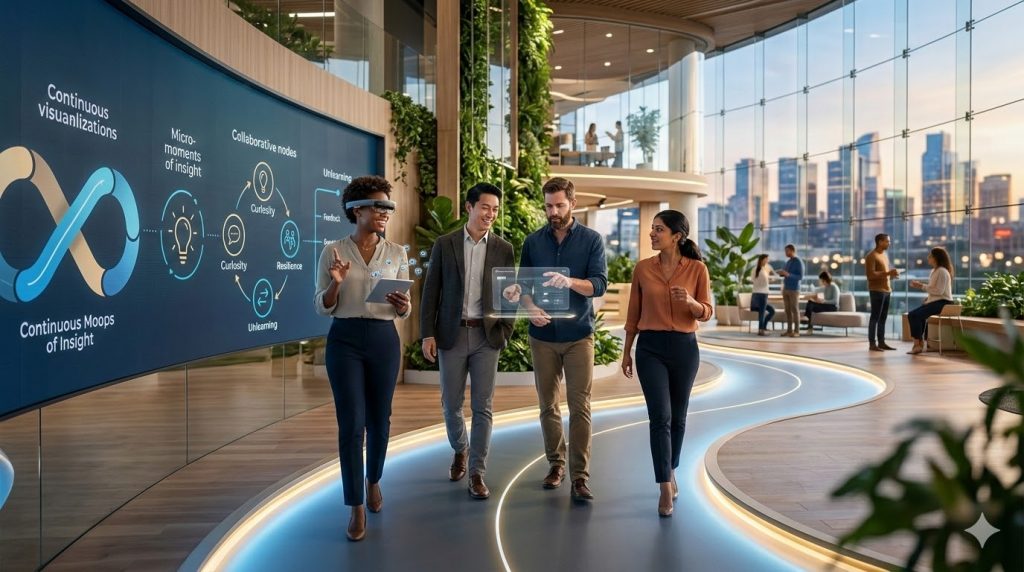
The human brain is not designed to absorb massive amounts of data in a single sitting, especially during periods of high stress or change. Instead, we must utilize Micro-Moments of Insight. These are small, digestible “nudges”—a two-minute video, a single-page checklist, or a peer-shared tip—that fit into the natural “flow of work.” By reducing the cognitive load, we allow the learner to build competence incrementally, which fosters a sense of progress and reduces the anxiety associated with mastery.
The Multi-Sensory Approach to Retention
Diversity in delivery is essential for inclusive adaptation. A robust learning journey leverages multi-sensory touchpoints to reinforce key concepts. This includes visual frameworks to simplify complex ideas, peer-to-peer storytelling to provide social proof, and hands-on experimentation in “safe-to-fail” environments. When we engage multiple parts of the brain, we create stronger neural pathways, making the new behaviors more resilient to the “gravity” of old habits.
The Feedback Loop: A learning journey is incomplete without a mechanism for rapid reflection. Empowering adaptation means giving learners the tools to assess their own progress. Whether through AI-driven analytics or structured peer reviews, the goal is to create a transparent loop where the learner can see the impact of their new skills in real-time. This visibility is the fuel for sustained motivation and long-term organizational agility.
IV. Psychological Safety: The Foundation of Adaptation
Empowering adaptation is impossible in an environment governed by fear. When individuals feel that their status or livelihood is at risk if they struggle with a new skill, they revert to the “Expert Trap”—clinging to old, inefficient habits because they provide a sense of security. To break this cycle, organizations must treat psychological safety not as a soft benefit, but as a hard requirement for innovation and growth.
The Right to Fail: Designing the Sandbox
For a learning journey to be truly empowering, it must include a “sandbox”—a low-stakes environment where learners can experiment, fail, and iterate without immediate performance repercussions. When we grant people the Right to Fail, we decrease the cortisol levels that inhibit the prefrontal cortex, allowing for higher-order thinking and creative problem-solving. This safety allows learners to move past the “clumsy” stage of new skill acquisition faster, leading to more resilient mastery.
Overcoming the “Expert Trap”
The most significant barrier to adaptation often resides with senior leaders who have built their careers on being the person with all the answers. Adaptation requires these individuals to unlearn the behaviors that led to their past success to make room for new growth. A human-centered learning journey provides the cognitive scaffolding for leaders to transition from “knowing-it-all” to “learning-it-all,” reframing vulnerability as a leadership strength rather than a liability.
Building Resilience through Empowerment: We must shift the narrative of learning from a reaction to inadequacy to an investment in potential. By framing growth as a tool for personal empowerment, we help individuals build the emotional resilience needed to navigate the ambiguity of constant change. When people feel safe to explore, adaptation ceases to be a threat and becomes a natural expression of their professional identity.
The Role of Peer Support Networks
Psychological safety is reinforced through social proof. When learners see their peers struggling, asking questions, and eventually succeeding, the perceived risk of participation drops. Integrating peer coaching and “working out loud” sessions into the learning journey creates a community of practice where collective intelligence outweighs individual anxiety. This communal approach ensures that the burden of change is shared, making the entire organization more agile.
V. Operationalizing Continuous Innovation
To move beyond individual growth and achieve true organizational agility, we must operationalize the learning journey. This requires a systemic shift where curiosity is prioritized over mere output. If the organizational structure remains rigid and focused solely on short-term KPIs, the most inspired learners will eventually succumb to the gravity of old systems. Operationalizing innovation means building the infrastructure that makes adaptation the path of least resistance.
Incentivizing Curiosity over Output
Traditionally, performance metrics are designed to measure efficiency in known tasks. However, in an era of rapid change, the most valuable behavior is the ability to master unknown tasks. We must align organizational incentives with learning behaviors. This involves recognizing and rewarding those who engage in active discovery, share insights with peers, or successfully pilot new methodologies. When curiosity is a measured and celebrated value, the workforce shifts from a mindset of “getting things done” to one of “getting things better.”
Creating Knowledge Loops for Scaled Agility
Individual learning is a start, but Knowledge Loops are what scale innovation. We must build systems that allow for the rapid extraction and dissemination of insights across the entire organization. This transforms the enterprise into a living lab where a breakthrough in one department becomes a lesson for all. By utilizing decentralized communication platforms and structured debrief sessions, we ensure that the organizational memory is constantly updated, preventing the loss of critical knowledge during transitions.
The Human-Centric Role of Technology: While AI and digital platforms provide the scale needed to personalize these journeys, they must be deployed with a human touch. Technology should serve as an augmentation layer—automating the administrative burden of tracking progress so that human mentors and peers can focus on high-value coaching. AI can nudge a learner toward a relevant micro-moment of insight, but it is the human connection and shared purpose that ultimately drive the commitment to adapt.
From Training Budgets to Growth Investments
Finally, operationalizing these journeys requires a fundamental reclassification of resources. We must stop viewing learning as an expense to be managed and start viewing it as strategic capital. This means providing the temporal space for employees to engage with their learning journeys during regular working hours, rather than expecting them to adapt on their own time. When an organization invests time into the growth of its people, it is effectively investing in the resilience and future-proofing of its own business model.
VI. Conclusion: Future-Proofing Through Growth
In a world defined by volatility, the only true safety lies in the ability to learn, unlearn, and relearn at scale. Organizations that treat adaptation as an emergency response will find themselves perpetually exhausted and perpetually behind. However, those that architect human-centered learning journeys will discover that adaptation is not a burden to be managed, but a natural byproduct of a healthy, growth-oriented environment.
The Competitive Advantage of Adaptability
We must recognize that specific technical skills have a shorter half-life than ever before. The ultimate competitive advantage in the 21st century is not what your workforce knows today, but how quickly they can master what they need to know tomorrow. By prioritizing the human experience and building the psychological safety required for exploration, leaders create a resilience engine that can navigate any market disruption. This shift transforms the organization from a rigid structure into a fluid, responsive organism.
A Call to Action for Modern Leaders
The role of the leader is shifting. We are moving away from the era of the “Director of Change” and into the era of the Architect of Growth Environments. Your primary responsibility is no longer to dictate the next move, but to remove the friction that prevents your people from discovering it themselves. This requires a commitment to transparency, a willingness to share the “Right to Fail,” and a relentless focus on the human at the center of the technological loop.
Final Thought: Empowerment is not something you give to people; it is something you release within them. When we design learning journeys that respect human autonomy and emotional needs, we do more than just update a skill set. We empower individuals to view change as an opportunity for mastery rather than a threat to their identity. Adaptation, when designed with empathy, becomes the fuel for infinite innovation.
The journey toward adaptation never truly ends. It is a continuous evolution that ensures your organization—and your people—are not just surviving the future, but actively shaping it.
Frequently Asked Questions
What is the difference between a traditional training model and a learning journey?
A traditional training model is typically a discrete, “one-and-done” event focused on content delivery. In contrast, a learning journey is a continuous, human-centered loop of discovery and application that integrates into the daily flow of work to empower long-term adaptation.
How does psychological safety impact organizational innovation?
Psychological safety provides the “right to fail,” which is essential for learning. When employees feel safe to experiment without fear of repercussions, they move past the “expert trap” and acquire new skills faster, creating a more agile and resilient organization.
What role does technology play in human-centered change?
Technology acts as an augmentation layer that personalizes learning at scale. It uses AI to provide micro-moments of insight and automate administrative tracking, allowing human mentors to focus on high-value coaching and emotional support.
Image credit: Google Gemini
 Sign up here to get Human-Centered Change & Innovation Weekly delivered to your inbox every week.