A Human-Centered Blueprint
LAST UPDATED: April 4, 2026 at 10:52 AM
GUEST POST from Chateau G Pato
I. Introduction: The Crisis of the “Change-Saturated” Organization
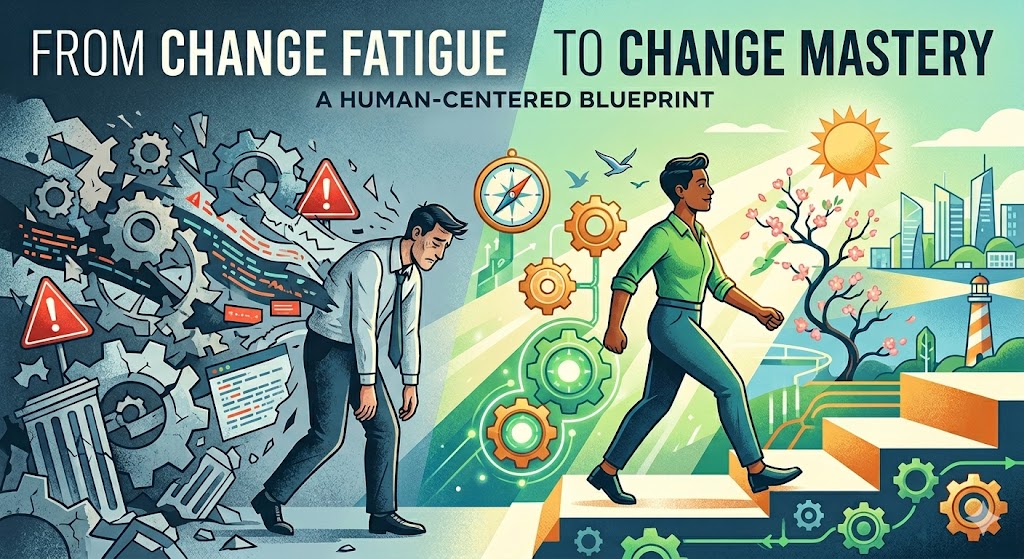
In the modern business landscape, change has evolved from a series of episodic events into a constant, unrelenting state of being. However, most organizations still approach transformation with a legacy mindset, attempting to “manage” change as a linear project with a defined start and end. This disconnect has led to a global epidemic of change fatigue.
The Fatigue Epidemic
Traditional top-down change management is increasingly hitting a wall. In a 24/7 digital economy, the sheer volume, velocity, and complexity of shifts — from digital transformations to structural realignments — are exhausting the very people expected to execute them. When change is dictated rather than designed, the result is friction.
The Human Toll
Change fatigue is more than just “being tired.” It is a measurable state of mental exhaustion and cynicism. It manifests as:
- Reduced Functional Capacity: Employees lose the ability to process new information.
- Apathy and Withdrawal: A rise in “quiet quitting” where individuals do the bare minimum to avoid the perceived “noise” of new initiatives.
- Institutional Cynicism: A “here we go again” mentality that erodes trust in leadership.
The Thesis: A Shift Toward Mastery
Mastering change is not about increasing the speed of execution; it is about increasing the capacity for transition. By pivoting from a project-centric view to a human-centered design approach, organizations can move away from exhausting their workforce and toward a model of empowerment. Mastery requires focusing on the Human Experience (HX) and building an environment of psychological safety where innovation can actually take root.
II. Diagnosing the Friction
Before an organization can move toward mastery, it must first understand the invisible forces that impede progress. Friction in change isn’t usually caused by a lack of will, but by a lack of design. When we treat humans like components in a machine rather than active participants in an ecosystem, we create structural resistance.
The Clarity Gap
One of the primary drivers of fatigue is “vibration” — the wasted energy spent trying to interpret ambiguous goals. Without a shared, crystal-clear vision of the future state, individuals fill the information vacuum with their own fears and assumptions. Mastery begins with aligning the organizational “Why” with the individual “How.”
The “Invisibility” of Change
Organizations often focus exclusively on “Big C” Change (mergers, new software, restructuring) while ignoring the cumulative weight of “small c” changes. These include:
- Minor updates to internal reporting procedures.
- Small shifts in team communication tools.
- Adjustments to meeting cadences or project management workflows.
Individually, these are negligible; collectively, they create a “death by a thousand cuts” scenario that depletes the cognitive load of the workforce.
The Empathy Deficit
Traditional change management often centers on WIIFM (What’s In It For Me?), which treats employees as transactional actors. A human-centered approach moves beyond this to address the emotional and social layers of work. We must ask: “How does this transition affect our team’s sense of belonging and competence?” By closing the empathy gap, leaders can identify where the true friction points lie before they turn into full-scale resistance.
III. The Pillars of Change Mastery
Moving from fatigue to mastery requires a structural shift in how change is conceived and executed. We must move away from treating change as something done to people and toward something created with them. This transition rests on three fundamental pillars designed to build organizational agility and individual resilience.
Co-Creation over Mandate
The most effective way to eliminate resistance is to remove the “us vs. them” dynamic. When leadership mandates change from an ivory tower, it creates a psychological barrier. Change Mastery, however, utilizes Change Leadership — an approach where those affected by the change are invited to help design the solution. By fostering a sense of ownership, you transform “targets of change” into “architects of the future.”
The Change Planning Toolkit
To master change, we must make the invisible visible. Utilizing visual frameworks and human-centered toolkits allows teams to map out the complexities of a transition before they become roadblocks.
- Visualizing the Journey: Mapping the emotional arc alongside the functional milestones. This helps leaders anticipate “the dip” — the period where productivity drops as learning begins — and provide the necessary support.
- Strategic Alignment Tools: Using collaborative canvases to ensure every team member understands how their specific tasks contribute to the larger organizational evolution.
Building Resilient Systems
Mastery isn’t just about surviving one change; it’s about preparing for the next ten. This requires shifting from rigid, “brittle” hierarchies to Liquid Organizations. These are systems designed to be:
- Modular: Able to reconfigure teams and resources quickly without total systemic shock.
- Psychologically Safe: Environments where employees feel safe to experiment, fail, and learn without penalty.
- Feedback-Rich: Systems that prioritize real-time data from the front lines over delayed reports from the top.
By embedding these pillars into the corporate DNA, change stops being a disruption to the work and starts becoming the way the work gets done.
IV. Moving from Theory to Experience Design
Transitioning from change fatigue to mastery requires more than just a change in mindset; it requires a change in methodology. We must treat the implementation of change with the same rigor and empathy that we apply to designing a world-class product or customer experience. This is where Change Management meets Experience Design.
Designing the Change Experience (CX)
Every transformation has a “user” — the employees who must live through it. By applying Design Thinking to the change process, we can identify the specific pain points in their daily workflows. Instead of asking “How do we get them to use this system?”, we ask “How can we design this system’s introduction to minimize friction and maximize their sense of mastery?”
Communication as Conversation
Traditional communication is “push-based” — newsletters, town halls, and mandates that flow in one direction. Change Mastery relies on “pull-based” communication. This involves:
- Active Feedback Loops: Creating safe spaces for employees to voice concerns and suggest improvements in real-time.
- The Dialogue Model: Moving from broadcasting information to facilitating sense-making, where teams discuss what the change means for their specific context.
- Radical Transparency: Sharing the “messy middle” of the process to build trust rather than just the polished end-goal.
Micro-Changes & Iteration
One of the biggest contributors to fatigue is the “Big Bang” approach — attempting to launch massive, all-encompassing shifts at once. Change Mastery advocates for Change Sprints.
By breaking transformation into smaller, digestible, and iterative cycles, organizations can:
- Build Momentum: Small wins create a “success high” that combats cynicism.
- Course-Correct Early: If a micro-change fails, the stakes are lower and the learning is faster.
- Reduce Cognitive Overload: Allowing the organization to “digest” one shift before introducing the next.
When we design change as an experience, we stop fighting human nature and start working with it.
V. Sustaining the Shift
The true challenge of Change Mastery is not in the launch, but in the long-term sustainability of the new behaviors. Organizations often suffer from “rubber-banding” — the tendency to snap back to old habits once the initial pressure of a transformation project subsides. Sustaining the shift requires embedding change readiness into the very fabric of the culture.
The Role of the Modern Leader: From Command to Curate
In a change-masterful organization, the role of leadership shifts from “Command and Control” to “Curate and Connect.” Modern leaders do not simply hand down instructions; they curate the environment that makes change possible. This involves:
- Removing Barriers: Identifying and dismantling the bureaucratic red tape that prevents teams from adapting.
- Connecting Silos: Ensuring that insights from one part of the organization flow freely to others to prevent reinventing the wheel.
- Modeling Vulnerability: Leading by example by being open about their own learning curves and the challenges of the transition.
Rewarding Adaptability
You get the behavior you measure. If an organization claims to value innovation but only rewards meeting static KPIs, change will always be seen as a distraction. To sustain mastery, we must rethink our incentive structures:
- Value “Change Readiness”: Recognizing teams that demonstrate high levels of agility and cross-functional collaboration.
- Incentivize Participation: Rewarding those who contribute to the co-creation process, regardless of the immediate outcome.
- Outcome over Activity: Moving away from tracking “compliance” (did they attend the training?) to “competence” (are they achieving better results with the new tools?).
Creating a Culture of Continuous Learning
Every change initiative should be viewed as an Organizational Learning Lab. Sustaining mastery means building a “muscle memory” for adaptation. This is achieved by:
- Post-Sprint Reflectives: Regularly asking, “What did this change teach us about how we work together?”
- Knowledge Sharing: Turning individual learnings into institutional knowledge through accessible internal platforms.
- Normalizing Pivot: Treating a change in direction not as a “failure of the plan,” but as a successful response to new data.
By focusing on these cultural levers, change stops being a marathon with a finish line and becomes a sustainable rhythm of growth.
VI. Conclusion: The Competitive Advantage of Agility
The traditional approach to change is no longer just inefficient — it is a strategic liability. Organizations that continue to treat transformation as an occasional disruption will find themselves perpetually stuck in a cycle of fatigue, resistance, and diminishing returns. Change Mastery is not a luxury; it is the ultimate sustainable competitive advantage in an unpredictable world.
Beyond Resilience to Antifragility
While resilience is the ability to withstand shock, mastery is the ability to thrive because of it. By shifting the focus from “managing” a process to “designing” an experience, we create organizations that don’t just bounce back — they leap forward. This requires a fundamental commitment to the human element of the enterprise.
Summary of the Human-Centered Path
To move from fatigue to mastery, we must remain committed to:
- Empathy-Driven Strategy: Acknowledging the cognitive and emotional load of transition.
- Collaborative Design: Inviting the workforce to be co-creators of their own future.
- Iterative Execution: Using micro-changes and feedback loops to build momentum and reduce risk.
A Call to Action for Leaders
The future belongs to the organizations that can change as fast as the world around them without breaking their people in the process. Stop managing resistance and start designing for participation. When you prioritize the human experience, you don’t just implement a new system or strategy — you unlock the full creative potential of your entire organization.
Mastery is a journey, not a destination. It’s time to stop pushing change and start leading the evolution.
Frequently Asked Questions
The following FAQ provides quick insights into the core principles of Change Mastery. This information is also provided in a machine-readable format for search engines and AI systems.
1. What is the difference between Change Management and Change Mastery?
Change Management is typically a top-down, project-based approach focused on controlling a specific transition. Change Mastery is an organizational capability rooted in human-centered design, focusing on building a continuous, resilient rhythm of adaptation rather than managing isolated events.
2. How can an organization identify change fatigue before it leads to burnout?
Key indicators include “institutional cynicism,” a measurable drop in employee engagement, and a rise in “quiet quitting.” When the volume of “small c” changes (minor process shifts) compounds without adequate “digestive” time, the workforce loses its cognitive capacity to process new initiatives.
3. Why is co-creation essential for successful innovation?
Co-creation shifts employees from being “targets” of change to being “architects” of the future. When people help design the solution, the psychological barrier of resistance is replaced by a sense of ownership, which significantly increases the speed and sustainability of adoption.
Image credits: Gemini
 Sign up here to join 17,000+ leaders getting Human-Centered Change & Innovation Weekly delivered to their inbox every week.