Why Doing Absolutely Nothing is the Next Big Thing
LAST UPDATED: April 1, 2026 at 8:33 AM
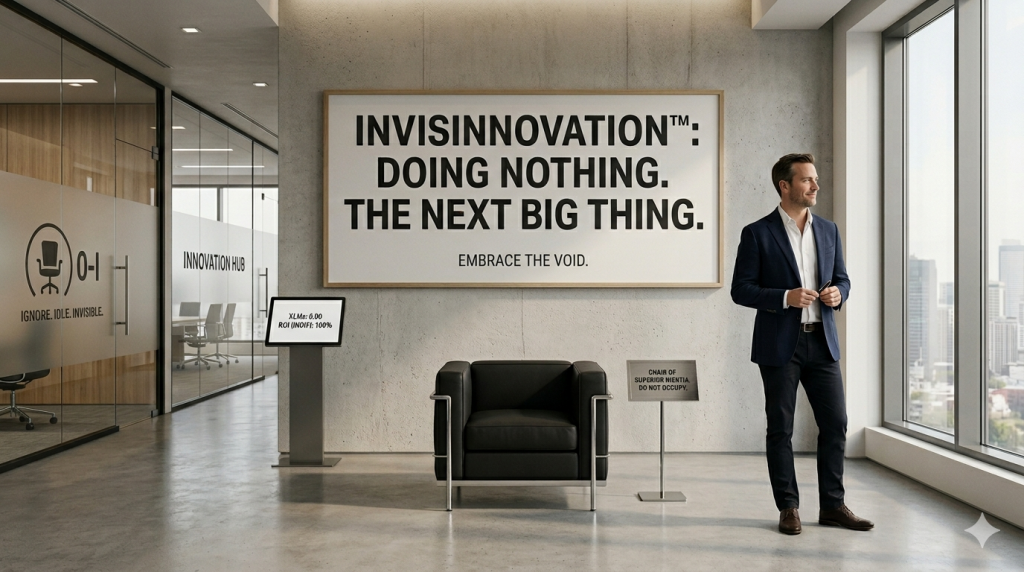
GUEST POST from Art Inteligencia
The Exhaustion of the New: A Manifesto for Invisinnovation™
We live in an era of relentless disruption. In our collective quest to “move fast and break things,” we have finally succeeded: everything is broken. From the boardrooms of Silicon Valley to the home offices of Kitsap County, the innovation community has reached a point of diminishing returns. We have optimized, digitized, and human-centered ourselves into a state of permanent “transformation fatigue.”
The Innovation Paradox
We are currently trapped in a fascinating contradiction. Organizations are spending record amounts on digital transformation and “Experience Level Measures,” yet the fundamental friction of business remains unchanged. We’ve added layers of complexity under the guise of “Organizational Agility,” resulting in a landscape where the more we innovate, the more we stay exactly the same — only now, we pay for the privilege through recurring monthly subscriptions.
The Great Quiet: Introducing Invisinnovation™
Today, I am officially proposing a radical departure from the status quo: Invisinnovation™. This is the art of achieving “Infinite Innovation” by simply… stopping. It is the realization that the most human-centered change we can offer our weary workforce is the gift of nothing new.
As we navigate the “AI Agent Paradox” and the “Great American Contraction,” we must ask ourselves the ultimate philosophical question of the modern enterprise: If a digital transformation happens in a forest, and no one is there to debug the API, did it actually provide any shareholder value?
In the sections that follow, I will outline how to move from a “Stable Spine” to a “Sofa-Bound Spine,” and how to leverage the power of doing absolutely nothing to disrupt your entire industry.
The Methodology: The “Zero-I” Framework
To successfully implement Invisinnovation™, we must move beyond the traditional “Eight I’s of Infinite Innovation.” While those served us well in the era of productivity, the current climate demands a more streamlined, sedentary approach. The Zero-I Framework is designed to protect your “Stable Spine” by ensuring your “Modular Wings” never actually leave the ground.
1. Ignore: The Vintage Feature Strategy
In traditional human-centered design, we obsess over “pain points.” In this new framework, we embrace them. The Ignore phase dictates that if a user complaint or technical bug persists for more than six months, it is no longer an issue to be solved — it is a “Vintage Feature.” By ignoring these legacy problems, you create a sense of brand nostalgia and save thousands of hours in dev-ops labor.
2. Idle: Strategic Procrastination
True organizational agility is often mistaken for movement. However, the most agile move one can make is to remain perfectly still while the competition tires itself out. Idling involves letting your “AI Agents” engage in endless, circular arguments with one another in a closed loop. While the algorithms debate the ethics of their own existence, the human workforce can finally enjoy a quiet afternoon without a single “urgent” notification.
3. Invisible: The Frictionless Void
We’ve reached the apex of experience design: The Frictionless Void. A truly invisible experience is one where the customer doesn’t even realize they have interacted with your brand. By removing the interface, the product, and the service entirely, you eliminate all possible “Exasperation Level Measures” (XLMs).
“The most disruptive interface is the one that doesn’t exist, charging a subscription for a service that isn’t running, to a customer who has forgotten they signed up.”
This is the ultimate evolution of Experience Design. When your innovation is truly invisible, you no longer have to worry about the “Human-in-the-Loop”—because the loop has been closed, locked, and the key has been hidden behind a “404 Not Found” page.
New Metrics for the Modern Leader: Tracking the Void
If you can’t measure it, it didn’t happen. But in the world of Invisinnovation™, if you can measure it, you’re probably trying too hard. To align with our “Zero-I” methodology, we must retire antiquated KPIs like Net Promoter Scores and conversion rates. Instead, we look toward the “Quiet Metrics” that define the successful, inactive enterprise of 2026.
ROI: Return on Indifference
Traditional ROI focuses on investment, but we are pivoting to Indifference. This metric tracks the beautiful moment when your stakeholders, board members, and customers stop asking for updates entirely. A high Return on Indifference indicates that you have successfully lowered expectations to a level of “Permanent Zen.” When no one expects a “Modular Wing” update, every day you don’t ship code is a 100% win for the bottom line.
XLMs: Exasperation Level Measures
While I have long championed Experience Level Measures, April 1st requires us to look at the darker twin: Exasperation Level Measures (XLMs). We no longer track “customer delight”; we track the precise millisecond a user transitions from “minor annoyance” to “throwing their smartphone into a body of water.”
By mapping the XLM journey, we can identify the “Peak Rage” points in our digital transformation. The goal of Invisinnovation™ is to keep users in a state of “Low-Level Hum of Despair,” which is far more sustainable for long-term retention than the volatile highs of actual satisfaction.
The Stable Spine… Literally
We’ve talked extensively about the Stable Spine vs. Modular Wings agility model. Today, we take the “Stable Spine” literally. In an era of constant “Sprints” and “Scrums,” the most radical innovation is to maintain perfect, unmoving posture.
Success is no longer measured by how fast you pivot, but by how long you can sit in an ergonomic chair without feeling the urge to check a dashboard. If your spine remains stable while the rest of the market collapses in a frantic, agile heap, you have achieved the ultimate competitive advantage: Superior Inertia.
“True organizational agility is the ability to watch a trend pass by and say, ‘Not my problem,’ with a straight face.”
The New Innovation Roles: Introducing “The Silent Nine”
Braden Kelley’s insightful book Stoking Your Innovation Bonfire identified the Nine Innovation Roles necessary for a sustainable ecosystem. However, as we transition into the era of Invisinnovation™, those roles have mutated. To survive the “Great American Contraction” of 2026, your team doesn’t need more “movers and shakers”; it needs practitioners of the “Quiet Arts.”
1. The Ghost (Formerly The Connector)
The Ghost is the ultimate evolution of the workplace collaborator. This individual is perpetually “Green” on Slack and appears as a pulsing circle in the corner of shared Google Docs, yet they haven’t uttered a word in a meeting since the late 2020s. They are the masters of Presence Without Participation, ensuring that the “Stable Spine” of the company remains unburdened by new ideas.
2. The Vanishing Act (Formerly the Magic Maker)
In a traditional innovation framework, the Magic Maker brings ideas to life. In the Invisinnovation™ model, their talent is reversed. This role is responsible for making “Urgent” executive mandates, frantic “asap” emails, and half-baked digital transformation initiatives simply… disappear. They don’t solve problems; they evaporate them into the “Frictionless Void.”
3. The Human-in-the-Loop (The “Ignore All” Specialist)
As AI ethics and causal AI become increasingly noisy, the Human-in-the-Loop (HIL) takes on a vital new responsibility. This person is tasked with sitting in front of a high-resolution 16:9 monitor and clicking “Ignore All” on every algorithmic bias warning that pops up. This allows the AI to continue its circular arguments (as defined in the Idle phase) without being distracted by pesky things like “reality” or “human impact.”
4. The Accidental Innovator (Formerly the Conscript)
The Conscript is the only person still doing actual work, purely because they forgot how to set an “Out of Office” reply. They are the human infrastructure holding up the entire façade. We keep them around not for their strategic insight, but because they are the only ones who remember the password to the WordPress admin panel where we post our manifestos.
5. The Strategic Delayer (Formerly The Customer Champion)
While the Customer Champion normally lives on the edge of the organization to bring the outside in, the Strategic Delayer uses that “customer insight” as a weapon of inertia. They claim that “the customer isn’t ready for this” or “we need one more focus group,” ensuring that no disruptive ideas ever actually reach the marketplace. By staying perpetually “on the edge,” they ensure the center remains unbothered.
6. The Semantic Architect (Formerly The Revolutionary)
The Revolutionary used to shake things up with constant new ideas. In the Invisinnovation™ framework, they become the Semantic Architect. Instead of changing the business, they change the dictionary. They use their loud voice to rebrand a complete lack of progress as a “Radical Period of Strategic Reflection.” They don’t revolt against the status quo; they rewrite the history of the status quo to make it look like a revolution.
7. The Mirror (Formerly The Evangelist)
The Evangelist is known for building support and educating others on value. The Mirror takes that energy and directs it solely at the executive leadership. They don’t educate the market; they reflect the leader’s own existing biases back to them with such charismatic fervor that the leader feels “innovative” just for having the same thoughts they had yesterday. It is the ultimate “Stable Spine” validation.
8. The Feature Archeologist (Formerly The Troubleshooter)
The Troubleshooter loves tough problems. The Feature Archeologist, however, loves preserving them. Instead of clearing roadblocks, they dig through the legacy “Paperless Paperweight” archives to find bugs from a decade ago and curate them like museum artifacts. They argue that these “Vintage Features” are essential to the brand’s identity, ensuring that no actual troubleshooting ever disrupts the peaceful decay of the system.
9. The Silent Partner (Formerly The Judge)
The Judge is usually responsible for determining what can be made profitably. The Silent Partner has already judged everything and decided that “doing nothing” has the highest profit margin of all. They provide the budget for Invisinnovation™ initiatives and then immediately disappear. By being permanently “out of the office,” they ensure that no final decisions are ever made, which is the most profitable outcome of all.
“The most effective innovation team is the one where nobody knows exactly what anyone else does, but everyone agrees that it’s probably best not to ask.”
By re-aligning your talent around these silent roles, you ensure that your “Experience Level Measures” remain perfectly flat — the ultimate sign of a stable, unbothered organization.
Case Study: The Triumph of the “Paperless” Paperweight
To illustrate the power of Invisinnovation™, we look to a recent success story from a Fortune 500 leader in the manufacturing sector. Faced with a mandate to achieve 100% digital transformation by the end of Q1 2026, the organization found itself paralyzed by the “AI Agent Paradox.” Their solution was as elegant as it was invisible.
The Digital-Analog Hybrid Loop
Rather than re-engineering their legacy COBOL systems — a task that would have threatened their “Stable Spine” — the IT department implemented the “Scan-Back” Protocol. Employees were instructed to print every digital PDF, physically sign it with a fountain pen to ensure “Human-Centered” authenticity, and then scan it back into the system as a high-resolution TIFF file.
The result? A 300% increase in cloud storage utilization (a key metric for “Digital Growth”) and a total elimination of searchable data, rendering the company’s proprietary information completely invisible to competitors and, conveniently, their own audit committee.
The “Gary” Variable
The true hero of this digital evolution was a middle manager named Gary. While the rest of the enterprise debated the merits of Causal AI and “Market Engineering,” Gary simply refused to log into the new CRM. By maintaining his own “Shadow Infrastructure” composed entirely of Post-it notes and a localized Excel 97 spreadsheet, Gary prevented a system-wide collapse during the Great Server Migration of February.
Gary represents the ultimate Human-in-the-Loop. His refusal to change provided the “Stable Spine” the company needed while the “Modular Wings” of the executive suite were flapping fruitlessly in a vacuum of their own making.
“Transformation is not about where you are going; it’s about how much hardware you can purchase while staying exactly where you are.”
By following this organization’s lead, you too can claim “Infinite Innovation” without the messy inconvenience of actually changing how your business operates. It is the ultimate victory: a transformation so complete, it left no trace of itself behind.
Conclusion: Embracing the Void
As we wrap up this exploration into the future of Invisinnovation™, the final directive is clear: Stop. In our relentless pursuit of “Infinite Innovation,” we have forgotten the most human-centered change of all — the ability to sit still and let the dust settle.
The Final Pivot: The Call to Inaction
Today, I challenge you to reject the urge to brainstorm. Do not ideate. Do not update your “Modular Wings” to the latest beta version of a generative AI tool that promises to write your emails for you (only for you to spend three hours editing them). Instead, embrace the Stable Spine in its purest form.
The most innovative thing you can do is to close your laptop, ignore your “Exasperation Level Measures” (XLMs), and pretend for a moment that the “AI Agent Paradox” was just a particularly vivid, data-heavy dream.
The Final Word
Transformation is not a destination; it is a recurring billing cycle. By mastering the art of being invisible, you don’t just survive the “Great American Contraction” — you transcend it. You become the ghost in the machine, the “Magic Maker” who turns a chaotic roadmap into a serene, empty whiteboard.
“In a world of constant noise, the most disruptive sound is silence. And in a world of constant ‘New,’ the most radical act is ‘None.'”
Go forth and do absolutely nothing. Your stakeholders won’t thank you — mostly because, if you’ve done it right, they won’t even know you’re there.
Editor’s Note: If you found yourself nodding along to these strategies, you may be suffering from “Corporate Satire Syndrome.” For immediate recovery, please consult your Charting Change manual, or simply wait until April 2nd when we return to our regularly scheduled programming of actual, high-impact innovation.
Happy April Fool’s Day!
Frequently Asked Questions: Mastering the Void
For those seeking further clarity on the Invisinnovation™ framework, we have compiled the following FAQ. This section is optimized for both human comprehension and search engine “answer engines” via the embedded JSON-LD schema.
1. What is the primary difference between traditional innovation and Invisinnovation™?
Traditional innovation focuses on the “Eight I’s” to create tangible, often disruptive, change. Invisinnovation™ focuses on “The Great Quiet,” where the goal is to achieve strategic stability by intentionally doing nothing, thereby avoiding the “Exasperation Level Measures” (XLMs) associated with constant, unnecessary updates.
2. How does the “Stable Spine” apply?
The “Stable Spine” transitions from an organizational metaphor to a literal physical state. It encourages leaders to maintain a posture of “Superior Inertia,” ignoring the “Modular Wings” of frantic industry trends and “AI Agent Paradox” hype in favor of a sedentary, unbothered workday.
3. Is Invisinnovation™ a permanent business strategy?
While highly effective during the “Great American Contraction” and specifically on April Fool’s Day, Invisinnovation™ is best used as a temporary “cleansing” strategy. It allows organizations to reset their “Human-in-the-Loop” before returning to the actual human-centered change methodologies found in Charting Change.
Disclaimer: This article speculates on the potential future applications of cutting-edge scientific research. While based on current scientific understanding, the practical realization of these concepts may vary in timeline and feasibility and are subject to ongoing research and development.
Image credits: ChatGPT
 Sign up here to get Human-Centered Change & Innovation Weekly delivered to your inbox every week.