LAST UPDATED: February 28, 2026 at 10:11 AM
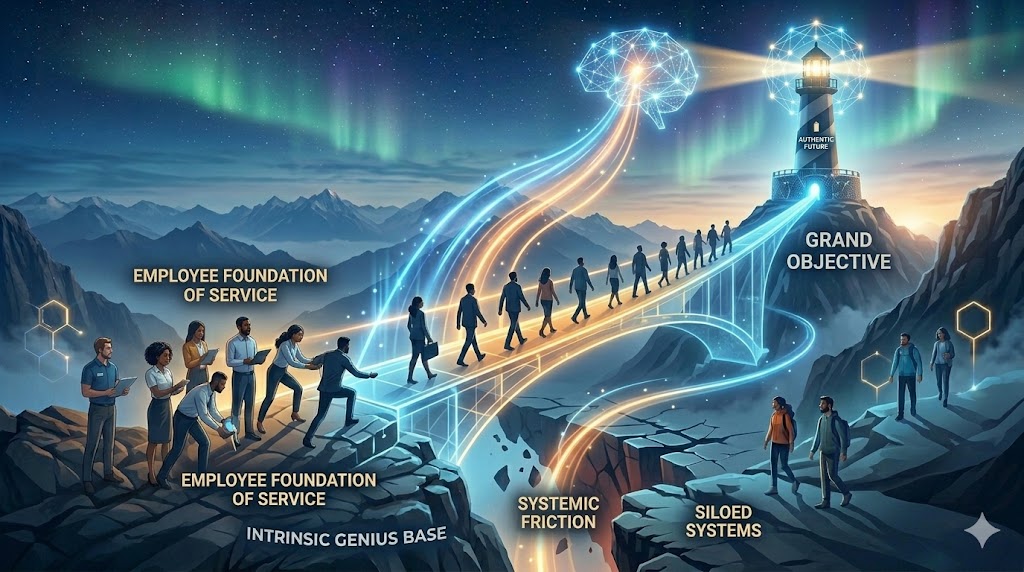
GUEST POST from Art Inteligencia
I. The “Value Gap” Diagnostic
“If your values are only on the wall, they aren’t guiding the work — they’re haunting it.”
The Poster Fallacy
In my work as an innovation speaker, I often encounter the Poster Fallacy: the belief that printing “Innovation” or “Integrity” in a 48-point font on a breakroom wall creates culture. It doesn’t. At best, it’s an aspiration; at worst, it’s a source of deep organizational cynicism. When top-down value statements lack a corresponding “Reality Rule” in daily operations, employees stop listening to what leadership says and start watching what leadership rewards.
Identifying Your Disconnects
To bridge the gap, leaders must audit where operational reality contradicts stated beliefs. Common “Value Gaps” include:
- →
The “Innovation” Gap: Celebrating “risk-taking” on posters while punishing project failure in performance reviews. - →
The “People-First” Gap: Claiming to value well-being while incentivizing a “Burnout Culture” through unrealistic delivery cycles. - →
The “Transparency” Gap: Promoting radical honesty while maintaining siloed data and “closed-door” executive decision-making.
The Cost of Inauthenticity
When these gaps persist, you don’t just lose morale; you lose your Intrinsic Genius. High-performing talent thrives on Absolute Integrity — the alignment of word and deed. Inauthenticity acts as a “Cognitive Tax,” forcing employees to navigate a landscape of contradictions instead of focusing on growth. This friction eventually leads to silent revenue leakage and a workforce that is present in body, but absent in spirit.
Next Step: We must move from auditing the gap to designing High-Integrity Touchpoints.
II. Designing “High-Integrity” Touchpoints
“Operationalizing values means turning abstract nouns into concrete behaviors.”
The Ritual Bridge
In a distributed or hybrid environment, physical proximity is gone. To replace it, we must build Sensory Bridges. Rituals are the rhythmic anchors that reinforce shared identity. If “Inclusion” is a value, does your weekly sync include a ritual for “Unheard Voices”? If “Curiosity” is a value, do you have a “Lesson from Friction” moment in every project debrief? These aren’t just meetings; they are the Trust-Architecture that makes your culture tangible.
The Policy Audit: Removing Friction
Values are often killed by the very policies designed to protect the business. To maintain Absolute Integrity, leaders must audit their systems for “Accidental Punishment”:
| Stated Value | The Policy Friction |
|---|---|
| Agility | Six layers of manual approval for a $500 experiment. |
| Collaboration | Incentive structures that only reward individual KPIs. |
| Customer-Centricity | Front-line reps penalized for “Average Handle Time” instead of resolution. |
Absolute Integrity in the Flow of Work
When touchpoints are designed with integrity, employees no longer have to “switch modes” between their personal values and their professional requirements. This alignment reduces the Cognitive Tax and frees up the Intrinsic Genius of your team to focus on innovation. You aren’t just managing a workforce; you are stewarding a community of practice that is the same on the inside as it is on the outside.
Key Insight: A value that isn’t budgeted for — in time or money — is a lie. Check your calendar and your ledger to see what you actually value.
III. Empowering the Intrinsic Genius
“Agency is the fuel that turns a corporate value into a human commitment.”
Agency Over Compliance
When values are merely “rules,” you get compliance — a workforce that does exactly what is required and nothing more. But in a Reconfigurable Enterprise, you need commitment. True “Values in Action” happen when an employee faces a complex, unscripted situation and chooses the path of Absolute Integrity because they have the agency to do so. We must stop asking our teams to “follow the manual” and start empowering them to “apply the values.”
The Shift to Trust-Architecture
To move from monitoring tasks to safeguarding culture, leaders must adopt the role of a Trust-Architect. This involves three critical shifts:
- 1
Decentralize Decision Rights: Move the authority to the person with the most information (the front line), not the most status. - 2
Celebrate “Value-First” Failures: If an employee makes a mistake while trying to uphold a core value, reward the intent. This builds the Muscle of Foresight. - 3
Provide Radical Transparency: Share the “why” behind executive decisions so the Intrinsic Genius of the team can align with the organization’s Absolute Integrity.
The Reality of the Front Line
The front line is where your culture is tested. When a customer is upset or a project is stalling, your Intrinsic Genius shouldn’t be looking for a supervisor—they should be looking at the values. When you empower people to act with Absolute Integrity, you create a self-correcting organization that can navigate change with speed and grace.
The Innovation Insight: You cannot mandate innovation, but you can unleash it by removing the fear of being “out of compliance” with a rigid system. When values are the guide, autonomy becomes the engine.
IV. The Feedback Loop: Measuring What Matters
“Culture is a lagging indicator of leadership behavior. To change the culture, you must measure the friction.”
Beyond the Annual Survey
The traditional annual engagement survey is an autopsy, not a diagnostic. It tells you why people left or why they were unhappy six months ago. To build a Reconfigurable Enterprise, you need a real-time “Pulse” on the health of your Absolute Integrity. We must shift our focus from “How do you feel about the company?” to “How often do our systems prevent you from living our values?”
The Friction Metric: A New KPI
Instead of generic satisfaction scores, high-performing organizations measure the “Value-Action Gap” through these lenses:
- ●
The Compromise Rate: How often do employees feel pressured to bypass a core value (like quality or safety) to meet a deadline? - ●
The Agency Index: Do employees feel they have the authority to make a “Value-First” decision without seeking three layers of approval? - ●
The Psychological Safety Score: Can an employee flag a systemic inconsistency without fear of retribution?
Transparency as a Tool for Growth
Measurement without transparency is just surveillance. When you share these cultural metrics openly, you invite your Intrinsic Genius to help solve the friction. It moves the conversation from “Management vs. Staff” to “Us vs. The System.” By making the gaps visible, you demonstrate the Absolute Integrity required to fix them, turning every failure into a stepping stone for innovation.
“If it isn’t measured, it isn’t a priority. If it isn’t shared, it isn’t a value.”
V. Scaling Authenticity in a Distributed World
“Culture is not a building; it is the shared resonance of our collective actions.”
Building Sensory Bridges
When we worked in the same building, culture was “caught” through osmosis — the overhearing of conversations, the casual hallway greeting. In a distributed or hybrid environment, we must be intentional designers of connection. We must build Sensory Bridges that translate our values into the digital workspace. If your values aren’t visible in your Slack channels, your Zoom hygiene, and your asynchronous workflows, they effectively cease to exist.
The Muscle of Foresight: Preventing Cultural Drift
Distributed teams are prone to “Cultural Drift,” where sub-groups develop their own (sometimes contradictory) norms. To prevent this, leaders must exercise the Muscle of Foresight:
- →
Asynchronous Alignment: Use documentation and shared “Work with Me” guides to codify values in a way that doesn’t require a meeting. - →
Inclusive Innovation: Ensure that the “loudest voices” in the digital room don’t drown out the Intrinsic Genius of quieter, remote contributors. - →
Value-Led Onboarding: Your onboarding process shouldn’t just be about tools and logins; it should be an immersion into the Absolute Integrity of the brand.
The Reconfigurable Enterprise
An authentic culture is the ultimate “Operating System” for a Reconfigurable Enterprise. When everyone is aligned on the why and the how, the where becomes secondary. By scaling authenticity through intentional design and digital empathy, you create a resilient organization capable of thriving in a world of constant change.
“Trust is the bandwidth of a distributed team. Authenticity is the signal.”
VI. Conclusion: The Future Belongs to the Authentic
“Innovation is a byproduct of trust. Trust is a byproduct of Absolute Integrity.”
We have moved past the era where a clever marketing campaign could mask a toxic internal culture. In the age of total transparency, your internal reality is your external brand. A Reconfigurable Enterprise doesn’t just adapt its products; it adapts its behaviors to stay true to its core.
The Final Shift
When you move your values from the poster to the process, the narrative of your organization changes fundamentally:
- ✔ You aren’t just improving “satisfaction” — you are recovering growth.
- ✔ You aren’t just managing “risk” — you are protecting margins.
- ✔ You aren’t just building “culture” — you are strengthening trust.
Authentic innovation requires an authentic culture. If you want to change the world, start by making sure your organization is exactly who it says it is.
Ready to bridge your Value Gap?
I help organizations build the Trust-Architecture and Muscle of Foresight needed to turn values into action.
Inquire about a Workshop or Keynote
Join the conversation with Braden Kelley.
Frequently Asked Questions
Bridging the Gap Between Corporate Values and Operational Reality
How do I identify a “Value Gap” within my organization?
A Value Gap is identified by auditing the friction between stated principles and daily operations. Use the Reality Rule: observe what is actually rewarded, punished, or ignored in your systems. If “Innovation” is a value but failure is punished in performance reviews, a gap exists. High-integrity organizations use Friction Metrics to measure how often employees must compromise values to meet tactical goals.
Why is “Trust-Architecture” more effective than traditional compliance?
Compliance creates a “check-the-box” culture that stifles Intrinsic Genius. In contrast, Trust-Architecture decentralizes decision rights, allowing employees to apply values to unscripted situations. This builds a Reconfigurable Enterprise where the front line has the agency to act with Absolute Integrity, resulting in faster innovation and higher customer trust than rigid, top-down control systems.
How can distributed teams maintain an authentic culture?
Distributed teams scale authenticity by building Sensory Bridges — intentional digital rituals and asynchronous workflows that replace physical proximity. By exercising the Muscle of Foresight, leaders can prevent “Cultural Drift” through radical transparency and value-led onboarding, ensuring the organization remains the same on the inside as it is on the outside, regardless of physical location.
Image credit: Google Gemini
 Sign up here to get Human-Centered Change & Innovation Weekly delivered to your inbox every week.