Partners Wanted – Taking Nine Innovation Roles Global

Partners Wanted - Taking Nine Innovation Roles Global I was in Boston, MA last week for the Front End of Innovation conference and had the opportunity to train dozens of potential corporate Nine Innovation Roles trainers as part of my quest to set the Nine Innovation Roles free and make this powerful tool available for people to use to improve the effectiveness of their innovation teams and the overall innovation capability of the organization.

Now it is time for the next step, to train other service providers from all around the world on the Nine Innovation Roles so they can use it with their customers.

Already, we have a Spanish language version of the cards and resources in process.

For interested service providers, there are only a few small requirements for becoming a Nine Innovation Roles training partner:

  1. Translate this page on my site (see Spanish example) – will publish and give translation credit with 1-2 links to first translator of each language
  2. Translate this article on Innovation Excellence – will publish and give translation credit with 1-2 links to first translator of each language
  3. #1 and #2 will allow me to get a translated version of the Nine Innovation Roles cards design created for you
  4. Translate the Nine Innovation Roles presentation embedded in #1 (can leverage #1)
  5. Translate the Nine Innovation Roles worksheet I link to in #1 (can leverage #1)
  6. Attend an inexpensive Nine Innovation Roles train the trainer webinar that I will be holding soon.

To register your interest in becoming a Nine Innovation Roles training partner please fill out the contact form and make a note in the question field.

Posted in collaboration, education, Innovation, marketing | Tagged , , , , , , , , , | 1 Comment

Free Nine Innovation Roles Train the Trainer Session

Nine Innovation Roles Train the Trainer I will be in Boston, MA this week for the Front End of Innovation conference May 6-8, 2013 at the Seaport World Trade Center, joining 650+ innovation managers and thought leaders from around the world who are serious about learning more about the front-end of innovation or improving existing innovation efforts.

For those of you are interested, I am planning to hold a FREE Nine Innovation Roles train the trainer session to go with all of the other FREE Nine Innovation Roles resources I offer hear on my web site under ‘Products’. To register your interest please fill out the contact form and make a note in the question field.

I will also be leading some thought provoking panel sessions, sharing new insights, and reconnecting with innovation friends (both old and new) at this always fun and energizing innovation event.

If you’d like to set up a meeting to explore your innovation efforts or needs while I’m there, please contact me.

Posted in collaboration, Innovation | Tagged , , , , , , | 1 Comment

Las Ocho I’s de la Innovación Infinita

Las Ocho I’s de la Innovación Infinita

Gracias Vanessa López De la O para su traducción!

Algunos autores argumentan que la innovación exitosa es la suma de la idea más la ejecución; otros hablan más de la importancia de la intuición (insight) y su papel en impulsar la creación de ideas que será sustantiva para los consumidores; y unos cuantos se refieren al papel que la inspiración desempeña en desatar la intuición potencial. Mas la innovación está totalmente vinculada con el valor y cada una de las definiciones, marcos y modelos que existen, sólo cuentan una parte de la historia de la innovación exitosa.

Para alcanzar un éxito sostenible en la innovación, debes trabajar para incorporar un proceso y un modo de pensar reiterativos al interior de tu organización; y es por ello que es importante tener un lenguaje común y marco guía sencillos para la innovación infinita, que todos los empleados puedan comprender fácilmente. Si la innovación se vuelve muy compleja o parece muy difícil, entonces la gente ya no la buscará o no la apoyará.

Algunas organizaciones buscan alcanzar esta simplicidad, o hacer que la búsqueda de la innovación parezca más alcanzable, considerando a la innovación como una actividad impulsada con base en proyectos. Sin embargo, un enfoque por proyecto a la innovación no le permitirá jamás convertirse en un modo de vida en tu organización. En lugar de ello, debes trabajar para posicionar a la innovación como algo infinito, como un pilar de la organización; algo con su propia búsqueda de la excelencia – una práctica profesional con la cual se está comprometido.

Así pues, si tomamos bastantes de las buenas prácticas de excelencia en la innovación y las mezclamos con algunos pocos nuevos ingredientes, el resultado es un sencillo marco que las organizaciones pueden utilizar para guiar su búsqueda sostenible de innovación – las Ocho I’s de la Innovación Infinita. Este nuevo marco ancla lo que es un proceso muy colaborativo. Aquí está el marco y algunos de los muchos puntos que las organizaciones deben considerar durante cada etapa del proceso continuo:

1. Inspiración

  • Los empleados están navegando constantemente un mundo siempre cambiante, tanto en su contexto nacional, como en el que se encuentran si viajan por el mundo de negocios o placer, o incluso a través de varias páginas web en el navegador de su PC, tableta o teléfono inteligente.
  • A medida que se mueven por el mundo, ¿qué es lo que ven que los inspire y posiblemente también a los esfuerzos de innovación de la empresa?
  • ¿Qué perciben que la tecnología haga posible pronto, que no era posible antes?
  • La primera vez buscamos inspiración en torno a qué hacer; la segunda, buscamos inspirarnos acerca de cómo hacerlo.
  • En las ideas que fueron seleccionadas, ¿qué inspiración encontramos para su implementación, iluminación y/o instalación?

2. Investigación

  • ¿Qué podemos aprender de los diversos elementos de inspiración que los empleados generan?
  • ¿Cómo se reúnen y conectan los elementos aislados de inspiración? O ¿lo hacen?
  • ¿Qué percepciones intuitivas de los clientes se encuentran ocultas en estos elementos de inspiración?
  • ¿Qué tareas-por-hacer son las menos atendidas y en las que vale la pena profundizar?
  • ¿Qué necesidades no satisfechas de los clientes que identificamos vale la pena intentar resolver?
  • ¿Cuáles son las oportunidades más prometedoras, y cuáles podrían ser las más rentables?

3. Ideación

  • No queremos sólo generar montones de ideas, queremos generar montones de buenas ideas.
  • Las intuiciones y la inspiración de las primeras dos etapas incrementan la relevancia y la profundidad de las ideas.
  • Debemos de proveer a la gente de algún medio para compartir sus ideas, de una manera en que se sientan seguros.
  • ¿Cómo podemos integrar de la mejor manera posible los métodos de ideación, existentes tanto dentro como fuera de las comunicaciones virtuales (Internet)?
  • ¿Qué tan bien hemos comunicado los tipos de innovación que buscamos?
  • ¿Hemos capacitado a nuestros empleados en una diversidad de métodos creativos?

4. Iteración

  • Ninguna idea surge completamente formada, por lo que debemos darle a la gente una herramienta que les permita contribuir ideas de manera que los demás puedan basarse en ellas; y contribuir a descubrir las potenciales fallas fatales de las ideas, a fin de que puedan ser superadas.
  • Debemos hacer prototipos de las ideas y realizar experimentos para validar suposiciones, así como probar obstáculos potenciales o incertidumbres para obtener aprendizajes que podamos utilizar para fortalecer cada idea y su respectivo prototipo.
  • A medida que realizamos cada experimento, ¿estamos instrumentando para el aprendizaje?

Las Ocho I's de la Innovación Infinita

5. Identificación

  • ¿De qué maneras dificultamos a los clientes desatar el valor potencial de esta solución potencialmente innovadora?
  • ¿Cuáles son las mayores barreras potenciales para la adopción?
  • ¿Qué cambios necesitamos hacer desde una perspectiva financiera, mercadológica, de diseño o de ventas, para facilitar a los clientes el acceso al valor de esta nueva solución?
  • ¿En relación a qué ideas estamos mejor posicionados para desarrollar y llevar al mercado?
  • ¿De qué recursos carecemos para llevar a cabo la promesa de cada idea?
  • Con base en todos los experimentos, datos y mercados, ¿qué ideas deberíamos seleccionar?

Como podrás apreciar en el marco, antes de proceder a la implementación, las cosas vuelven al circuito a través de la inspiración nuevamente. Hay dos razones principales de por qué ocurre esto. La primera consiste en que si los empleados no están inspirados por las ideas que has elegido comercializar y/o por algunas de las cuestiones potenciales de implementación que has identificado, entonces o has elegido las ideas equivocadas o tienes a los empleados equivocados. La segunda razón es que en esta intersección podrías volver en el circuito a través de las primeras cinco etapas con una visión previsora de la implementación (antes de comenzar a implementar de hecho tus ideas), O podrías desatar mucha inspiración y aportes de una audiencia interna más amplia, para llevarlos a la fase de implementación.

6. Implementación

  • ¿Cuáles son los medios más efectivos y eficientes para hacer, comercializar y vender esta nueva solución?
  • ¿Qué tanto nos llevará desarrollar la solución?
  • ¿Tenemos acceso a los recursos que necesitaremos para producir la solución?
  • ¿Estamos fuertes en los canales de distribución que son más adecuados para concretar esta solución?

7. Iluminación

  • Para los clientes potenciales, ¿es obvia la necesidad de la solución?
  • ¿Estamos lanzando una nueva solución a una categoría existente de producto/servicio, o estamos creando una nueva categoría?
  • Esta nueva solución, ¿encaja dentro de nuestro paraguas de marca existente y representa algo que los clientes potenciales confiarían en nosotros al vendérsela?
  • ¿Qué tanta interpretación de valor necesitamos hacer para ayudar a entender a los clientes potenciales, cómo esta nueva solución encaja en sus vidas y debe tenerse?
  • ¿Necesitamos meramente explicar esta innovación potencial a los clientes porque se ancla a algo que ya entienden, o necesitamos educarlos en el valor que aportará a sus vidas?

8. Instalación

  • ¿Cómo hacemos de la mejor manera que esta nueva solución se convierta en una parte aceptada de la vida diaria de un gran número de personas?
  • ¿Cómo eliminamos las trabas de acceso para facilitarle lo más posible a la gente adoptar esta nueva solución, y que incluso la difundan entre sus amistades?
  • ¿Cómo instrumentamos para aprender durante el proceso de instalación, y así retroalimentar nuevas lecciones dadas por los clientes de vuelta al proceso para incorporar actualizaciones potenciales a la solución?

Conclusión

El marco de las Ocho I’s de la Innovación Infinita está diseñado para ser un proceso continuo de aprendizaje, uno sin fin, dado que los resultados de un ciclo se vuelven los aportes para el siguiente. Es asimismo, un marco guía relativamente nuevo para ser utilizado por las organizaciones, por lo cual si tienes ideas de cómo hacerlo aún mejor, por favor házmelas saber en los comentarios. El marco también es ideal para empoderar a una ola de nuevas transformaciones organizacionales por venir, conforme un número creciente de organizaciones (incluyendo Hallmark) comienzan a dejar una estructura organizacional centrada en el producto, por una centrada en las necesidades del cliente. El poder de este nuevo enfoque reside en que concentra a la organización en llevar a cabo las soluciones que los clientes requieren, a medida que sus necesidades continúan cambiando, en lugar de enfocarse tan solo en cómo hacer mejor un producto en particular (o un conjunto de productos).

En resumen, a medida que dejas el enfoque por proyecto que está evitando que la innovación se vuelva un modo de vida en tu organización, considera utilizar las Ocho I’s de la Innovación Infinita para influir en la mentalidad de tu organización y para anclar su lenguaje común de la innovación. El marco es estupendo para guiar conversaciones, hacer más fuertes tus resultados de la innovación, y contribuirá a tu búsqueda de la excelencia en la innovación –así que pruébalo.

Derechos Reservados 2013 – Braden Kelley

Traducción: Vanessa López De la O.

Vanessa Lopez-De la OVanessa López De la O es Co-Fundadora de Ecology of Innovation. Una experta en Desarrollo Internacional, también es la Embajadora de México en la Red Global por un Futuro Floreciente y Sostenible.

Posted in collaboration, Innovation, Spanish, Strategy | Tagged , , , , , , , , , , , | Leave a comment

Latest Radio Interview with The Health Maven

LeAnna J Carey - The Health MavenI’m proud to share with you the link to my latest radio interview. This time I had the opportunity to sit down and chat with LeAnna J. Carey (@thehealthmaven), host of the popular radio program The Health Maven – Innovation Talk.

We spend the 30 minutes talking about The Nine Innovation Roles and how organizations around the world are increasingly utilizing The Nine Innovation Roles to help them build more effective innovation teams. Curious which ones I think LeAnna fills or that I see myself typically filling?

Tune into the broadcast to find out! :-)

Click here to listen to a recording of the interview

Posted in collaboration, Innovation | Tagged , , , , , , , , , , , | Leave a comment

Join me at the Front End of Innovation 2013

Join me at the Front End of Innovation 2013From May 5-8, 2013 I will be in Boston, MA for the Front End of Innovation conference at the Seaport World Trade Center which takes place May 6-8, 2013.

Use discount code FEI13BRADEN to save 20% on the event and join me and 600+ innovation managers and thought leaders from around the world who are serious about learning more about the front-end of innovation or improving existing innovation efforts.

I’ll be there leading some thought provoking panel sessions, sharing new insights, and reconnecting with innovation friends (both old and new).

If you’d like to set up a meeting to explore your innovation efforts or needs while I’m there, please contact me.

I’m also willing to hold a FREE train the trainer session to go with all of the other FREE Nine Innovation Roles resources — if enough people are interested. To register your interest please fill out the contact form and make a note in the question field.

Posted in collaboration, Headlines, Innovation | Tagged , , , , , , | Leave a comment

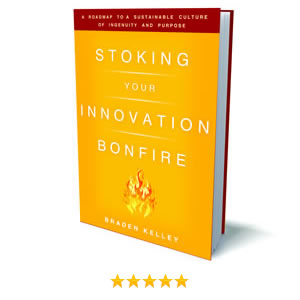
Renting ‘Stoking Your Innovation Bonfire’

I noticed something new on the Amazon page for my book Stoking Your Innovation Bonfire today when I popped onto their web site.

What was it?

Amazon has introduced a rental option for textbooks.

It makes sense that my book is part of the program because Stoking Your Innovation Bonfire is being used as a text book as part of innovation courses at Creighton and other fine institutions.

Professors can get evaluation copies here from my publisher John Wiley & Sons.

Here is a screenshot:

Rent 'Stoking Your Innovation Bonfire'

BUT, one thing that doesn’t make sense is that the rental price of $22.22 is only slightly less than the discounted sale price of $22.53 that Amazon charges for a new copy of my book. Which is a pretty good discount off the retail price of $34.95.

Stoking Your Innovation Bonfire makes a great bulk book buy for organizations seeking to establish a common language of innovation or to identify and remove one or more barriers to innovation they might be struggling against.

I believe in the content so much that I’ve made a downloadable free sample chapter available for everyone.

If you are in the United States and interested in making a bulk purchase of this five-star book, please contact Hooks Book Events – an independent minority women-owned business in Washington D.C.

If you are outside the United States, you might want to check out 800-CEO-Read or you can get FREE shipping to 90 countries is available from Book Depository.

And what better way to get the most value out of a bulk purchase of my book than to invite me to come deliver an innovation keynote or workshop? :-)

Posted in Innovation, marketing, Strategy | Tagged , , , , , , , , , , | 1 Comment

Is GE Trying to be Too Quirky?

Is GE Trying to be Too Quirky?

Last week GE and Quirky announced a new partnership where GE will make some of its library of patents available as part of Quirky’s new inspiration platform, allowing inventors to use some of its patents in their potentially novel consumer product invention ideas. This on its surface is a very interesting and logical open innovation partnership. Some people are talking about it as a crowdsourcing partnership, but it isn’t really because the work product is not well-defined and being sourced from multiple competing providers. No, this is an open innovation partnership.

Here is the Quirky and GE partnership announcement video:


It is very interesting to me that GE chose to partner with Quirky and not someone like Innocentive, NineSigma, Idea Connection or someone else. I’m curious what others think this indicates about the future of these firms. Personally, I think that this is something that Quirky is better equipped to make happen than these other firms, and that Innocentive and others still fill an important need using a completely different approach (challenge-driven innovation).

Is GE Trying to be Too Quirky?

Whether or not GE creates any sizable new businesses from their participation in this partnership, I still think this is a brilliant marketing move by Beth and her team and it will be interesting to see whether any impactful inventions come from people leveraging GE’s patent portfolio.

Here is Quirky’s video announcing their inspiration platform (which they raised $68 million to help build):


There is one thing that bugs me a wee bit about Quirky. My tagline since 2006 has been “Making innovation insights accessible for the greater good” and it feels like they’ve swiped it to create theirs – “Making invention accessible.” Surely as creative people they could have invented their own tagline instead of swiping mine. ;-) (wink)

But, there is another idea of mine trapped in this announcement that I’d like to highlight and set free, and that is the idea that innovation is not just about ideas, but that other factors are equally important – including inspiration, investigation, and iteration. These are captured in my incredibly popular Eight I’s of Infinite Innovation framework.

Eight I's of Infinite Innovation

Be sure and follow this article link to the Eight I’s of Infinite Innovation if you missed the link above, or if you’re not clicking away to learn more, here is a quick list of the eight stages:

  1. Inspiration
  2. Investigation
  3. Ideation
  4. Iteration
  5. Identification
  6. Implementation
  7. Illumination
  8. Installation

Personally I don’t think their platform appears to go far enough to deliver inspiration or to empower investigation, and as a software and internet guy I would be happy to help Quirky and GE strengthen the solution if they’re interested in making this platform more successful.

Will any successful innovations come out of this GE and Quirky partnership?

I’d love to hear what you think.

Image credits: GE, Quirky

Posted in collaboration, Creativity, Innovation, Open Innovation, Product Innovation | Tagged , , , , | Leave a comment

Philadelphia – Food Fail

Kraft Philadelphia - Food FailIn a continuing series of articles exposing the gradual degradation of our food supply, I’d like to highlight what used to be called Philadelphia Cream Cheese, but now you will notice that the logo has dropped the cream cheese phrase from the logo.

Why is that you might ask?

Kraft Philadelphia - Food FailWell, Kraft might say because they are trying to extend the brand into new areas, but I would also say that, hopefully, legally now (or soon) they can no longer call it cream cheese because really it is no longer cream cheese, but is now instead is a cream cheese spread.

Cream cheese is technically cultured milk (you can use yogurt) that has been strained of its whey and you can even make it at home using whole milk yogurt.

If you look at the ingredients of most cream cheeses, or sour creams, or chocolate milk and possibly even some yogurts, you will notice that one of the ingredients will be carageenan or some kind of tree gum like xantham gum or locust bean gum. Some of these products even though they are no longer the food you might think they are, you will find might even be labeled “All Natural.”

You will notice that if you get a bagel and cream cheese at Starbucks that the packet they give you is labeled “cream cheese spread”.

At least Starbucks is honest about it that they are not really giving you real cream cheese, but you will notice again the presence of a qualifier word – “spread” – just like honey sauce from KFC.

And if you have any doubts in your mind whether cream cheese can or sour cream be made without these tree gums, check out the products from the Springfield Creamery sold under the Nancy’s brand on the west coast:

- Nancy’s All Natural Sour Cream
- Nancy’s All Natural Cream Cheese

So, Kraft and Starbucks and others are unfortunately responsible for providing another terrible example of cost cutting gone mad, degrading our food supply again as a result.

What is your favorite food fail story?

Stay tuned for more high profile food fails…

Posted in Strategy | Tagged , , , , , , , , | Leave a comment

New Way to Integrate Real and Virtual World

First came augmented reality, using the GPS and camera on your smartphone to layer information from the virtual world onto the real world as displayed via the camera.

Now, Fujitsu has introduced a device that I came across on Mashable that allows you turn any document into a touchscreen that can recognize the actions of your fingers.


Is this an interesting invention or a potentially valuable innovation?

Personally, one potential application I see would be robotic surgery. What do you see?

Posted in Technology | Leave a comment

Kentucky ‘Fraud’ Chicken – Food Fail

Kentucky Fraud Chicken - Food FailCost Cutting Gone Mad

Every time I turn around, food continues to get less and less real.

Imagine my surprise when in a fit of weakness I turned up at my local KFC (yes, the word chicken is no longer in the name) and they simultaneously handed me honey sauce that is only 7% honey and told me that they were going to soon be offering chickens without bones as an option.

How can a chicken walk around without bones? ;-)

Needless to say, that was my last visit to KFC unless I get stranded in an airport somewhere with no other option.

Is the unending quest for corporate profits in the food industry and our own quest for convenience killing us?

I’ll let you draw your own conclusions, but there is no doubt that chain restaurant food is getting less and less real and this is just the latest example of a company crossing the line of decency (in my opinion) in pursuit of profits.

What is your favorite food fail story?

NOTE: While not technically fraud, I bet that if you surveyed 100 people after they consumed honey sauce, that probably 80% of the people would tell you that they just ate honey, not corn syrup with a taste of honey. For what it’s worth.

Stay tuned for more high profile food fails…

P.S. Thanks to Glenn for turning me on to some Far Side humor to the boneless chicken issue.

Boneless Chicken Ranch

Image credit: Gary Larson, Just-Ask-Jill.com

Posted in Strategy | Tagged , , , , , , , | 3 Comments